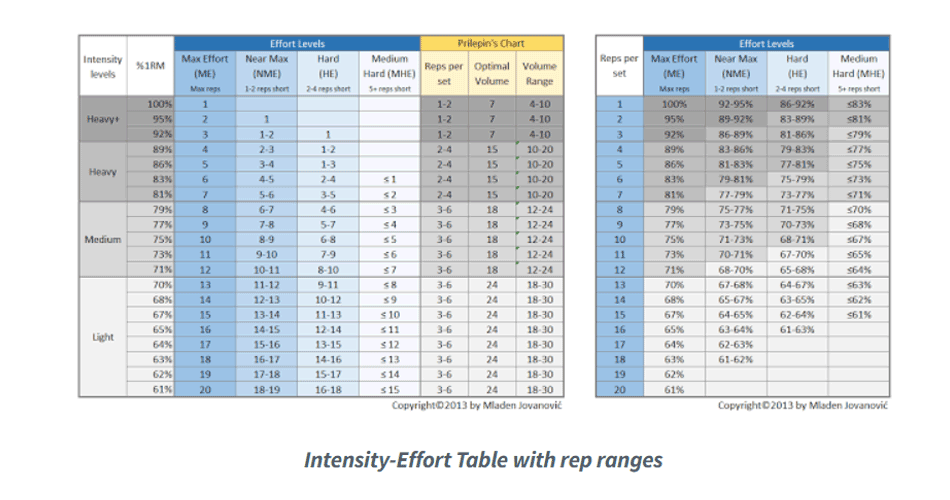
Continuing on my rant on three parameters of intensity in strength training I decided to update my Percent-Repetition Chart that seems to be quite popular (I have seen it in couple of blogs and some recent books – I do…

Coaches, and especially researchers should take into account all three parts of prescribing and quantifying Intensity (Intensity together with Volume provide LOAD; but I will leave different ways of quantifying Volume fo…
I have updated Percent-based to velocity-based converter to include conversion from velocity-based to percent-based approach using load-velocity profile and %1RM-max reps profile. This is important since it allows coache…
Introduction – There are two main methods for estimating 1RM of an exercise: (1) to build up to true 1RM lift and (2) to estimate 1RM from reps-to-(technical)-failure with sub-max weight using various formulas and tab…
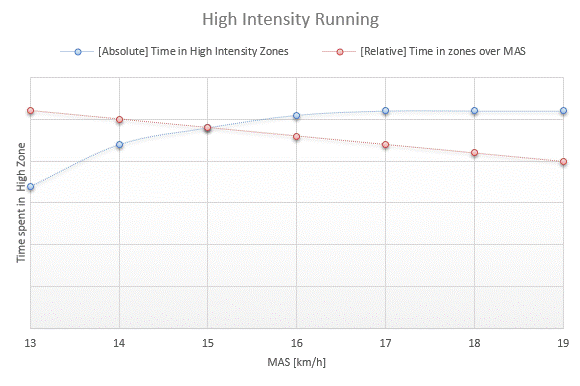
Using Absolute vs. Relative Velocity Zones Suppose you are coaching two distance runners, one with MAS (Maximum Aerobic Speed) of 18km/h and one with MAS of 21 km/h. The former is definitely more aerobically fit and woul…
Please note:
This action will also remove this member from your connections and send a report to the site admin.
Please allow a few minutes for this process to complete.
Report
You have already reported this .
Share Your Work with Complementary Training
Got something valuable to share — an article, a tool, or an idea that could help others in the coaching world?
We’d love to see it, share it, and make sure your work gets the recognition it deserves.
Fill out the form below and let’s get started.
Cancel Membership
Please note that your subscription and membership will be canceled within 24h once we receive your request.