
The Specificity Conundrum and the Intervention Pyramid Part 1 – Why “Functional” Training Never Really Solved It

Coaches have been circling the same specificity conundrum for centuries:
How much should preparation resemble the performance it is supposed to improve?
If training outside the sport looks nothing like the sport, why should it transfer? If it looks almost identical, why not simply practice the sport?
The vocabulary changes. General versus specific. Basic versus special. Functional versus non-functional. Isolation versus integration. Gym strength versus “usable” strength. Underneath these arguments sits one stubborn problem:
What should physical preparation borrow from the sport, and what should it deliberately leave to sport practice?
There is also a second problem hiding underneath the first one.
Sport performance depends on qualities that travel across many sports and qualities that become more important because of the particular sport. Call them human-specific and sport-specific qualities for now. The obvious temptation is to give the first group to physical preparation and the second group to sport practice.
Unfortunately, reality refuses to organize itself that neatly.
Sport practice develops both. Physical preparation can also develop both. A child playing soccer is not only learning soccer; they are also running, accelerating, decelerating, jumping, falling, competing, cooperating, and learning how to use a body in a changing environment. A strength session is not only “general”; it can deliberately address a recurring sport demand that practice does not supply reliably.
So where should we start?
Functional training looked like a way out. It correctly reminded us that humans act as integrated systems, that context changes function, and that training should not reduce an athlete to a bag of spare parts. But the correction gradually became another exercise-classification ideology. Exercises were judged by what they looked like before anyone defined what job they were supposed to perform.
The Intervention Pyramid gave me a cleaner way through the mess. It does not settle the argument by assigning one family of qualities to the gym, another to the field, and the rest to luck. Nor does it declare one family of exercises functional, another sport-specific, and the rest useless. It changes the order of questions.
That sounds less exciting than a new exercise category. It is also far more useful.
In Part I, I will explain why resemblance and functional-training labels do not settle the specificity problem. I will then distinguish human-specific from sport-specific qualities, show why sport practice and physical preparation can develop both, and introduce the Intervention Pyramid, the Intervention Barbell, and the Substance~Form distinction.
In Part II: From Pyramid to Practice, I will test the model across different sports, separate physical preparation from skill practice, and turn the framework into a practical audit for Monday morning.
Why the old question keeps producing costumes
How do you physically prepare a soccer player?
Easy. Make the gym look like soccer.
Attach a cable to the ankle, stand on something unstable, add a ball, and perform something that resembles kicking. The player will hate it, the exercise will photograph well, and everyone can pretend resemblance equals transfer.
How do you prepare a sailor? Put the sailor on a wobble board while pulling a rope.
How do you prepare a handball player? Throw a medicine ball from one leg while somebody pokes them with a stick.
How do you prepare an MMA fighter? Take several useful exercises, remove adequate rest, arrange them in a circle, and call the resulting suffering “fight-specific.”
I am exaggerating, but not by much.
The joke works because it begins with a reasonable observation: sports are different. Soccer is not basketball. Basketball is not sailing. Sailing is not American football. Their physical, technical, tactical, environmental, and cultural demands differ. Preparation should respect those differences.
Fair enough.
The trouble starts when we jump from “sports are different” to “physical preparation should imitate the visible surface of each sport.” We copy a posture, movement, work-to-rest ratio, or emotional flavor. We begin with the costume and hope the function arrives later.
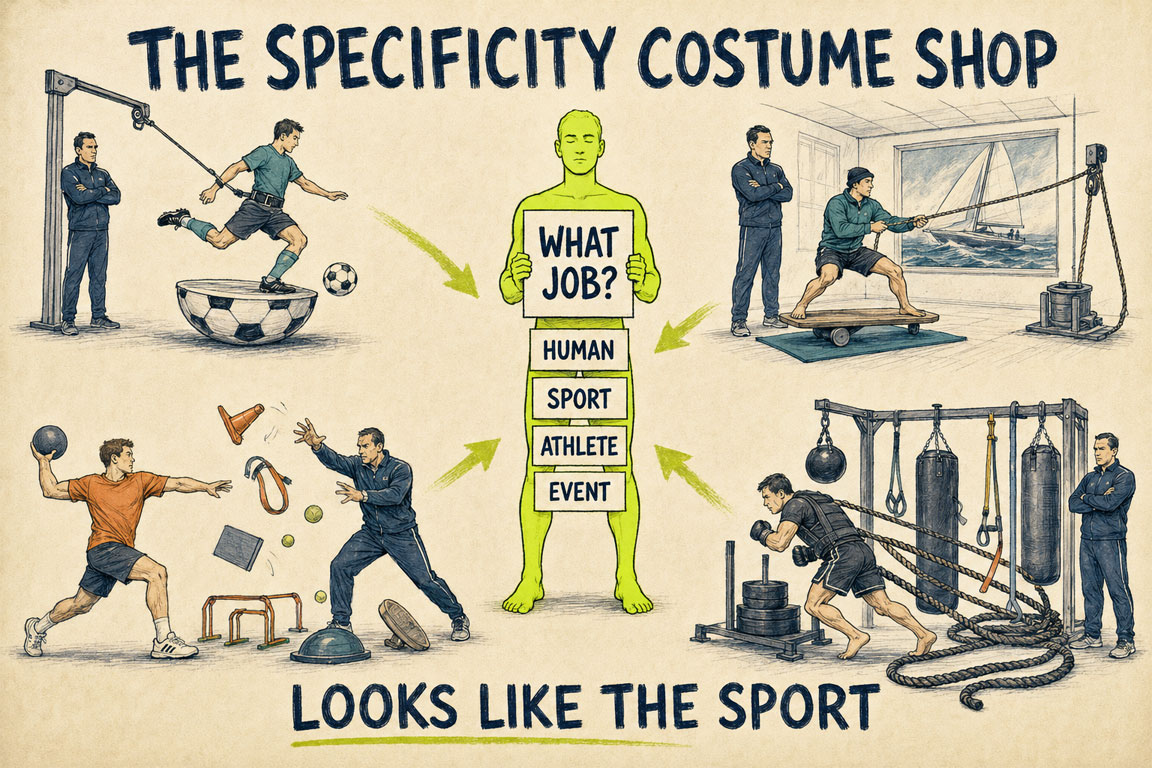
Figure 1— The specificity trap begins with surface resemblance. The Intervention Pyramid begins with the job.
Figure 1 shows the first half of the conundrum. The more an exercise resembles sport, the more specific it appears. Yet resemblance alone tells us little about the job the exercise performs, the dose it delivers, or the problem it solves.
Functional training offered a necessary correction
The functional-training movement reacted to this confusion and to its apparent opposite: training body parts as if the athlete were a collection of spare pieces.
Its original instinct was useful:
- human action is integrated;
- context changes function;
- coordination matters;
- the body does not operate as a bag of independent muscles.
For many coaches, this seemed to settle the conundrum. Instead of inventing a separate training universe for every sport, train fundamental human functions: squat, hinge, push, pull, lunge, rotate, brace, carry, and move in several planes.
That was a genuine improvement over copying the sport’s surface. It offered a common human platform.
Then the correction hardened into an ideology.
Exercises were divided into functional and non-functional as if somebody had issued a moral list. Free weights were good. Machines were suspicious. Standing was functional. Sitting was apparently a character flaw. Multi-joint exercises were real training; isolation work was bodybuilding contamination.
This replaces sport cosplay with exercise ideology.
A knee-extension machine can be useful when the job is to load the knee extensors directly, progressively, and with little technical noise. A back squat can be a poor choice when its total cost exceeds the useful stimulus we are trying to produce. A machine does not become useless because it fails to resemble life. An exercise does not become useful because somebody performs it barefoot on a half-ball.
Almost anything can be functional relative to a clearly defined function.
Without naming that function, functional is merely a compliment attached to exercises we already like.
The sport-specific crowd and the functional-training crowd therefore make different-looking versions of the same error. One judges the exercise by resemblance. The other judges it by membership in an approved category. Both classify the tool before defining its job.
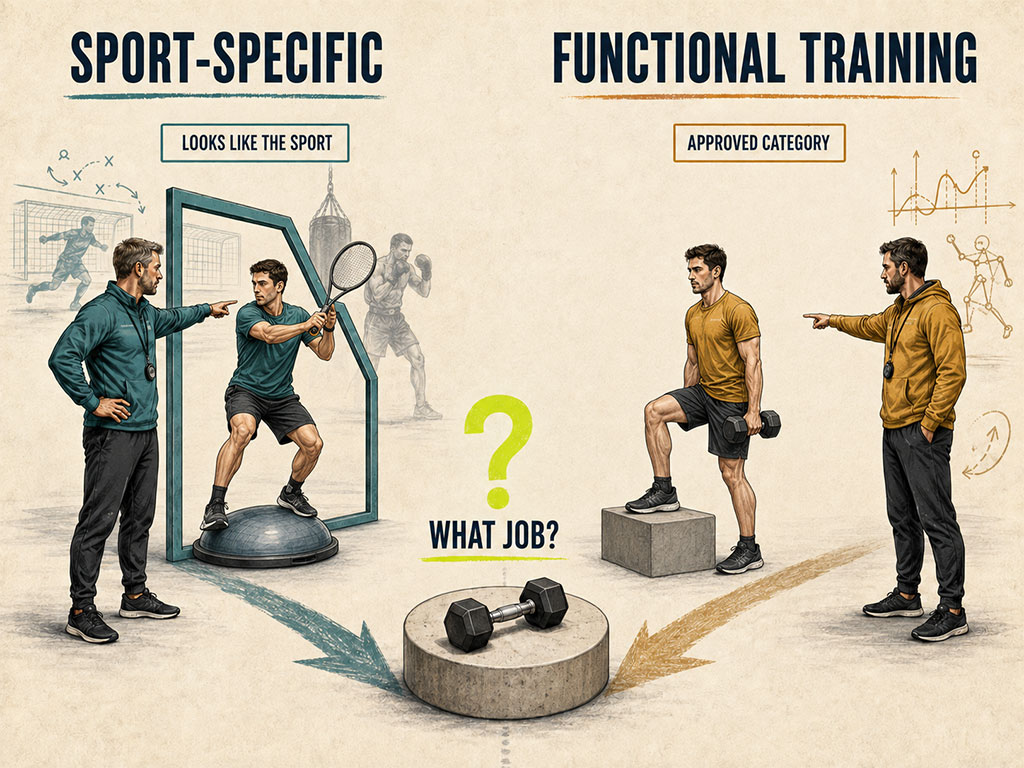
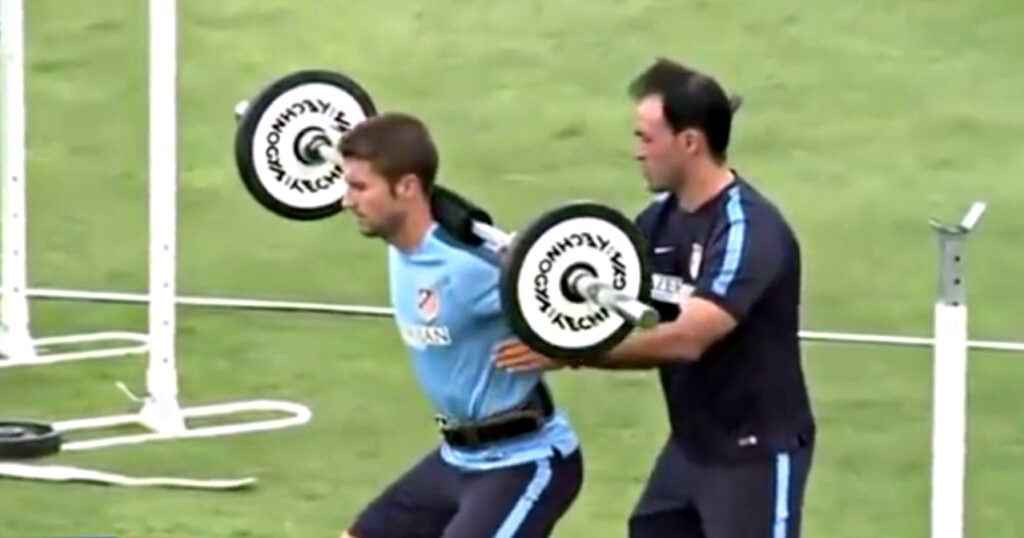
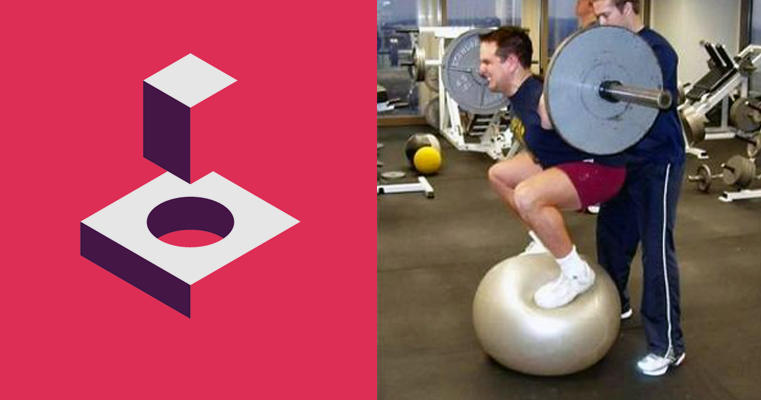
Figure 2— Two camps, same shortcut. One approves the exercise because it combines a sport implement with an unstable surface. The other approves the step-up because it belongs to the accepted functional-training menu. Different costumes, same error: both classify the tool before defining its job.
Specificity is relevance, not resemblance
The word specific is doing too many jobs. It can mean that an exercise:
- looks like the sport;
- reproduces a measurable demand of the sport; or
- addresses a relevant problem for this athlete, in this context, at this time.
These meanings can overlap. They are not interchangeable.
A heavy sled push does not look much like late-game soccer, yet it may let an athlete accumulate useful lower-body work without adding more high-speed running. A small-sided soccer game looks perfectly specific, yet it may be a poor way to provide maximal-speed exposure. A knee extension looks nothing like a change of direction, yet it may be the cleanest way to deliver the local loading an athlete currently needs.
Surface similarity is easy to see. Relevance to the actual problem is harder.
That is why coaches drift toward the visible. It is easier to sell an exercise that resembles a highlight reel than to explain why a boring machine, a basic jump, or an apparently generic strength exercise has a precise supporting role.
Physical preparation is not a tribute act. It does not need to imitate the sport badly. It needs to perform a useful supporting job.
“The purpose of Physical Preparation is to make athletes better at their sport by increasing both the quality and quantity of their sports practice.”
This quotation keeps sport practice in the center. Physical preparation matters because it can help the athlete practice more, practice better, tolerate the recurring costs of practice, and arrive with resources the sport itself may not develop in a reliable dose.
That gives us a more useful question than “Is this exercise functional?”
The deeper conundrum: who develops the qualities?
What can or should physical preparation provide when sport practice cannot deliver it reliably, yet performance still depends on it?
Sport depends on qualities.
That sentence looks almost too simple to be useful. It becomes difficult as soon as we ask what those qualities are, how they should be divided, and who is responsible for developing them.
Borrowing lightly from Robert Pirsig’s Metaphysics of Quality, we often recognize Quality in performance before we can define it. We can see when a fighter controls an exchange, when a midfielder keeps arriving at the right moment, or when a sailor remains composed while the environment is trying to negotiate different terms. We recognize something good before we agree on the pieces producing it.
Then theory arrives with a toolbox and a label maker.
We divide the felt whole of performance into smaller physical qualities: strength, power, speed, aerobic capacity, repeatability, mobility, local muscular endurance, tissue tolerance, coordination, or whatever other constructs our model considers useful. Another coach may divide the same performance differently. A physiologist, biomechanist, skill-acquisition specialist, and sport coach will not draw identical maps.
That is not necessarily a problem. Qualities are working constructs, not labeled fluids stored in separate tanks inside the athlete. The list earns its keep only when it helps us explain an observation, choose an intervention, or notice when the intervention is failing.
For the present argument, two broad domains are useful. Table 1 defines the distinction and, equally important, its limits.
| Domain | What the label points toward | Level of generality | What it does not mean |
|---|---|---|---|
| Human-specific qualities | Broad physical resources and movement options that remain useful across many sports and in ordinary human functioning | General across people and sports | One universal program or a sacred movement checklist |
| Sport-specific qualities | Physical resources, tolerances, and exposure patterns that become important because of the recurring demands of a sport | General within that sport | Exercises that merely look like the sport |
Table 1 — Human-specific and sport-specific name two domains of relevance, not two owners or two exercise families.
The distinction helps, but it creates another conundrum.
Sport practice develops human-specific qualities. A child playing soccer runs, accelerates, decelerates, jumps, lands, falls, gets up, competes, cooperates, and adapts to a changing environment. None of that belongs exclusively to soccer.
Sport practice also develops sport-specific qualities. Repeated exposure to the game changes what the athlete can tolerate, repeat, and express under the sport’s constraints.
Physical preparation can also develop both. Sprinting, jumping, throwing, lifting, carrying, climbing, rolling, and aerobic work can preserve a broad human portfolio. The same preparation process can target a recurring demand of MMA, soccer, sailing, basketball, or another sport.
The two domains therefore identify what matters. They do not decide who develops it.
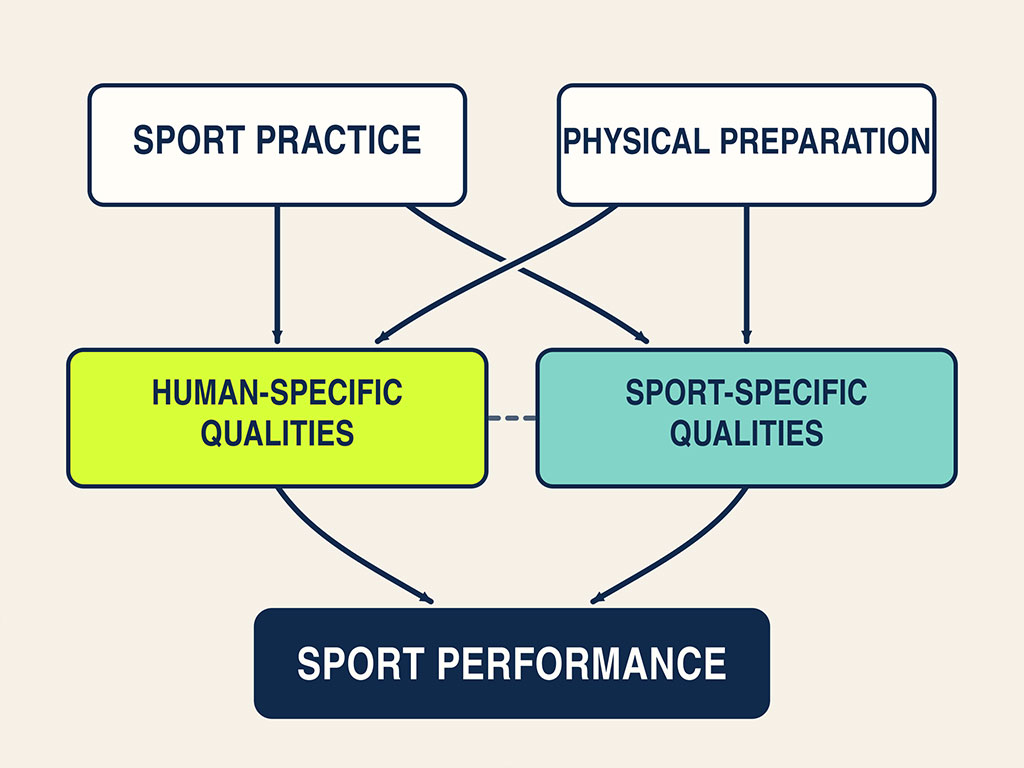
Figure 3 — Human-specific and sport-specific qualities can both be developed through sport practice and physical preparation. The domains identify what matters; they do not assign ownership.
Figure 3 deliberately stops before offering a solution. It shows why “human-specific versus sport-specific” cannot become another simplistic division of labor. Sport practice and physical preparation overlap.
The purpose of physical preparation is therefore not to claim a territory. It is to use a more controllable form of practice when something important to performance is not being developed reliably enough, or when sport repeatedly threatens a resource on which it depends.
That gives physical preparation two broad routes:
- Via positiva: develop, supplement, or top up something valuable.
- Via negativa: protect something valuable, remove avoidable downside, or stop adding more of what sport already supplies in abundance.
This is the basic answer to the question at the start of Section 3. But it still does not tell us where the intervention belongs. Is the issue part of a broad human base, a recurring sport demand, a meaningful athlete bottleneck, or a temporary event condition?
That is the job of the Intervention Pyramid. Figure 3 exposes the ownership problem; Figure 4 changes it into a sequence of decisions.
The Intervention Pyramid tells us where to start
The overlap in Figure 3 does not license us to jump straight to an exercise. First, locate the reason for intervening.
The Pyramid starts from two relatively general priors and moves toward two increasingly individualized updates:
- Human-specific
- Sport-specific
- Athlete-specific
- Event-specific
The first two layers are general in different ways. The human-specific layer is broad across people and sports. The sport-specific layer is shared by participants who face similar demands, misses, and threats within a sport. Neither one is “generic” in the lazy sense. They are starting priors.
The upper two layers narrow the decision. Athlete-specific preparation responds to meaningful information about this person. Event-specific preparation responds to what is unusually true for this person, role, opponent, venue, schedule, or competition. These are increasingly individualized and conditional updates.
This gives us a direction:
Start with what is broadly useful. Add what the sport repeatedly requires. Individualize when the athlete gives you a reason. Adapt temporarily when the event gives you one.
As we move upward, the intervention becomes narrower and more tailored. It also depends on more specific—and often more uncertain—information. That is why specificity must be earned rather than decorated.
The Pyramid is not a fixed allocation scheme. I am not proposing 40% human-specific, 30% sport-specific, 20% athlete-specific, and 10% event-specific. Coaches love percentages because they make judgment look scientific. Unfortunately, false precision remains false.
The Pyramid is a decision process. It tells us which question should come next, what level of generality the answer belongs to, and how much confidence the answer deserves.
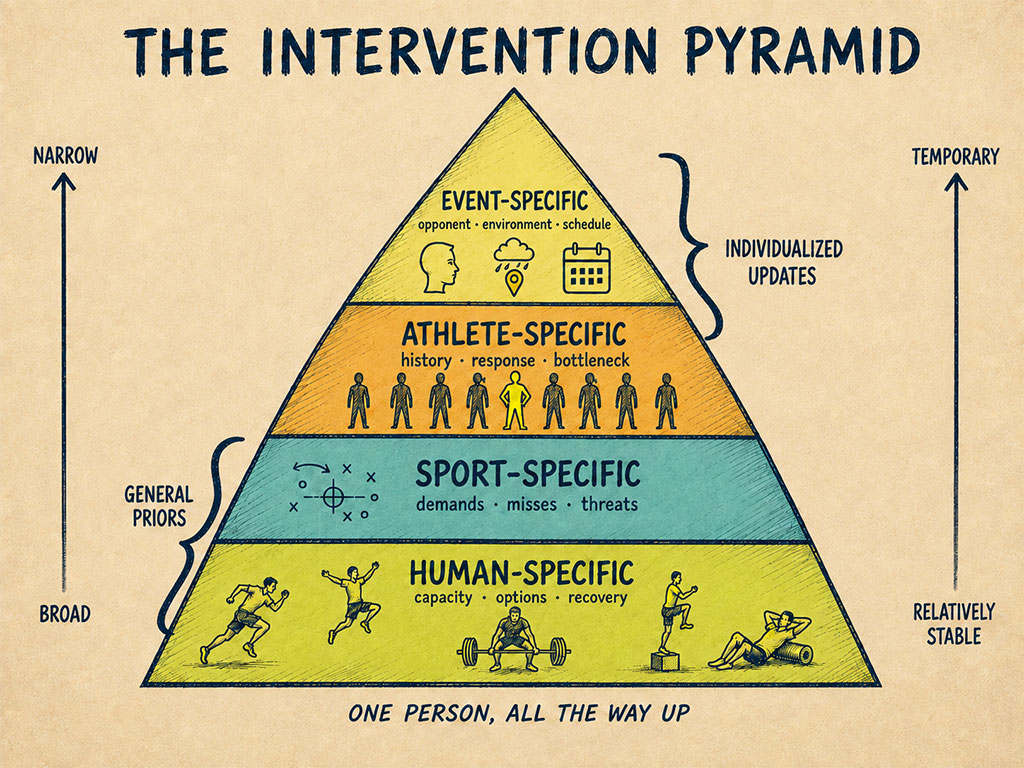
Figure 4 — The Intervention Pyramid moves from general human- and sport-level priors toward increasingly individualized and conditional athlete- and event-level updates.
Figure 4 shows the architecture. Table 2 turns it into four coaching questions.
| Layer | Type of inference | Default coaching question | Evidence needed | Common error |
|---|---|---|---|---|
| Human-specific | General prior across people and sports | What broad capacities and options should remain available to this person? | General training history, current exposure, basic tolerance, practical constraints | Premature specialization |
| Sport-specific | General prior within the sport | What does the sport demand, underprovide, and repeatedly threaten? | Practice and competition demands, exposure patterns, recurring costs | Copying the sport’s appearance |
| Athlete-specific | Individualized update | What is meaningfully different about this athlete now? | Individual history, repeated observations, response to previous doses | Individualization theatre |
| Event-specific | Individualized and temporary update | What changes because of this opponent, venue, environment, schedule, or competition? | Credible event information and a clear time limit | Letting one event redesign the whole system |
Table 2 — The Intervention Pyramid moves from general priors toward increasingly individualized and temporary updates. Its layers are questions, not fixed percentages.
Human-specific: preserve a broad physical portfolio
The human-specific layer asks what should remain available because the athlete is a human being before they are a specialist.
This matters for every athlete, but the logic becomes especially clear with children. We usually do not know their eventual sport, position, competitive level, preferences, or even whether organized sport will remain the center of their physical life. A broad portfolio preserves future options. It also protects against the downside of asking one activity to provide an entire physical education.
Protective does not mean injury-proof. It means less unnecessary narrowing, fewer obvious exposure gaps, and more than one physical answer available when life or sport changes the question.
Humans sprint, jump, throw, climb, crawl, hang, land, fall, roll, get up, lift, carry, play, and recover. These are movement families, not literal qualities. Sprinting can express speed, force, stiffness, timing, confidence, and skill. Throwing can express power, sequencing, coordination, and intent. The action is visible; the qualities we infer underneath it depend on the model we use.
That distinction matters. Figure 5 is an action map, not an anatomical truth and not a weekly checklist.
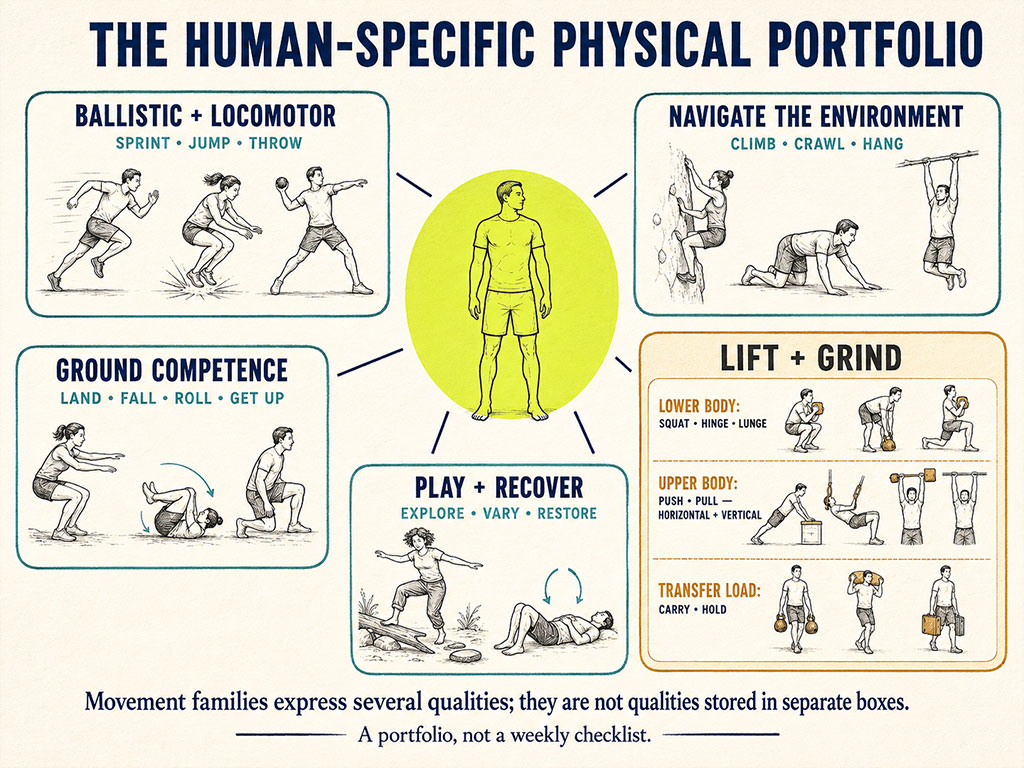
Figure 5 — A human-specific physical portfolio preserves broad movement options. The listed actions are movement families through which several qualities can be developed and expressed—not a universal exercise menu.
The lifting branch deserves a little expansion because “lift” can become another baggy word. For programming purposes, I use it to cover slower, force-oriented tasks in which the athlete must overcome, redirect, or stabilize an external load.
Lower-body strategies can be organized roughly as squat, hinge, and lunge. Upper-body work can be organized as push and pull, each in more horizontal or vertical directions. Carries and holds add the problem of transferring or stabilizing a load while the body changes position or resists being changed.
These are useful lenses, not the tablets carried down from Mount Biomechanics. A split squat can look like a lunge and behave like a squat. A row can ask more from the trunk than the arms. A carry can become a conditioning task, a grip task, a gait task, or an expensive way to walk a dumbbell around the gym. The job and dose decide.
A specialist will not express every part of Figure 5 equally. Nor should they. Specialization deepens some options while allowing others to shrink. That trade can be useful, necessary, and expensive at the same time.
The human-specific layer manages that trade. It tries to preserve enough force production, speed, locomotion, ground competence, environmental interaction, play, and recovery to keep the specialist from becoming unnecessarily narrow. Human-specific does not mean “natural movement only.” Humans built machines. We are annoyingly inventive primates.
The base is broad, but it is not random. It is a managed portfolio of capabilities.
Sport-specific: cover demands, misses, and threats
The sport-specific layer remains a general prior. It asks what tends to matter for participants in this sport before we claim to know what this athlete needs.
Start with four questions:
- What does performance in the sport demand?
- What does sport practice already express and develop?
- What important exposure does practice miss or underprovide?
- What valuable resource does participation repeatedly threaten or erode?
The first question describes relevance. The second prevents duplication. The third opens a via positiva route. The fourth opens a via negativa route.
Take MMA as an example. Drilling, grappling, striking, wrestling, sparring, and competition express and develop a wide range of human-specific and sport-specific qualities. But these practices are organized around opponents, positions, timing, tactics, coaching goals, and safety. They are not clean laboratory doses of maximal strength, aerobic development, local tissue loading, or any other single physical quality.
Nor should they be.
You cannot ask live sparring to behave like a precise conditioning prescription without changing what sparring is. You cannot guarantee that every athlete receives the same positions, forces, work intervals, or local loading. The better the practice preserves the sport’s uncertainty, the less neatly it behaves as a physical-training dosage tool.
Replace MMA with soccer, basketball, sailing, or almost any other sport and the relationship remains. Sport practice is usually the biggest and most important rock. It develops both domains in Figure 3, but it may develop them unevenly, supply an exposure at the wrong dose, or repeatedly spend resources the athlete still needs.
Figure 6 expands the simple conundrum into a sport-level audit.
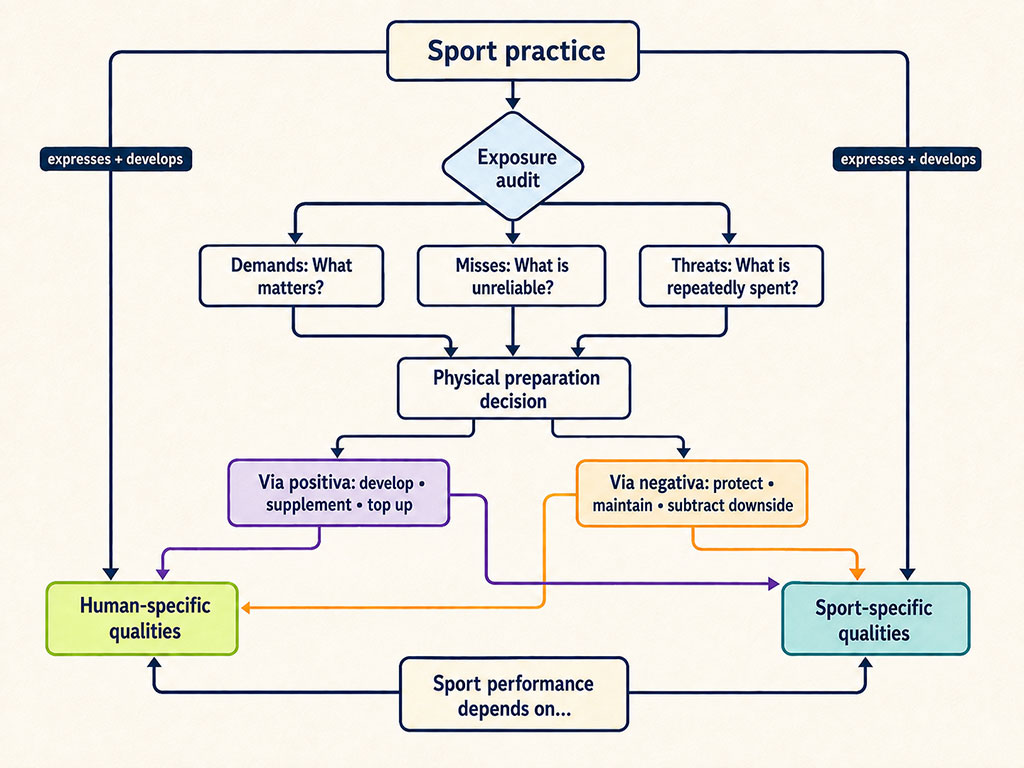
Figure 6 — At the sport-specific layer, demands identify what matters, sport practice reveals what it already develops and what it misses or threatens, and physical preparation adds or protects across both quality domains.
The diagram does not say that every miss deserves more work. The athlete has limited time and recovery. Some gaps are irrelevant. Some are too expensive to fill. Some sport-related costs are simply the price of becoming good at the sport.
The intervention begins where an important demand is not delivered reliably enough, or where the downside is large enough to justify protection.
Via positiva may involve direct strength work, controlled high-speed exposure, local tissue loading, aerobic volume, or another deliberately dosed intervention. Via negativa may involve maintaining a quality during a congested period, removing redundant work, changing the exercise form, or refusing to make physical preparation another source of unnecessary cost.
I do not mean “injury-proofing”—that phrase belongs in the same cupboard as unicorn repellent. I mean preparing for recurring costs without pretending we can eliminate uncertainty.
This is sport relevance through consequence rather than costume.
Athlete-specific: earn individualization with information
The athlete-specific layer is where the general priors begin to bend around the person in front of us. It asks:
What is meaningfully different about the person in front of us?
Not the average athlete in a review paper. Not the fantasy athlete in the spreadsheet. The actual person.
Relevant differences may include training history, recent exposure, recurring symptoms, observed solutions, response to previous doses, position, match minutes, preferences, adherence, travel, sleep, and non-training demands.
Individualization should be earned by information. Otherwise, it becomes personalization theatre: different exercises for everybody, different colors in the spreadsheet, and no clear reason for any of it.
An athlete-specific intervention is a hypothesis. Keep the bet small enough to survive being wrong, define what feedback matters, and update.
The goal is not to discover the athlete’s hidden truth. It is to learn faster without making the athlete pay heavily for our confidence.
Event-specific: add a temporary overlay
The event-specific layer is the narrowest and most conditional. It deals with what is unusually true this time for this athlete, role, or competition:






Responses