
Prescribing Strength Training for Team Sports – Part 3

In case you missed the previous part of this video series, click here to watch Part 2 on Prescribing Strength Training for Team Sports.
I’ve been called “the VBT guy” since 2014. I wrote a primer that somehow picked up 250+ citations. Not a scientific paper. Just practical ideas using Excel.
Then I put VBT on the back burner. It was my first PhD topic before I switched to sprinting. I’ll get back to it — {LEVsim} gives me the tools to explore VBT’s theoretical foundations properly but first, let’s talk about what breaks in practice.
The Two Central Ideas
VBT tracks concentric lift velocity. Simple premise: heavier load, slower movement. If you’re lifting with maximum intent—actually trying to move the bar fast—that relationship becomes predictable.
First idea: velocity at a given percentage of 1RM stays stable over time.
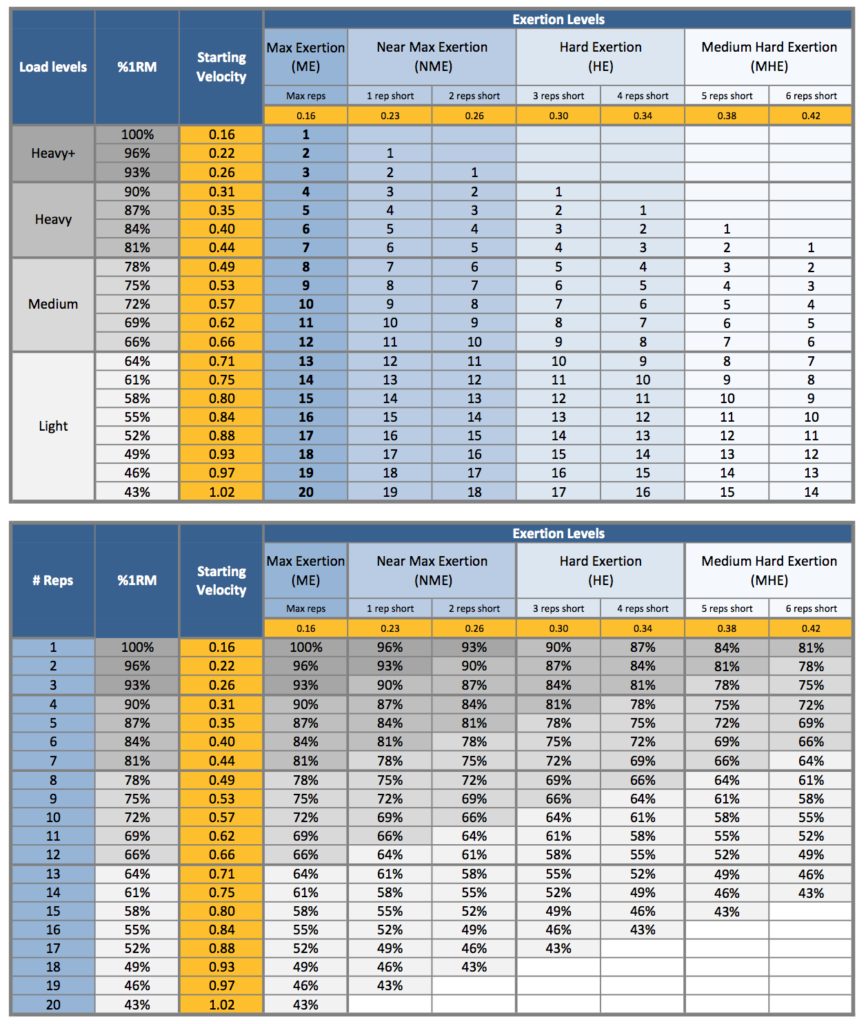
Lift at ~0.5 m/s? That’s probably ~80% of your 1RM today. Next week, same velocity, same percentage. No max testing needed.
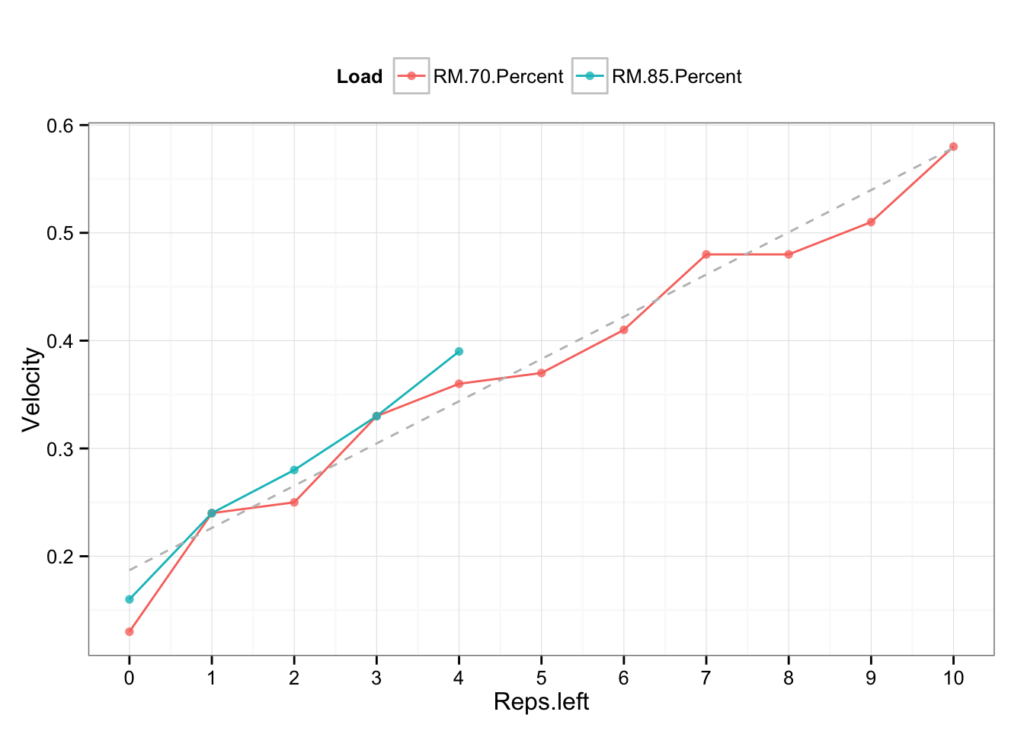
Second idea: velocity at a given proximity to failure stays stable regardless of load.
Last rep at ~0.23 m/s? One rep in reserve. Last rep at ~0.30 m/s? Three reps in reserve.
Doesn’t matter if you’re at 70% or 90%—velocity tells you how close you are to failure.
Combine these two and you get individualized velocity tables.
Prescribe sets by velocity zones instead of percentages or rep counts.
Clean on paper.
Why Velocity Loss Doesn’t Work
Some groups tried to sidestep the complexity. Forget individual profiles—just use velocity loss. Do reps until velocity drops by 20%, and you’ve controlled proximity to failure without custom data.
It doesn’t work.
Velocity loss is terrible at predicting proximity to failure. At 40% velocity loss, one athlete is at zero reps in reserve. Another has five or six left. You’re not individualizing anything. You’re just adding noise and calling it precision.
The Practical Problem
Even if VBT profiles are accurate. Even if prescription error is low. You hit a wall the moment you try to scale this in a real gym.
You need individual profiles for every athlete and every exercise.
Back squat. Front squat. Safety bar squat. Box squat with a pause.
Barbell curl. Triceps extension. Ring dips.
Change squat depth? New profile.
Add a pause at the bottom? New profile.
Switch to a variation? Start over.
You can’t profile everything. There’s no time.
And even when you prescribe by velocity, the athlete still has to find the load that hits those targets. You end up running a loading drill before the actual training even starts. Searching for weights. Accumulating fatigue. Burning time.
You still need ballpark percentage estimates just to reduce the search space.
Where VBT Actually Works
VBT isn’t useless. But it’s better suited for quality control than prescription.
Velocity feedback works for explosive lifts—improving intent and tracking adaptations. It works for occasional profiling and for monitoring trends over time. And for a small number of key exercises, it can act as a simple quality check: Did this set hit the velocity range we wanted?
But as the foundation of a prescription system?
For an entire program?
It doesn’t scale.
Prescribe with ranges. Use percentages. Use VBT where it adds value—mostly as feedback, not as the method.
If your system only works when nothing changes, it’s not robust enough.






Responses