
Managing Athletes Using Trello – Part 1

Most teams don’t struggle because they lack information. They struggle because important things slip through the cracks.
Miscommunication between coach and physio. Unclear return-to-play decisions. Players accumulating too few minutes. Training groups drifting out of sync.
The problem isn’t always complexity. It’s visibility.
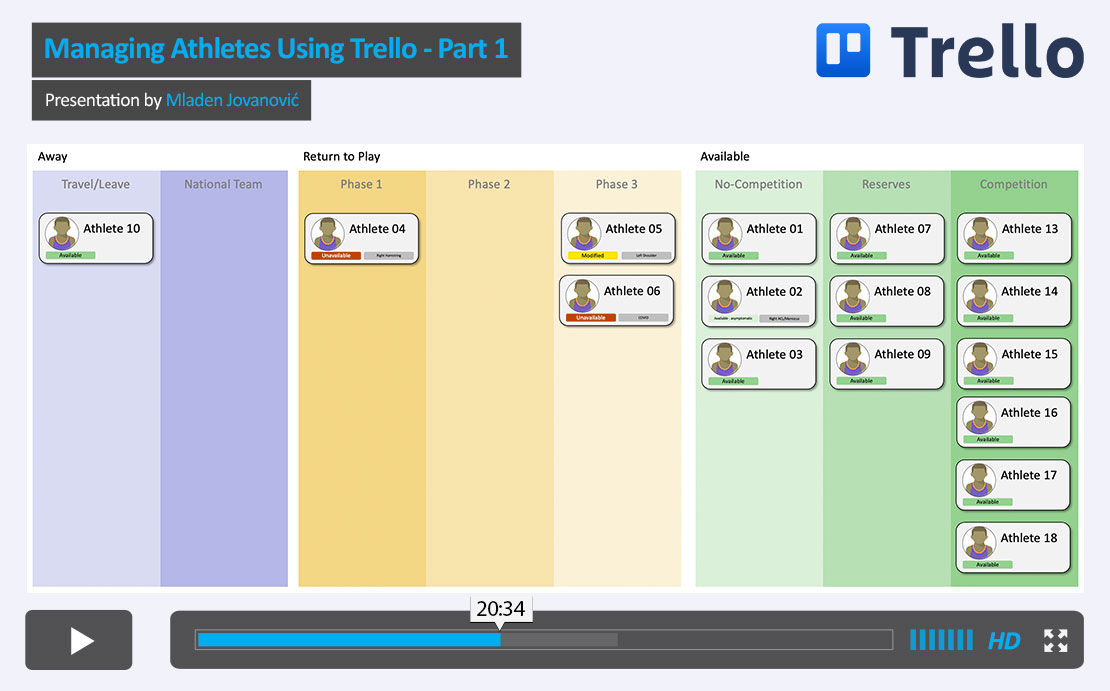
This two-part series shows how to build a simple visual system to manage athletes using the free version of Trello. But before building it, we need structure.
This is the foundation.
Start With Standard Operating Procedures
A visual board only works if you know what you’re managing. That means defining repeatable processes—not perfect plans, but clear checkpoints.
Return-to-play phases. Recovery procedures. Warm-up routines. Nutritional interventions.
For return-to-play, define benchmarks:
- When does an athlete move from Phase 1 to Phase 2?
- What objective criteria must be met?
- Who makes the decision?
Make the Invisible Visible
The principle is simple: make work visible.
Think of a car dashboard. It doesn’t drive the car, but it warns you early when something’s wrong.
A visual team board does the same. When a player has been stuck in Phase 2 for three weeks, you see it. When someone missed three speed sessions, you see it.
If you see it on Monday, you can fix it on Tuesday.
That’s how teams improve—not by adding complexity, but by shortening feedback loops. Visual management accelerates learning because problems become obvious quickly, the whole staff sees the same information simultaneously, and discussions focus on solving visible issues rather than debating what’s happening.
Separate Medical Status From Training Status
Medical availability and training availability are not the same thing.
An athlete can be healthy but away on national duty. Or medically symptomatic but still training. So we separate them.
Medical (Health) Status
A simple structure works well (modified from McGrath & Ozanne-Smith):
Available – No Issues: Fully healthy, no concerns.
Available – Asymptomatic Issues: Fully available but monitor something. Example: ACL reconstruction three years ago, no current symptoms, but you keep an eye on it.
Available – Symptomatic Issues: Can train and compete but symptoms present. Example: knee swells after sessions but athlete manages it and remains available.
Modified – Symptomatic Issues: Needs modified training, cannot compete. Example: late-stage return-to-play, participating in some team activities but not full sessions.
Unavailable: Medically unavailable due to illness or injury.
In the first three categories, the athlete can train and compete. The distinction helps you track what to monitor.
Add contextual labels if needed: current injury, previous injury, illness, allergies.
This isn’t about medical perfection. It’s about clarity. When you see it on a board, you immediately know where the athlete stands.
Training Status
Medical status tells you if the athlete can train. Training status tells you what they’re actually doing.
Available – Full Training: Full participation in training and competition.
Available – Reserve: Trains fully but played less than 60 minutes in the match. This group often needs different programming the day after a game.
Available – Non-Travel: Trains fully but doesn’t compete—squad depth, yellow card accumulation, tactical decisions, not selected for game protocol.
Modified Training: Participates in team sessions with modifications. Could be return-to-play protocols, specialized programs, or tactical restrictions.
Unavailable: Cannot train for medical reasons (covered by Medical Status above).
Away – Holiday: Unavailable for personal reasons (religious observance, family emergency).
Away – National Team: Unavailable due to national team obligations.
Together, Medical + Training Status gives you the complete picture. An athlete can be “Available – No Issues” medically but “Away – National Team” for training. Or “Available – Symptomatic Issues” medically and “Modified Training” for training status.
Functional Groups: Planning for Reality
Two extremes don’t work in team sport: everyone trains the same, or everyone trains individually.
The first ignores context. The second is impossible—you can’t practice team tactics with mannequins. You need live opponents and teammates.
The solution is functional groups. Cluster athletes by similar training load or scenario to help with planning.
It’s not perfect individualization. It’s practical coordination.
Example in soccer (30-player squad):
Playing Squad: 11 starters who played 60+ minutes in the match
Reserves: On the bench, traveled but played less than 60 minutes. These athletes need different programming than the playing squad the next day.
Non-Travel: 12 athletes who stayed home, not in the 18-player game protocol
Injured: In return-to-play protocols with specialized programs
Away: Loaned to other teams or junior sides to get game minutes
Each group needs a different stimulus inside the same week. The challenge is synchronizing them.
Mini-Blocks: Structuring the Week
Break the microcycle into mini-blocks: recovery, loading, taper, game.
Here’s how it looks in practice:
Match Day:
- Playing squad competes
- Reserves who didn’t play 60+ minutes may need loading session after match (if logistically possible)
- Non-travel squad loads at training ground
- Injured follow modified plan
MD+1 (Monday):
- Playing squad does recovery
- Reserves (if they loaded post-match) do recovery
- Rest day for all if logistics demand it (simplest option, gives coaches recovery too)
MD+2 and MD+3 (Tuesday-Wednesday):
- All available athletes do hard loading block
- This is your primary training stimulus
MD-1 (Saturday):
- Game protocol athletes taper
- Non-travel athletes may load if not selected
Here’s the real challenge: if squad selection happens late, you risk underloading some players or overloading others who might get called up last-minute.
When it’s visible on the board, you can discuss trade-offs early instead of reacting mid-week. Some squads do extra conditioning for reserves immediately after the match to synchronize groups faster, but it’s logistically challenging with long travel or psychologically difficult after a loss.
Track Attendance: The Simplest Meaningful Data
Before GPS units and wellness questionnaires, track attendance. Even high-performance teams should start here and build up.
Attendance Categories:
Full: Participated fully in the session
Partial: Participated in most of the session
Modified: Participated with modifications (return-to-play athlete doing modified drills)
Missed: Scheduled but didn’t attend
Not Scheduled: Had a specialized program. Important distinction: an athlete in return-to-play doing their own session during team training is NOT “missed”—they weren’t scheduled for that team session.
Tag sessions by type: speed, acceleration, defensive work, offensive work, conditioning.
Then you can quickly answer:
- Who missed all speed sessions this month?
- Which athletes haven’t accumulated enough high-speed running?
- Has this player done any acceleration work in the last two weeks?
If someone misses three speed sessions in a row, you know before their performance drops. This simple tracking often reveals more actionable information than complex monitoring systems.
You can also track key performance indicators: rolling sum of playing minutes (last 4 weeks), rolling attendance percentage, rolling high-speed distance, session RPE load.
When these are visualized on the board, patterns become obvious.
Why This Works
When the board is visible, conversations happen naturally.
Head coach walks in. Two players stuck in Phase 2. One hasn’t done speed in 10 days. Decision made in minutes.
The board doesn’t solve problems—it makes them visible so you can solve them faster.
Five-minute daily stand-up before sessions. Update statuses. Flag issues. Sprint reviews every 1-3 weeks with the whole staff to review concerned athletes, check testing data, improve the process.
See it. Discuss it. Adjust it.
That’s how teams learn faster—not through perfect planning, but through rapid iteration on visible information.
Should Athletes See the Board?
Probably not. This depends on your culture, but the board is a staff coordination tool.
It might flag athletes for load reduction or wellness check-ins. It might show performance indicators you want to address privately. Making it public can create unnecessary anxiety or misinterpretation.
The board is for staff transparency, not athlete motivation. Err on the side of keeping it internal—you can always make it public later, but going the other direction is harder.
What’s Next
The theory gives you the framework. Part 2 shows you how to build this in Trello—which columns to create, how to use labels for health status, how to structure athlete cards, how to run quick daily stand-ups.
The system isn’t about perfection. It’s about seeing what’s actually happening instead of what you think is happening.
Start simple. Build from there.






Responses