
Speed in Modern Professional Football

Scientific foundations, applied biomechanics and training methodology
ABSTRACT
Speed in modern football is not just the ability to run fast in a straight line. It is a multidimensional construct integrating neuromuscular, biomechanical, and perceptual-cognitive mechanisms, whose expression is conditioned by the game context, player position, and accumulated fatigue. This article synthesizes the most current scientific evidence on speed development in professional football, addressing its physiological foundations, the biomechanics of linear and curvilinear sprint, analytical training methods (resisted and assisted), repeated sprint training (RST), change of direction (COD), and competitive microcycle planning. Dosage protocols, methodological progressions, and individualization criteria based on the Morin-Samozino force-velocity profile are proposed.
Keywords: speed, sprint, acceleration, horizontal force, GRF, COD, RST, professional football, periodization.
1. INTRODUCTION: SPEED AS A DETERMINANT OF FOOTBALL PERFORMANCE
Elite football has changed substantially in its physical demands over the past decade. Load analysis using GPS (EPTS) systems and optical tracking technologies document sustained increases in total distance covered at high intensity, the number of high-magnitude accelerations and decelerations, and distance covered at speeds exceeding 25 km/h (Barnes et al., 2014; Bush et al., 2015).
The simplistic interpretation of speed as synonymous with ‘running fast in a straight line’ is one of the most persistent conceptual errors in football training. Speed in real competition is situational, multidirectional, reactive, and conditioned by accumulated fatigue.
“The fast player is not necessarily the one who reaches the highest top speed, but the one who gets there first when the match demands it.”
1.1. Sprint statistics in professional male football
Table 1. Sprint profile by position in professional male football
| Position | Sprints/match | Sprint Dist. (m) | Max. Speed (km/h) | Predominant profile |
|---|---|---|---|---|
| Goalkeeper | 2–8 | 20–60 | 21–24 | COD + reactive starts |
| Central Defender | 10–20 | 80–150 | 27–29 | Long recovery + reactive sprint |
| Full Back | 20–40 | 180–320 | 29–33 | Wide sprint + COD + RST |
| Central Midfielder | 15–30 | 120–220 | 27–30 | Multidirectional acceleration |
| Winger / Wide Mid | 25–50 | 250–400 | 30–35 | Long sprint + off-the-ball run |
| Centre Forward | 15–30 | 120–250 | 28–32 | Stand-start + curvilinear profile |
2. PHYSIOLOGICAL AND NEUROMUSCULAR FOUNDATIONS OF SPRINT
Running speed is ultimately the result of the neuromuscular system’s capacity to apply force against the ground within extremely short time windows.
2.1. Ground Reaction Force (GRF): the master variable
GRF is the force the ground exerts on the foot in response to the force applied by the foot. Its three components directly determine the player’s locomotor capacities:
- Vertical GRF: linked to muscle-tendon stiffness, reactivity, and jumping.
- Antero-posterior GRF: the critical component for acceleration. Sprint efficiency depends on the direction of force application, not just its magnitude. (Morin et al., 2011).
- Medio-lateral GRF: central in COD and curvilinear sprint.
In a football sprint, ground contact time ranges between 80 and 120 ms. Elite sprinters apply more force in less time — not more contact time.
2.2. Rate of Force Development (RFD) and F-V profile
RFD is more relevant than maximal isometric force for predicting acceleration performance when ground contact times are below 150 ms (Aagaard et al., 2002). The force-velocity optimization model by Morin and Samozino (2016) identifies whether a performance deficit stems from low force (force-deficit) or low velocity (velocity-deficit), enabling precise prescription of the optimal training method.
2.3. Central nervous system and speed
Recruitment of high-threshold motor units (type IIx fibers), inter- and intramuscular synchronization, agonist-antagonist coordination, and inhibition of the braking reflex are neural variables that constrain running speed (Ross et al., 2001). The CNS requires freshness to produce quality speed stimuli: complete recovery between repetitions, low volume, maximal intensity.
Table 2. Energy classification of sprint in football
| Energy System | Duration | Substrate | Relevance in Football |
|---|---|---|---|
| Alactic Anaerobic Power | 0–6 s | ATP-PC | Acceleration, starts |
| Alactic Anaerobic Capacity | 6–18 s | ATP-PC + glycolysis | Long sprint, transition |
| Lactic Anaerobic Power | 18–36 s | Anaerobic glycolysis | Sustained pressing |
| Lactic Anaerobic Capacity | 36–42 s | Glycolysis + lactate | Extreme situations |
3. SPRINT BIOMECHANICS IN FOOTBALL
3.1. Sprint phases
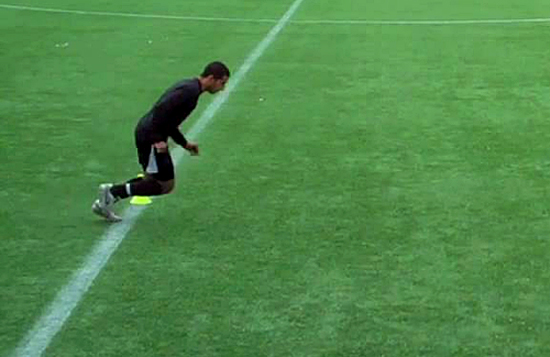
Acceleration (0–20 m) — The most relevant phase in football
- Large trunk lean, short and frequent steps
- High horizontal force production, high Resultant Force Ratio (RF)
- High demand on hip extensors: gluteus and hamstrings
Maximum velocity (>40 m)
- ‘Spring-mass’ model: ground contact time 80–100 ms
- Vertical GRF dominates. Ankle-foot SSC: 50–60% of propulsion
- Upright posture, high knee drive, elbow at 90°
3.2. Curvilinear sprint: the most underrepresented content
Caldbeck et al. (2020) establish that approximately 85% of competitive sprints follow a curved trajectory. This entails biomechanical demands radically different from linear sprint:
- The outer leg acts as the main propulsive lever, applying greater mediolateral GRF
- Systematic bilateral biomechanical asymmetry between both limbs
- Achievable speed is reduced 8–15% compared to linear sprint at equal effort
Methodological implication: training only linear sprint provides only partial transfer to real football. Curvilinear sprint must be trained systematically throughout the entire season in both directions.
Table 3. Biomechanical comparison: linear vs. curvilinear sprint vs. COD
| Variable | Linear Sprint | Curvilinear Sprint | COD (>60°) |
|---|---|---|---|
| Dominant GRF | Antero-posterior | Med-lateral + AP | Med-lateral (braking) |
| Ground contact time | 80–120 ms | 100–140 ms | 140–200 ms |
| Bilateral symmetry | High | Low | Very low |
| Eccentric demand | Low-Moderate | Moderate | Very high |
| Injury risk | Low | Moderate | High |
4. ACCELERATION: THE MOST DECISIVE QUALITY IN FOOTBALL
The ability to accelerate from a stationary or low-speed position is the most determining physical quality in competitive performance (Faude et al., 2012). Its frequency of appearance in goal situations, duels, and defensive recovery makes it the priority focus of speed training.
4.1. Limiting factors
- Absolute horizontal force production (related to relative maximal strength and RFD)
- Resultant Force Ratio (RF): direction of force application relative to displacement
- Body projection angle (trunk lean)
- Reaction time and stimulus processing speed
Table 4. Acceleration training dosage
| Objective | Start Position | Distance | Reps | Sets | Session Vol. | Rest |
|---|---|---|---|---|---|---|
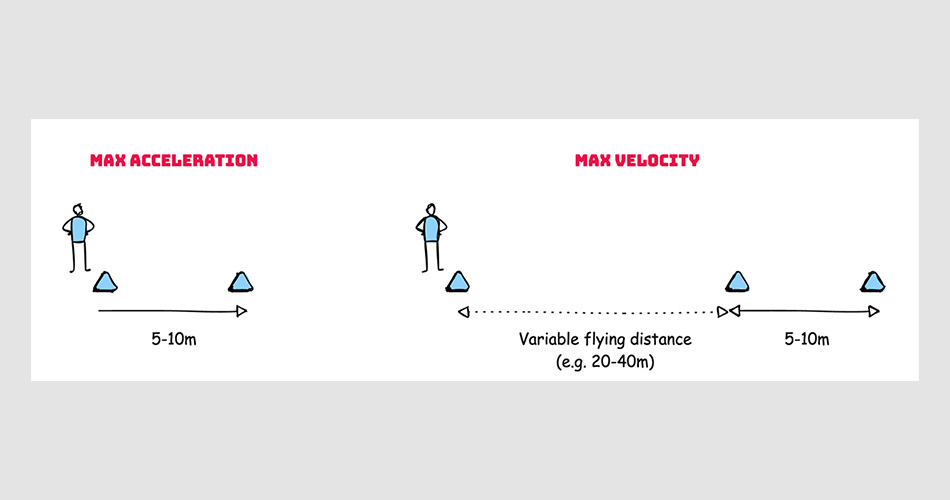
| First steps | Front / Lateral / Back | 5 m | 3–5 | 2–3 | 60–100 m | 30–45 s |
| Initial acceleration | Seated / Prone / Kneeling | 10 m | 3–4 | 2–3 | 80–120 m | 45–60 s |
| Mid acceleration | Visual or auditory stimulus | 15 m | 3–4 | 2–3 | 100–160 m | 60–90 s |
| Full acceleration | Standing front start | 20 m | 2–4 | 2–3 | 120–200 m | 90–120 s |
5. MAXIMUM VELOCITY: THE PERFORMANCE CEILING
Exposure to speeds >90–95% of individual maximum velocity (Vmax) constitutes the minimum effective stimulus threshold for neuromuscular adaptations. Mendiguchia et al. (2020) demonstrated that lack of exposure to real Vmax is an independent risk factor for hamstring muscle injury.
You don’t necessarily need to sprint at Vmax every week — but you do need to do it often enough that the body is ready when the match demands it.
Table 5. Flying sprint protocol for maximum velocity
| Format | Free Zone | Max Zone | Reps | Sets | Rep Rest | Set Rest | Session Vol. |
|---|---|---|---|---|---|---|---|
| Basic | 15 m | 20 m | 3–4 | 1–2 | 3 min | 5 min | 60–100 m |
| Standard | 20 m | 25 m | 3–4 | 1–2 | 3–4 min | 5–6 min | 80–120 m |
| Advanced | 25 m | 30 m | 2–3 | 1–2 | 4 min | 6 min | 90–130 m |
6. CURVILINEAR SPRINT: SPECIFIC TRAINING
Despite representing 85% of competitive sprints, curvilinear sprint is the most absent content in training programs at most clubs, especially in lower and mid-tier categories.
6.1. Biomechanical foundations
- Medial lean of the body toward the center of the arc
- Outer leg: greater GRF, greater demand on gluteus and outer adductor
- Inner leg: trajectory guide, greater demand on inner adductor and abductor
- Chronic asymmetry: possible risk factor for hamstring and adductor injuries (Judson et al., 2021)
Table 6. Curvilinear sprint training dosage
| Variant | Arc Radius | Distance | Reps (per side) | Sets | Rest | Session Vol. |
|---|---|---|---|---|---|---|
| Light curves | Wide (>20 m) | 20–30 m | 2–3 | 2–3 | Complete | 80–120 m |
| Medium curves | Medium (10–20 m) | 20–30 m | 2–3 | 2–3 | Complete | 80–120 m |
| 1/4 circular + linear | Variable | 20–40 m total | 2–3 | 2–3 | Complete | 100–150 m |
| 1/2 circular + linear | Variable | 30–50 m total | 2–3 | 2 | Complete | 100–140 m |
| Full circle | 15–25 m | Perimeter | 2 | 2 | Complete | 80–120 m |
7. CHANGE OF DIRECTION (COD) AND DECELERATION
COD generates braking forces of up to 3–5 times body weight, with maximum eccentric demand on quadriceps, hamstrings, and adductors. The distinction between COD as a closed skill and agility as an open, decision-based skill has direct methodological implications.
Table 7. Technical strategy by COD angle
| COD Angle | Strategy | Penultimate Foot Role | Eccentric Demand | Traffic Light |
|---|---|---|---|---|
| 0°–45° | Crossover | Limited | Low | GREEN — Maintain speed |
| 45°–60° | Side Step | Moderate | Moderate | YELLOW — Decelerate |
| 60°–120° | Side Step / Pivot | High | High | RED — Brake |
| 120°–180° | Pivot / Full turn | Decisive | Very high | MAXIMUM RED |
Table 8. COD training dosage








Responses