
Speed in Soccer Masterclass

The case at the center of this masterclass starts with two sessions on consecutive days. One was played in small spaces with a strength focus, the next in big spaces with an endurance and speed focus. The GPS showed the exact same number of accelerations, and the players reported the exact same average RPE.
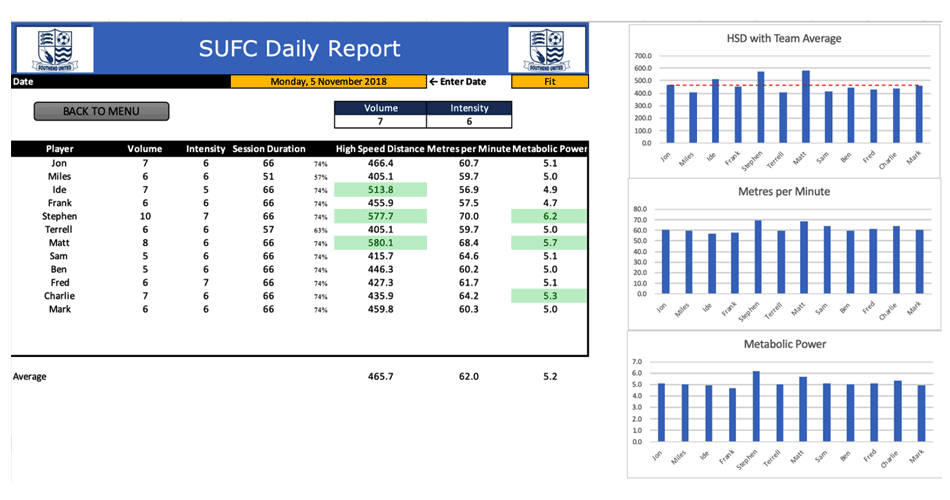
So which one was harder? The team report pointed at the strength session, with plenty of red alerts for players outside their normal range that day. That raised the question of whether the session had gone as planned, which led to a discussion with the assistant coach.
Both sessions carried a high neuromuscular load. A session built around metabolic work still includes accelerations, decelerations and changes of direction, so you can’t label one day neuromuscular, the other metabolic, and move on. The job is finding the balance between the two.
That’s the practical problem this masterclass deals with. Speed work is easy to write into a plan. Making it look like football, and then reading what it actually asked from your players, is much harder.
The masterclass is split into two videos. The theory section covers player profiling, what speed in soccer actually is, and how to train it in an integrated way. The real case scenario takes those ideas onto the pitch with two full training sessions with the Nea Salamis Famagusta FC women’s team, which Efthymios has been consulting for the last couple of years. It includes the warm-ups, progressions, mistakes and corrections that a clean drill diagram leaves out.
Start With the Game, Then Look Past the Averages
If you plan speed work from match averages, the moments that decide games can easily get lost. That’s why the theory section starts with the game itself, before it gets to profiling.
On average, soccer looks mostly aerobic, with heart rate around 85% of max. But the most decisive actions rely on anaerobic metabolism, especially creatine phosphate. In the most intense periods, heart rate goes above 95% of max and players reach speeds above 35 km/h. The average and the peak describe very different demands.
The load also comes from more than running. A game includes more than 700 accelerations, decelerations and changes of direction, plus kicking, jumping, tackling and duels. All of that adds fatigue that a distance total won’t show.
So the reference for session design needs three layers: the averages, the most intense periods, and rolling averages over 1, 2, 3, 5 and 10 minutes. Going a step further, those demands are read per position and in context, meaning what the player does with and without the ball.
What Speed in Soccer Actually is
Speed in soccer shows up in two forms: max acceleration (the short sprint) and max sprint (the longer one). Both can happen at any moment of the game, in attack or in defense, and both can start from a standstill. Not every acceleration turns into a sprint, but every longer sprint builds up from a moderate or high acceleration. The path can be straight or curved.
That has a direct consequence for training. In a game, players reach around 90% of their max sprint speed. In training, you may want to expose them to that 90% or to their full 100%, and those are two different targets. Knowing which one you’re chasing starts with sprint testing, and GPS units can be a valid and reliable way to measure max sprint speed.
Profiling Beyond Fast or Slow
Once you know what the game asks for, the next question is what each player brings to it. On the locomotor side, research makes this fairly straightforward. Players can be sorted into four profiles based on max aerobic speed and max sprint speed, and thresholds can be set relative to each player’s physiological profile. The easiest and most important application is an individualized zone 6, set above 90% of each player’s max sprint speed.
The neuromuscular side is less settled, and the masterclass treats it as an open question. Could the same logic work with max strength and max acceleration, sorting players into strong and fast, weak and fast, strong and slow, or weak and slow? It isn’t easy. But a profile like that could guide individual work in the gym, in short sprints and changes of direction, and in load monitoring.
It also changes how you read a report. If a player isn’t very strong or doesn’t accelerate well, low acceleration numbers make more sense in that light. Before prescribing extra work, check whether the player actually needs it.
Integration Needs a Physical Target and a Football Reason
The bigger challenge is training physical qualities with tactical or technical purposes, which the masterclass calls the ultimate integration. How feasible is that in practice? The field sessions are the answer. In a well-built drill, players have to decide where to pass, where to sprint, where to decelerate and how to close space, while the drill still hits its physical target. That’s a lot to process, and it takes repetition.
The theory section gives two clear examples. A curved sprint reaching more than 30 km/h ends in a two versus one defensive action, so max speed exposure comes with competition built in. Max aerobic speed work runs at around 15 to 20 km/h, with heart rate as the main reference.
In both cases, you hit the physical target while players get more touches and practice the decisions and game model behaviors the coach wants to see.
Two Days on the Pitch
Day one is strength oriented and played in smaller spaces. After a foot tennis warm-up, the passing drill adds a defender, and space decides the action. If the defender is far enough away, the player turns and finishes. If she’s close, she plays the back pass and opens to the side for the return, and the finish is followed by a short acceleration. Later, a six versus six asks for 15-second efforts at full intensity, where players go in fast, decelerate and defend. When the final four versus four needs more intensity, the pitch gets shorter.
Day two moves into bigger spaces and shifts toward speed and endurance. Players receive, turn, dribble at speed and finish on small goals, and the first to score can go back and defend, so the action doesn’t stop at the shot. A six versus four follows: one team needs 10 passes before it can score, while the other tries to win the ball and play it straight to a winger for the transition. With the fullbacks pushed high, the central defenders have to talk about who defends and whether a fullback needs to cover.
Across both days, the coaching is as instructive as the drills. Players are told not to start before the signal and to read the trigger. After passing, they take the right angle first and only then accelerate. The first touch goes in front. One line keeps returning: quality of the movements. As it’s put during the session, small details make the difference.
The Numbers Need the Session Beside Them
That brings you back to the two sessions with the same acceleration count and average RPE. The masterclass names five checks to run before you judge a report like that:
- Did the session achieve its tactical targets?
- Did it achieve its physical targets?
- Is it being compared with the same session type?
- Is it being compared with the same day type?
- If individualized thresholds are used, did each player work as intended?
The tactical question comes first. The physical targets may well have been met, but football is the priority, and that includes whether the coaches are happy with what the players did. The advice is to look beyond the numbers and think more holistically, keeping the game and the tactical aims of each session at the center.
Watch the Speed in Soccer Masterclass
The two videos below belong together. The theory presentation covers match demands, what speed in soccer is, player profiling, integrated training, session types and how to interpret load data. The real case scenario shows those ideas across two full field sessions, with the coaching and corrections left in.
You can copy a drill from a screenshot. Knowing why it’s there, what it’s meant to expose and what would make you change it takes more than that.
Already a Complementary Training member? Log in and watch the full masterclass below.
Not a member yet? Click below to join Complementary Training and unlock the full masterclass.






Responses