
The Invisible Strength of Performance: Strength Training Applied to Football

Introduction
When I first started working in football, most players already had some relationship with the gym. Squats, bench press, some weights. The problem was never the absence of strength training. The problem was — and still is in many teams — that strength never showed up on the pitch.
The player who squats 120 kg loses the duel. The one with a good bench press doesn’t get there before the opponent. Speed doesn’t improve. Injury “prevention” doesn’t happen.
What was going on? They were training conventional gym strength. No transfer. No criteria for football application.
This article is the result of years of work with first division teams, youth players, and experience in Italian football. It is not a theoretical compendium — it is a practical application system: the specific decisions I make and the reasoning behind each one.
Part 1: Types of Muscle Contractions
Before discussing methods and exercises, we need to understand the language of the muscle. Every expression of strength — in the gym or on the pitch — is the result of a type of muscle contraction. Understanding these differences changes how we plan training.
1.1 Concentric Contraction
Force production phase with limited direct transfer to deceleration or injury control
The muscle generates tension by shortening its fibres to overcome a resistance. This is the active work phase: driving the bar up in a squat, extending the knee during a sprint, propelling the body in a jump. Concentric contractions are the most trained — but not necessarily the most important for injury prevention.
1.2 Eccentric Contraction
Key contraction for braking, deceleration and muscle injury prevention
The muscle generates tension while its fibres lengthen. The resistance exceeds the force generated and the muscle yields in a controlled way. This is the braking phase: lowering the bar in a squat, decelerating during a run, landing after a jump.
Eccentric contraction is the most important for preventing muscle injuries. The muscle under tension while lengthening generates greater stress on the fibres — which is why most tears occur in eccentric phases. Training the eccentric progressively and systematically is the foundation of “preventive” strength.
In football: braking after a maximum-speed run is an eccentric contraction of the hamstrings. The Nordic Hamstring Curl specifically trains this eccentric phase — hence its effectiveness in injury reduction. Reference: Eccentric overload training for elite soccer players (Brughelli & Cronin, 2007).
1.3 Isometric Contraction
Critical for joint stabilisation, tendon stiffness and maintaining position under contact
The muscle generates tension without changing its length. No visible movement. In football: holding position in a contact duel, stabilising the trunk during a sprint, maintaining posture under a rival’s pressure. Produces improvements in tendon stiffness that protect against injuries such as patellar tendinopathy.
1.4 Auxotonic Contraction
Combination of isotonic and isometric contraction — present in dynamic stabilisation and duel situations, often observed in band-resisted exercises
A combination of isotonic and isometric contraction. The muscle first shortens then holds tension statically. Occurs naturally with elastic bands. Appears in dynamic stabilisation exercises and duel situations where position must be held under load.
1.5 Isokinetic Contraction
Primarily evaluative tool with limited application in field performance
The muscle contracts at a constant angular velocity throughout the entire range of motion. Only possible with specific isokinetic machines. Its use is primarily evaluative and rehabilitative — quantifying strength deficit between injured and healthy limbs. Not a common field training method.
1.6 Stretch-Shortening Cycle (SSC)
Determinant of explosive performance through the eccentric–isometric–concentric sequence and coupling time
The SSC is not a type of contraction per se, but the eccentric–isometric–concentric sequence that occurs naturally in explosive movements. First described by Rodolfo Margaria in the 1960s and formalised by Carmelo Bosco and Paavo Komi.
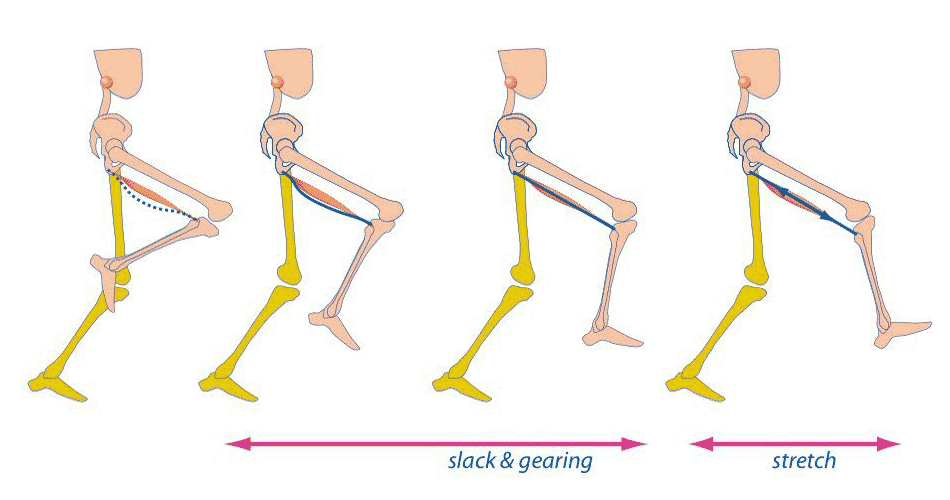
When the muscle stretches rapidly, it stores elastic energy in the tendons. If the transition phase is short (coupling time < 200–250 ms), that energy is released in the concentric phase, generating more force than a pure concentric contraction alone.
| SSC Type | Coupling Time | Football Example | Training Method |
|---|---|---|---|
| Slow SSC | > 250 ms | Header jump, fall and rebound | CMJ, box jumps |
| Fast SSC | 150–250 ms | Change of direction, sprint | Depth jumps, bounding |
| Reactive SSC | < 150 ms | Reactive acceleration, quick dribble | Continuous rebounds, drop-catch |
Part 2: Types of Strength and Adaptations
2.1 Types of Strength Applied to Football
Hierarchical relationship: maximum strength as the base for power and endurance
| Type | Definition | Expression in Football | Primary Method |
|---|---|---|---|
| Maximum strength | Maximum tension the neuromuscular system can voluntarily generate | Contact duels, body support, base for all qualities | Loads >85% 1RM, 1–3 reps |
| Structural strength | Functional hypertrophy and muscular base development. 70–80% 1RM | Season foundation, young players or muscular deficit | 6–10 reps, 70–80% 1RM |
| Power strength | Ability to express force in the shortest possible time. F×V=Power | Sprint, jump, change of direction, ball strike | Contrast, complex, plyometrics, 55–75% 1RM |
| Strength endurance | Ability to sustain force expression over extended periods | Maintaining duel quality in 2nd half, final-minute actions | Circuits, high density, strength SSG |
The relationship is hierarchical: maximum strength is the common denominator. Without an adequate maximum strength base, power cannot be expressed and strength endurance will have a very low ceiling.
2.2 Adaptations
Neural adaptations dominate early performance improvements
Neural Adaptation
The first to appear and with the greatest impact on performance. It is about a more efficient nervous system recruiting motor units, not a bigger muscle. Developed with high loads (>80% 1RM), intentional execution velocities and explosive exercises.
Strength improvements in the first months of training are almost exclusively due to neural adaptations. Reference: Neural adaptations to resistance training (Sale, 1988).
Muscular Adaptation (Hypertrophy)
Increase in muscle fibre diameter, mainly type II. Necessary as a structural base — especially in pre-season and young players. The goal is not the biggest muscle, but the most functional one.
Neuromuscular Adaptation
Coordination between the nervous system and the muscular system in complex, changing movements. Developed with exercises integrating multiple kinetic chains and reactive demands. Strength-oriented SSG and duels fall into this category.
Tendon Adaptation
Strength training — especially isometric and eccentric work — generates adaptations in tendon stiffness and thickness that increase elastic energy capacity and reduce the risk of tendinopathies. The patellar, Achilles, and proximal hamstring tendons are the most relevant in football.
Metabolic Adaptation
Ability to sustain strength work under accumulated fatigue. Trained with high-density methods, strength circuits, and strength-endurance SSG.
Part 3: Exercise Classification
3.1 Analytical Strength vs. Specific Strength
Transfer increases with variability, opposition and decision-making demands
| Criterion | Analytical Strength | Specific Strength |
|---|---|---|
| Environment | Controlled, predictable | Variable, with opposition |
| Ball | Without ball | With or without ball |
| Opponent | Without opponent | With opponent or external reference |
| Direction of effort | Fixed by the exercise | Multidirectional, reactive |
| Primary goal | Develop capacity | Transfer to the game |
| Examples | Squat, RDL, Nordic, Press | Duels, SSG, contrast, traction duels |
| Priority period | Pre-season | Competitive season |
3.2 Movement Patterns
Movement categorisation as a tool for targeting football-relevant actions
| Pattern | Movement | Key Exercises | Football Relevance |
|---|---|---|---|
| Knee dominant | Knee flexion-extension | Squat, Front Squat, Leg Press, BSS | Acceleration, jump, COD |
| Hip dominant (hinge) | Hip hinge | Deadlift, RDL, Hip Thrust, GHR | Sprint, deceleration, ball strike power |
| Horizontal push | Elbow extension + pectoral | Bench press, DB press, Dips | Contact duel, block |
| Horizontal pull | Elbow flexion + lat | Barbell row, Cable row, Face pull | Traction duel, scapular stability |
| Vertical push | Shoulder + elbow flex-ext | Military press, Push Press | Header, aerial duel |
| Vertical pull | Shoulder ext + elbow flex | Lat pulldown, Weighted pull-ups | Upper trunk stability |
| Unilateral / stabilisation | Asymmetric | Lunge, Step-up, Bulgarian | COD, imbalances |
3.3 Resistance Directions
Force vector orientation as a key determinant of transfer
| Direction | Type | Examples |
|---|---|---|
| Vertical downward (gravity) | Bar or bodyweight exercises | Squat, RDL, CMJ, Nordic |
| Horizontal (cable/band) | Frontal or lateral push and pull | Pallof press, Cable row |
| Diagonal (functional) | Multiplanar movements | Chops, Lifts, Cable rotations |
| Direct opposition (duel) | Live resistance from opponent | Traction duels, wrestling, pushing |
| Free (free weights) | Requires active stabilisation | Dumbbells, kettlebells, barbells |
3.4 Intensity Chart and Equivalences
Load prescription aligned with specific physical qualities
| Quality | % 1RM | Reps | Sets | Rest | Velocity | Physiological Goal |
|---|---|---|---|---|---|---|
| Maximum strength | >85–95% | 1–4 | 3–6 | 3–5 min | Max concentric intent | Neural adaptation, MU recruitment |
| Structural strength | 70–82% | 5–10 | 3–5 | 2–3 min | Controlled, 2–3s eccentric | Functional hypertrophy, muscular base |
| Power strength | 55–75% | 4–8 | 3–5 | 2–4 min | Explosive, max velocity | Mechanical power, SSC, neuromuscular adaptation |
| Strength endurance | 40–65% | 12–25 | 3–4 | 30–90 sec | Moderate, continuous | Local muscular endurance, lactate tolerance |
Practical Note: With 2 matches per week, maximum strength work is reduced to a minimum. Power and strength endurance (applied in SSG) are the priorities. Structural strength: 1 session per week, 2–3 sets at 75–80% 1RM.
Part 4: Analytical Training Methods
Building Capacity That Does Not Automatically Transfer
Analytical methods are the structural foundation of strength training. They build force production capacity in a controlled, predictable environment without direct opposition. On their own, these methods develop capacity. Their value depends on how they connect to specific strength and game actions.
Method Selection — Role in the System
Analytical methods are not interchangeable. Each one targets a specific adaptation and fits a different moment in the training process.
4.1 Maximum Strength Method
Role in the system: Common denominator for all strength qualities.
- Intensity: 85–100% 1RM
- Reps: 1–4 per set
- Sets: 3–6
- Recovery: 3–5 full minutes
- Execution velocity: maximum concentric intent
The goal is not fatigue, but neural stimulation. Each repetition is a stimulus for neural adaptation and motor unit recruitment. This requires solid technical execution in the main exercises and low accumulated fatigue before the session.
Primary application: pre-season weeks 3–8, when there is enough distance from matches to absorb the load and recover.
Session example (MD-5, pre-season week 5):
A1: Back Squat 88% × 3 reps × 4 sets — 4 min recovery
B1: RDL 83% × 3 reps × 3 sets — 3 min recovery
C1: Bench Press 85% × 3 reps × 3 sets — 3 min recovery
4.2 Submaximal Method
Role in the system: Maintains force production capacity with a lower fatigue cost.
- Intensity: 70–85% 1RM
- Reps: 4–8 per set
- Sets: 3–5
- Recovery: 2–3 minutes
- Velocity: intentional concentric, controlled eccentric (2–3 seconds)
The key variable is intent. Each concentric repetition is performed with the goal of moving the load as fast as possible, without reaching failure. Without this intent, the stimulus shifts toward structural work rather than maintaining neural qualities.
Primary application: competitive period, when recovery time between matches is limited.
4.3 Isometric Method
Role in the system: Develops tendon stiffness and maintains force under load with minimal mechanical cost.
- Contraction without visible joint movement
- Duration: 15–60 seconds per contraction
- Intensity: 70–100% of maximum voluntary contraction
- Angle-specific: improvements mainly at trained angle ±15°
In practice, this is one of the most underused methods in amateur football — which is hard to justify given the evidence behind it. Its main applications are managing tendinopathies and maintaining strength during periods of high match density.
Quadriceps isometric protocol (patellar tendon):
3× per week — 5 sets × 45 seconds at 60° knee flexion — 70–80% perceived maximum voluntary contraction — 90 seconds recovery between sets. (Rio et al., 2015)
4.4 Eccentric Method
Role in the system: Develops braking capacity and reduces injury risk, particularly relevant for hamstring injuries during high-speed running.
- Emphasis on the muscle lengthening phase under load
- Load can exceed concentric 1RM (supramaximal: 100–120%)
- Eccentric velocity: controlled (3–6 seconds)
- Requires more recovery time than concentric work
It has the greatest potential for muscle injury prevention. It shifts the peak force angle toward more elongated muscle positions — exactly the risk angle during maximum-speed sprinting. Progressive eccentric training shifts the peak force angle toward these positions, which are critical during maximum-speed sprinting.
Primary exercises: Nordic Hamstring Curl, Romanian Deadlift.
4.5 Cluster Sets
Role in the system: Maintains execution quality under high loads by reducing intra-set fatigue.
- Intra-set micro-rests (10–20 seconds between reps)
- Intensity: 80–90% 1RM
- Example: 5 total reps = 1 + 15″ rest + 1 + 15″ rest + 1 + 15″ rest + 1 + 15″ rest + 1
- Recovery between sets: 3–4 minutes
Cluster sets provide a similar neural stimulus to maximum strength work, with lower metabolic and mechanical cost, making them useful during the competitive period.
4.6 Contrast Method
Role in the system: Links force production to explosive output.
- Alternation of an analytical strength exercise with an explosive exercise of the same pattern
- Strength exercise: 75–85% 1RM × 3–4 reps
- Rest between both: 3–4 minutes (PAP window)
- Explosive exercise: jump or sprint at maximum intent
After a high-intensity contraction, the neuromuscular system remains more excitable for 3–8 minutes, temporarily increasing power output in the following explosive action. This is Post-Activation Potentiation (PAP), which underpins the method.
Example:
A1: Back Squat 80% × 3 reps → 3 min rest
A2: Maximum broad jump × 4 reps (max intent)
Football-specific variant:
A1: Back Squat 78% × 3 → 3 min rest
A2: 15m reactive start sprint × 3 (Robbins, 2005)
4.7 Complex Method
Role in the system: Combines fatigue and potentiation within the same set.
Strength and explosive exercises are performed without rest. Fatigue and potentiation overlap, increasing the demand of the stimulus. This method requires a solid strength base; without it, fatigue dominates and reduces effectiveness.
4.8 Neuromuscular Intermittent Method
Role in the system: Develops the ability to express force under pre-fatigue conditions, as required in the second half of a match.
- Structure: short blocks of analytical strength work (6–8 reps at 65–75% 1RM) interspersed with sprint or direction change actions
Example:
6 reps of Hip Thrust at 70% → 15m sprint → 45 sec recovery → Repeat 5 times
This method reflects the conditions under which force is expressed in football: not in a fresh state, but under accumulated fatigue.
Practical Decision Rules
| Situation | Method |
|---|---|
| Building maximum force capacity | Maximum strength |
| Maintaining strength with lower fatigue cost | Submaximal |
| Low mechanical cost / tendon management | Isometric |
| Injury risk reduction / braking capacity | Eccentric |
| High neural stimulus with reduced fatigue | Cluster sets |
| Transfer from force to power | Contrast |
| Integrated high-demand stimulus | Complex |
| Match-specific fatigue conditions | Neuromuscular intermittent |
Integration into the Training Week
Method selection depends on distance from the match and accumulated fatigue.
- Far from match (MD-5): maximum strength, contrast
- MD-4: submaximal strength + plyometrics / MD-3: light submaximal + duels
- MD-2: preventive isometrics only / MD-1: minimal neuromuscular activation
Analytical methods build capacity. Without the connection to specific strength and game actions, that capacity stays in the gym. You either develop strength that does not appear in the game, or performance that cannot be sustained under load.
Part 5: Specific Strength in Football
Where Capacity Meets Opposition
Analytical methods build the engine. Plyometrics develops how that engine fires. Specific strength is where both are tested under the conditions that decide matches — opposition, unpredictability, and accumulated fatigue.
This is the transfer layer. Without it, the work done in the gym stays in the gym.
Having played the game gives me the judgement to understand what it demands from the body. Football is not a sequence of controlled exercises. It is a chaotic environment — force expressed in fractions of a second, in directions that cannot be predicted, under an opponent actively working against you. That reality has to be trained directly — not just assumed.








Responses