
Philosophy Behind Agile Periodization: Phenomena, Theories, and Models — Part 1

What these articles cover
Suppose a player’s test scores cluster together and a report names the cluster “explosive ability.” The label makes the results easier to discuss. It becomes much more consequential when the next sentence recommends an exercise to develop the supposed ability. Between the test scores and the exercise, several claims have entered the conversation.
We need to know which claims the analysis supports. A pattern in data can be worth explaining. A statistical model can describe or predict that pattern. An explanation needs additional assumptions about how the world works, and an intervention needs a reason to expect that changing something will help. These are related tasks with different requirements.
This discussion separates the target system, observations, phenomena, constructs, theories, and models. The load–repetition relationship gives us a concrete test of those distinctions: an equation can help select a starting load without explaining why the final repetition ends. Following that reasoning makes the claims between a measurement and a prescription easier to inspect. The distinctions draw on Fried, Borsboom, Smaldino, and related philosophy-of-science work (Fried 2021, 2020b, 2020a; Borsboom 2005; Borsboom et al. 2021; Smaldino 2020a, 2020b, 2017).
Before a profile guides training, we should know which claims the model supports and which still depend on assumptions or evidence we have yet to establish.
Further detail appears in Info box 1.
The previous articles examined the assumptions and filters in coaching thought. Here we separate the objects those filters can blur: an event, its recorded data, a recurring phenomenon, a proposed explanation, and a model built for a particular job. We will examine what those representations leave out in an upcoming blog post.
1 From the world to data
The target system is the piece of the large world we are trying to understand: athletes train, opponents interact, fatigue accumulates, devices sample signals, coaches give instructions, and people occasionally enter the wrong number into the spreadsheet. The system is real. Our access to it is partial.
The phrase data-generating process is used in two related senses. It can refer to the real processes that produce observable events. In statistics and simulation, however, it often refers to an explicitly specified mechanism that generates data. Those are not the same object. To keep the categories from breeding in the dark, I will use target system for the real athlete–task–context system and data-generating model for its explicit analytical or simulated representation.
In a simulation, we construct a data-generating model and let it produce synthetic observations. We know its rules because we wrote them. That tells us what follows inside the simulated small world. It does not prove that the athlete outside the laptop obeys those rules (Fried 2020b; Smaldino 2020b).
Observations are the parts of the target system we notice or record. Data are observations represented in a form we can store and analyse. A phenomenon is a pattern abstracted across observations and treated as a target for explanation. The sequence is not mechanically clean, because theories and measurement choices already influence what we notice. It is still worth separating the layers.
The phrase “phenomena come first” therefore describes the target of explanation, not necessarily the order in which a researcher discovers it. Some phenomena are visible in practice. Others emerge only after systematic data collection. Neither route allows one dataset to appoint itself reality.
2 Robust phenomena come first
A robust phenomenon is a recurring feature of the world that appears across observations, contexts, datasets, or methods strongly enough that it deserves explanation.
Drop an object and it falls. The regularity did not wait for Newton. But turning that regularity into a scientific phenomenon still required observation, abstraction, and a claim about what recurs. The world supplies resistance; scientists still have to formulate the target (Borsboom et al. 2021).
The same sequence appears in coaching. Athletes and coaches notice patterns in plain language before science formalizes them. Some of those observations are wrong, local, or contaminated by expectation. Others recur so reliably that ignoring them would be silly.
Consider three robust phenomena we can observe or experience in strength or resistance training.
2.1 Load~repetitions
As the external load rises, the maximum number of repetitions generally falls. Individuals and exercises differ, but the basic pattern is hard to miss. A similar phenomenon appears in endurance: the faster the pace, the shorter the duration that can be sustained.
2.2 Load~velocity
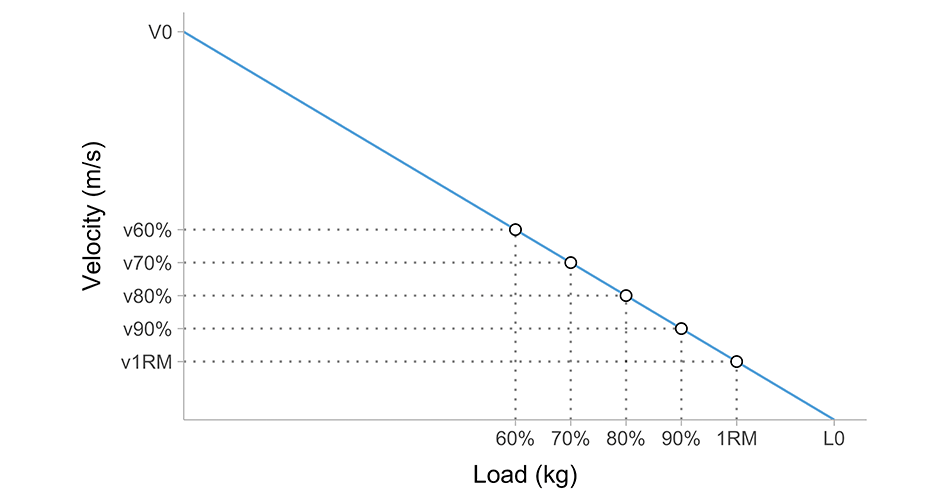
When the athlete intends to lift as fast as possible, heavier loads generally move more slowly. A light load can be moved slowly on purpose, but the ceiling of possible velocity falls as load increases.
2.3 Fatigue~repetition velocity
Hold the load constant, ask for maximal concentric intent, and repetition velocity tends to decline as fatigue accumulates. The exact shape depends on the exercise, athlete, and task, yet the pattern keeps appearing.
These are phenomena. Explanations come later.
We may invoke motor-unit recruitment, cross-bridge behaviour, metabolite accumulation, central and peripheral fatigue, perception of effort, or changes in technique. We may model the relationships with linear, exponential, or other equations. The phenomena are what those theories and models are trying to account for. Table 1 gives coaching examples of these distinctions; Figure 1 depicts how the three interact.
| Robust phenomenon | Plain coaching observation | Possible theories | Possible formal models |
|---|---|---|---|
| Load~repetitions | Heavier weight means fewer possible reps. | Recruitment, force capacity, fatigue | Rep-max equations, %1RM tables |
| Load~velocity | Heavy loads move more slowly under maximal intent. | Force–velocity characteristics, mechanics | Load–velocity regression |
| Fatigue~velocity loss | Reps slow as the set progresses. | Peripheral and central fatigue, effort regulation | Velocity-loss curves |
| Speed~duration | Faster pace is held for less time. | Energetic supply, fatigue, pacing | Critical-speed or power-duration models |
Table 1: Phenomena, theories, and models are related but not interchangeable.
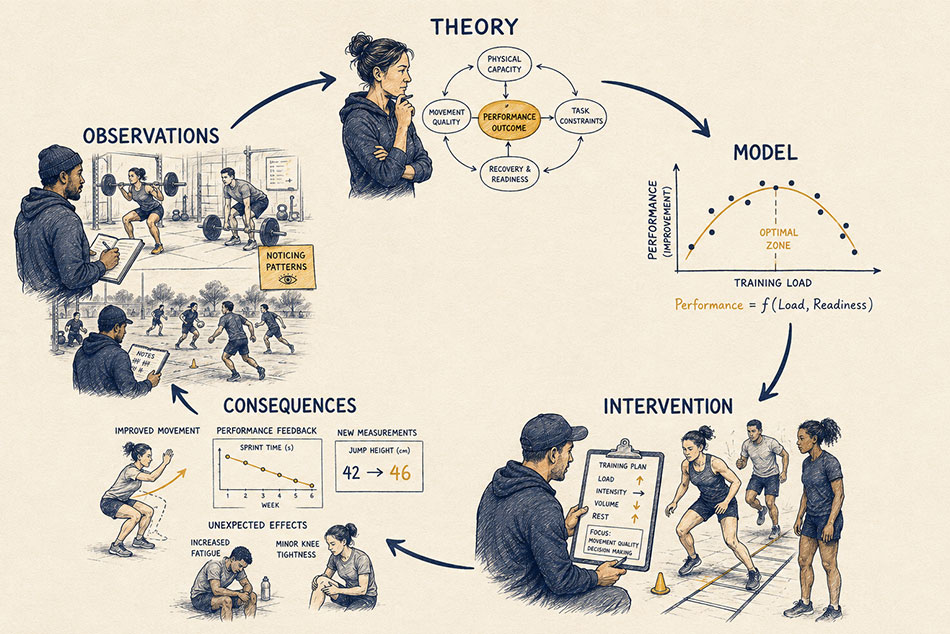
Figure 1: Recurring phenomena motivate theories; theories guide models; models return predictions and interventions to the world.
3 Phenomenological coaching language
Coaches frequently skip a step. We observe that bar velocity falls, sprint power declines, pace collapses, or decision-making becomes messy. Then we immediately call it central nervous system fatigue, fast-twitch fibre fatigue, lactate intolerance, or some other mechanism we did not actually observe.
The explanation may eventually prove useful. It may even be correct. But it did not come attached to the observation.
If bar velocity drops during the second half of a set, then the first honest description is exactly that: bar velocity drops during the second half of the set. If an athlete produces high power in the first sprint but cannot reproduce it after twenty seconds of recovery, say that. If the athlete holds the required pace for sixty seconds and then falls apart, name the pace drop and when it occurs.
These descriptions are not intellectually inferior because they use ordinary language. They are often more precise because everybody knows what is being discussed.
I call this phenomenological language. I use phenomenological in a modest coaching sense: begin with what is observed from the outside or experienced from the inside before claiming to know the machinery underneath it.
From the outside, a coach may observe:
- velocity declining after the fourth repetition;
- peak power falling across repeated sprints;
- the first two acceleration steps disappearing late in the session;
- pace dropping during the final twenty seconds of an effort;
- an athlete scanning less and taking an extra touch late in the match.
From the inside, the athlete may report:
- “My legs stopped responding.”
- “I could produce power once, but I could not repeat it.”
- “I could hold the pace until the last section.”
- “I felt one step behind the game.”
- “The load did not feel heavy, but I could not move it quickly.”
The athlete’s experience is also an observation, from inside the system. It should not automatically be promoted into physiology either. “My legs stopped responding” is useful information. It is not a muscle biopsy.
Phenomenological language keeps the name close to the problem, a point we will revisit in an upcoming blog post. It tells us what repeatedly happens, where it happens, and under which conditions it becomes visible. It does not pretend that naming the problem explains it.
That distinction protects both coaches and scientists.
The scientist should not dismiss a coaching phrase merely because it sounds informal. The coach should not turn an informal phrase into a hidden mechanism. “Strong in duels” may point toward a robust phenomenon. It does not establish that maximal strength causes duel success. The observed advantage may involve strength, mass, leverage, positioning, timing, confidence, perception, skill, intent, or their interaction.
Name the phenomenon first. Allow several explanations to compete afterward (Fried 2020b; Borsboom et al. 2021). Info box 2 turns that principle into a naming rule.
Use the closest defensible description of what happened.
State the task, the observable change, and the conditions under which it occurred. Introduce physiological or psychological mechanisms only when you are ready to defend the causal step. Table 2 contrasts the claims made at each of those levels.
Hyphens are cheap. Explanations are expensive.
3.1 Description before mechanism
The four levels in Table 2 separate description from a proposed mechanism.
| Level | Example | What it claims |
|---|---|---|
| Observation | Bar velocity fell after the fourth repetition. | Something changed during this set. |
| Recurring phenomenon | This athlete repeatedly loses velocity during the second half of moderate-load sets. | The pattern recurs under specified conditions. |
| Practical construct | The athlete has poor ability to reproduce power across repetitions. | Several observations are summarized under a useful label. |
| Candidate mechanism | The decline is caused by fast-twitch fibre fatigue. | A particular physiological process explains the pattern. |
Table 2: Observation, phenomenon, construct, and mechanism should not be collapsed into one label.
Moving from observation toward a proposed mechanism requires additional evidence. Unfortunately, coaching conversations often begin at the bottom.
The phrase repeat-power ability can be useful if we define it transparently: the ability to reproduce a specified level of power across specified efforts and recovery periods. Without the task, duration, and recovery conditions, repeat-power ability is merely another impressive sticker.
The same applies to lactate tolerance. What exactly was observed: failure to maintain target pace during a sixty-second effort, collapsing power during the final repetitions, severe reported discomfort while mechanical output remained stable, or blood lactate differing from previous trials? Those are different phenomena.
Calling all of them “lactate tolerance” bundles the observation, construct, and proposed mechanism into one convenient phrase. It sounds scientific while communicating surprisingly little. If the practical problem is that the athlete cannot maintain a specified pace for an effort lasting between forty and 120 seconds, say that first. The duration describes the task. It does not prove that lactate caused the failure.
3.2 More examples from practice
Instead of saying:
The athlete has central nervous system fatigue.
Try:
Movement velocity remains lower than usual across several exercises despite normal loading and maximal intent.
This leaves several explanations open: central fatigue, peripheral fatigue, poor sleep, pain, reduced motivation, technical changes, or measurement error. That is a feature, not a weakness. We have named the problem without pretending to have solved it.
Instead of saying:
The athlete has poor fast-twitch fatigue resistance.
Try:
Peak power is high in the first sprint but falls sharply across repeated sprints with twenty seconds of recovery.
Now the coach knows what the athlete can do once, what cannot be repeated, and under which recovery conditions the problem appears.
Instead of saying:
The athlete needs more lactate tolerance.
Try:
The athlete can hold the target pace for approximately sixty seconds, but pace and mechanics deteriorate during the final twenty seconds.
That description can guide training and testing immediately. Possible explanations involving glycolytic contribution, acid–base regulation, pacing, discomfort, local muscular fatigue, or motivation can be investigated later.
Instead of saying:
The athlete has a speed–strength deficit.
Try:
The athlete produces high force when time is available but cannot express enough of it during the short contact time of the first acceleration steps.
Or, if that is what was actually measured:
The athlete is strong in the slow test, but the first five metres remain poor.
The second sentence is less sophisticated. It is also harder to misunderstand.
Terms such as strength–speed and speed–strength can be useful for organizing exercises or regions of a load–velocity continuum. Problems begin when the label is treated as a substance stored inside the athlete. Saying that somebody “lacks speed–strength” does not yet identify what failed, in which task, or why.
Instead of saying:
Decision-making deteriorates because of cognitive fatigue.
Try:
During the final fifteen minutes, the athlete scans less before receiving the ball, takes an additional touch, and selects the safer option more often.
That description provides something coaches can observe again. Cognitive fatigue remains one possible explanation. Tactical pressure, opponent behaviour, reduced movement options, physical fatigue, anxiety, and score-line effects remain others.
This is the practical advantage of phenomenological language: another coach, scientist, or athlete can understand the problem without first agreeing with your favourite physiology lecture.
A useful phenomenological label should answer three questions:






Responses