
New Member Benefit: Football Recovery Decision Framework

A starter who played 90 minutes and a substitute who came on for 15 shouldn’t automatically get the same recovery plan just because they were in the same match.
The same goes for a player with another game in 36 hours versus one who has five days, or a player coming off a heavy strength session versus one who has just landed after a long flight and slept badly.
Recovery methods don’t exist in a vacuum. Their usefulness changes with the player, the goal, the recovery window, the match exposure, the surrounding context, and the equipment you actually have in your building.
That’s the problem the Football Recovery Decision Framework (FRDF) is built to make easier.
We’ve added it as a new benefit for Complementary Training members. It comes in two parts: the Football Recovery Coaching Manual and the interactive FRDF web app.
Who Built This
The FRDF was created by Nicolás Rodríguez, one of our own members.
He did the work of turning the recovery evidence into something a coach can actually use in practice, and then made both the manual and the app available to the rest of the community. Nicolás, thank you for sharing this with us.
The Manual
The manual is the application layer. The evidence base is the review article Recovery Methods in Football; the manual takes that evidence and turns it into protocol cards, decision tools, planning templates and checklists that a technical staff can use directly. It is deliberately not another long review of the literature.
Across 39 pages and nine independent sections, you get:
- Protocol cards for individual recovery methods, seventeen in total, covering sleep, nutrition and hydration through to cold water immersion, contrast, sauna, compression, massage, foam rolling, active recovery, stretching, mobility, recovery boots, percussion devices, EMS, breathing work and meditation. Purpose, parameters, contraindications, coaching notes.
- An outcome matrix showing which methods are actually relevant for which recovery goal.
- Five applied football scenarios: the 90-minute starter, the substitute, a youth player at peak height velocity with school stress and no budget, domestic and international travel, and a tournament with three matches in six days.
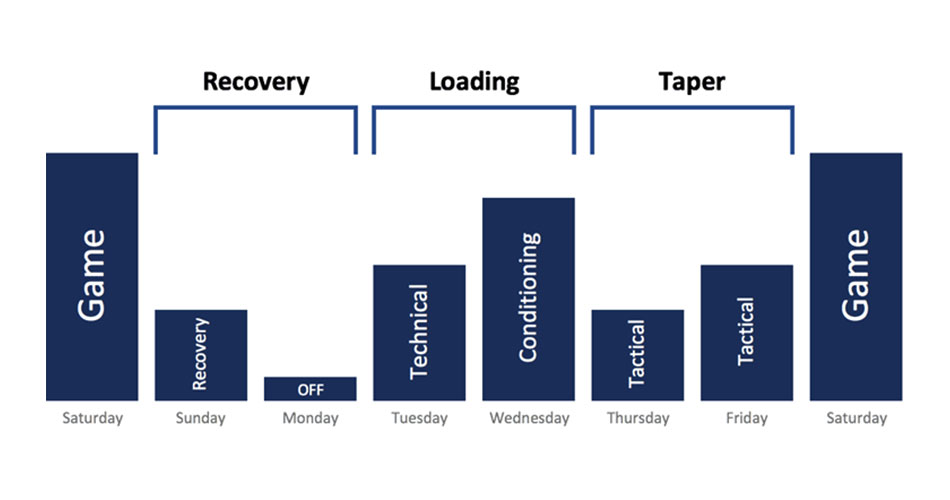
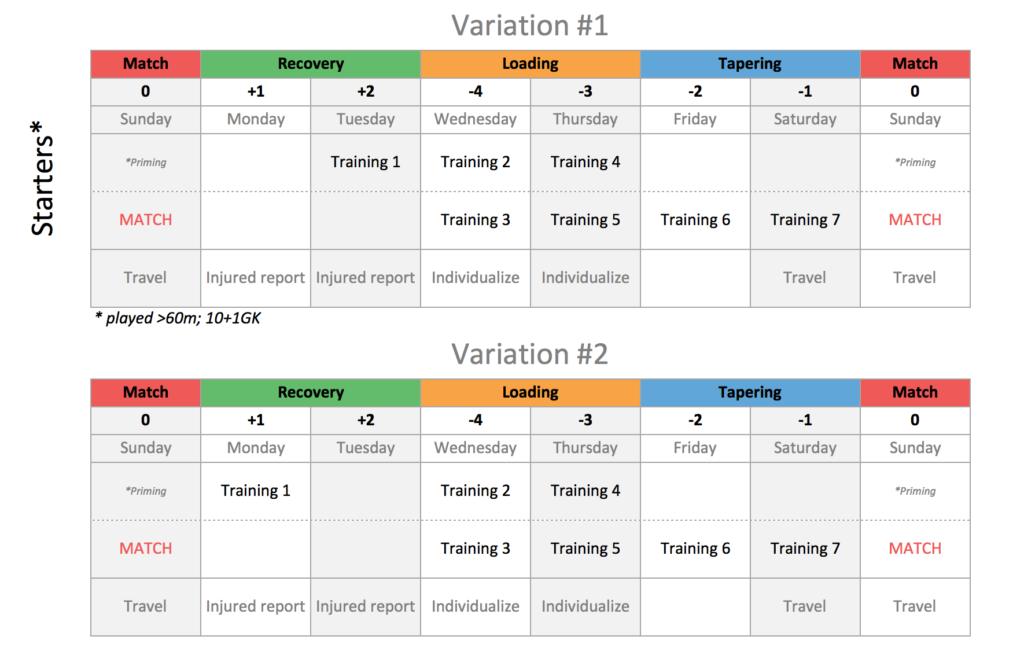
- Six microcycle examples, from a one-match week through congested blocks, international breaks, off-season and pre-season.
- A club resource comparison across four budget levels, for anyone who has read a recovery paper written in a facility that looks nothing like theirs.
- Practical checklists, the static FRDF decision tree, twenty FAQs, and twelve key coaching takeaways.
The point isn’t to hand you another shopping list of ice baths, massage guns, compression boots, foam rollers and whatever gadget shows up next season. It’s to help you decide when a method makes sense, for whom, for what outcome, and under which constraints.
The Interactive App
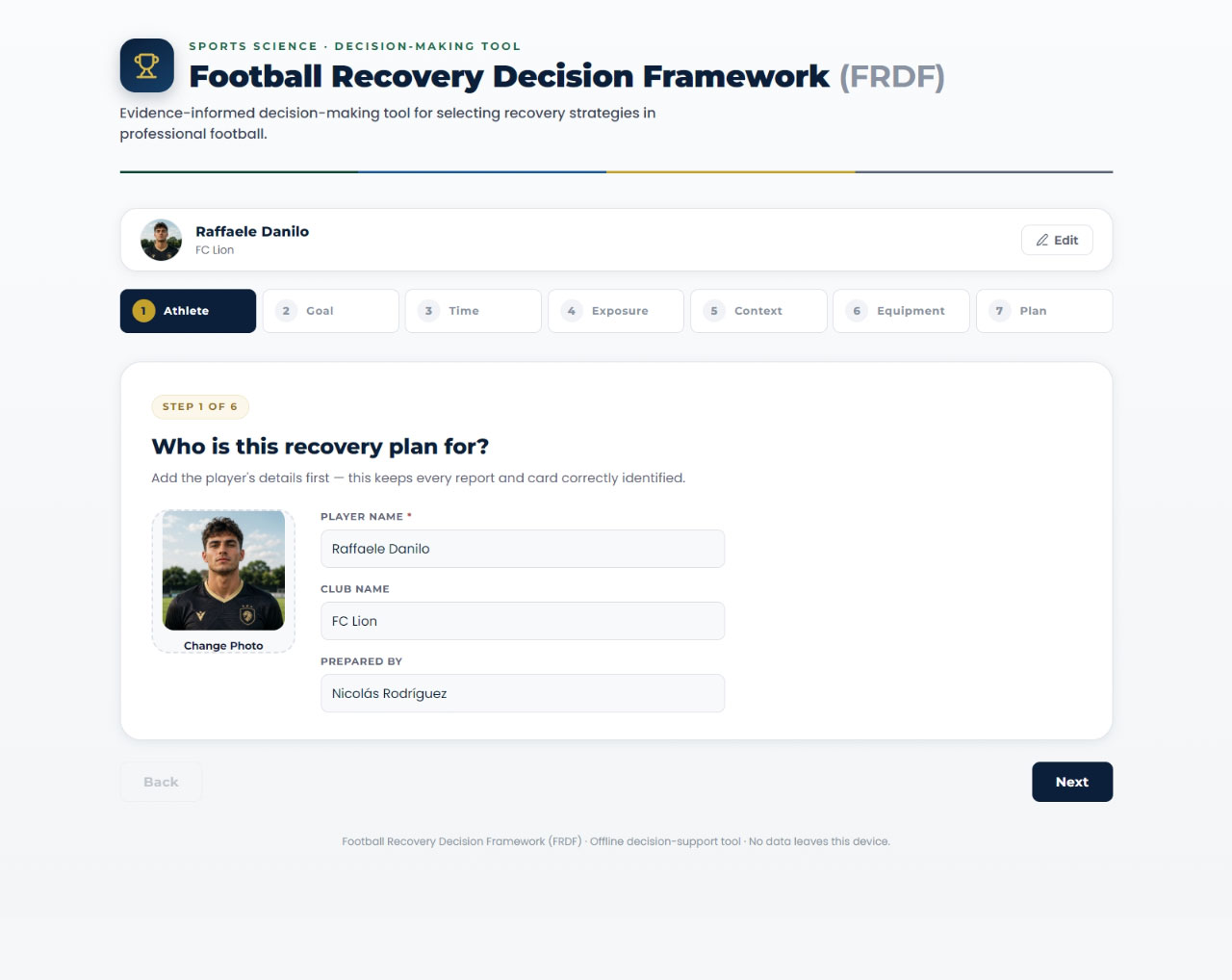
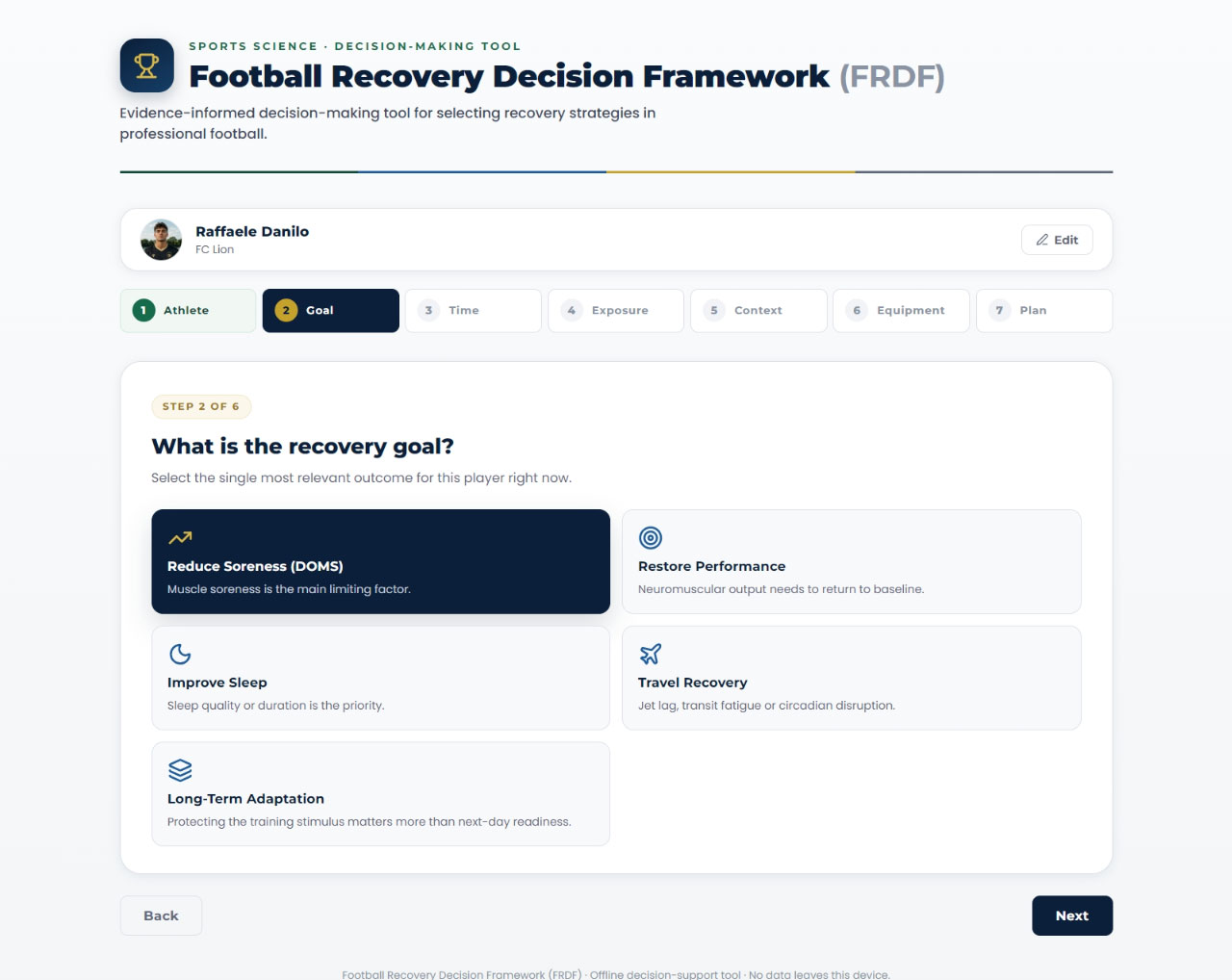
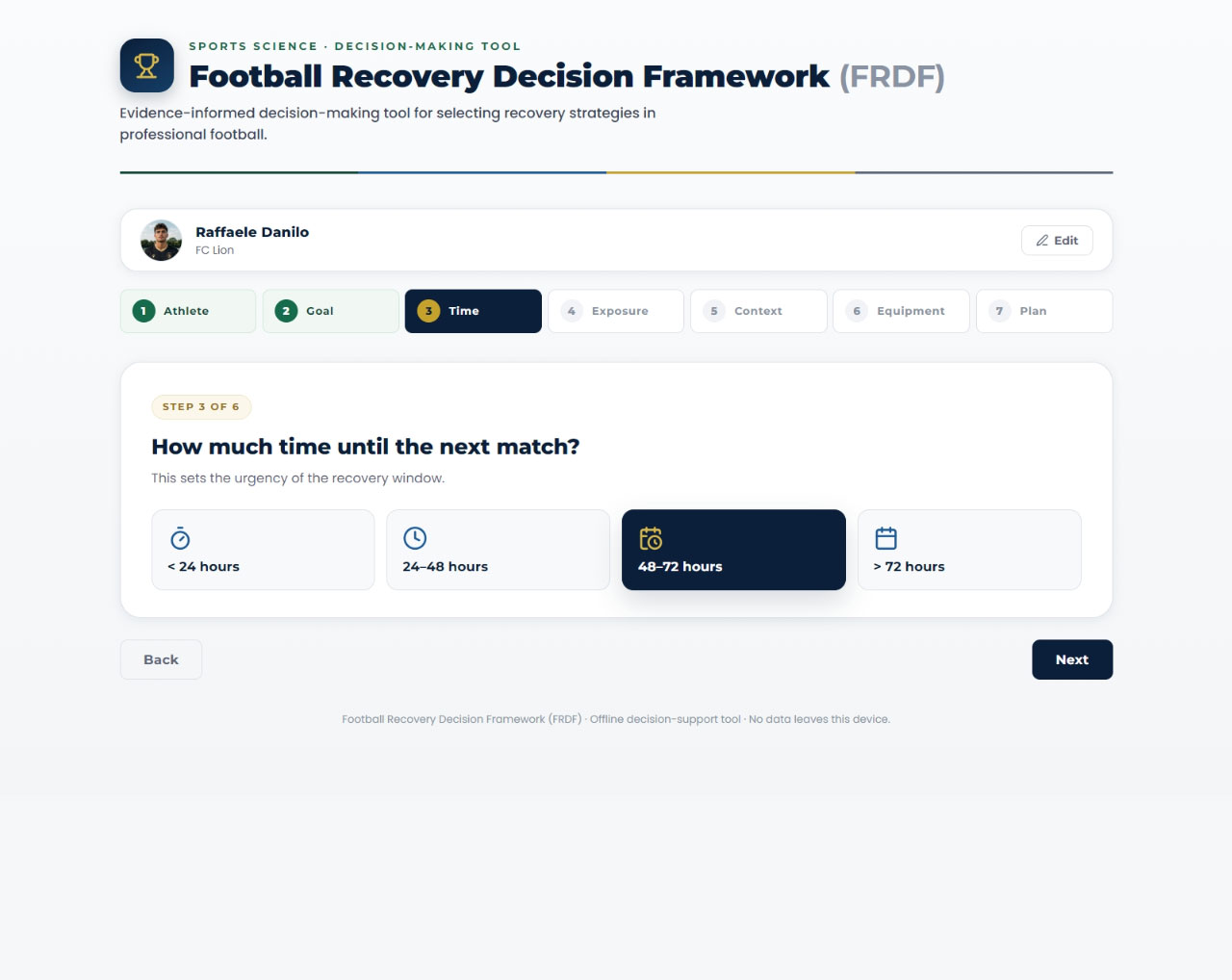
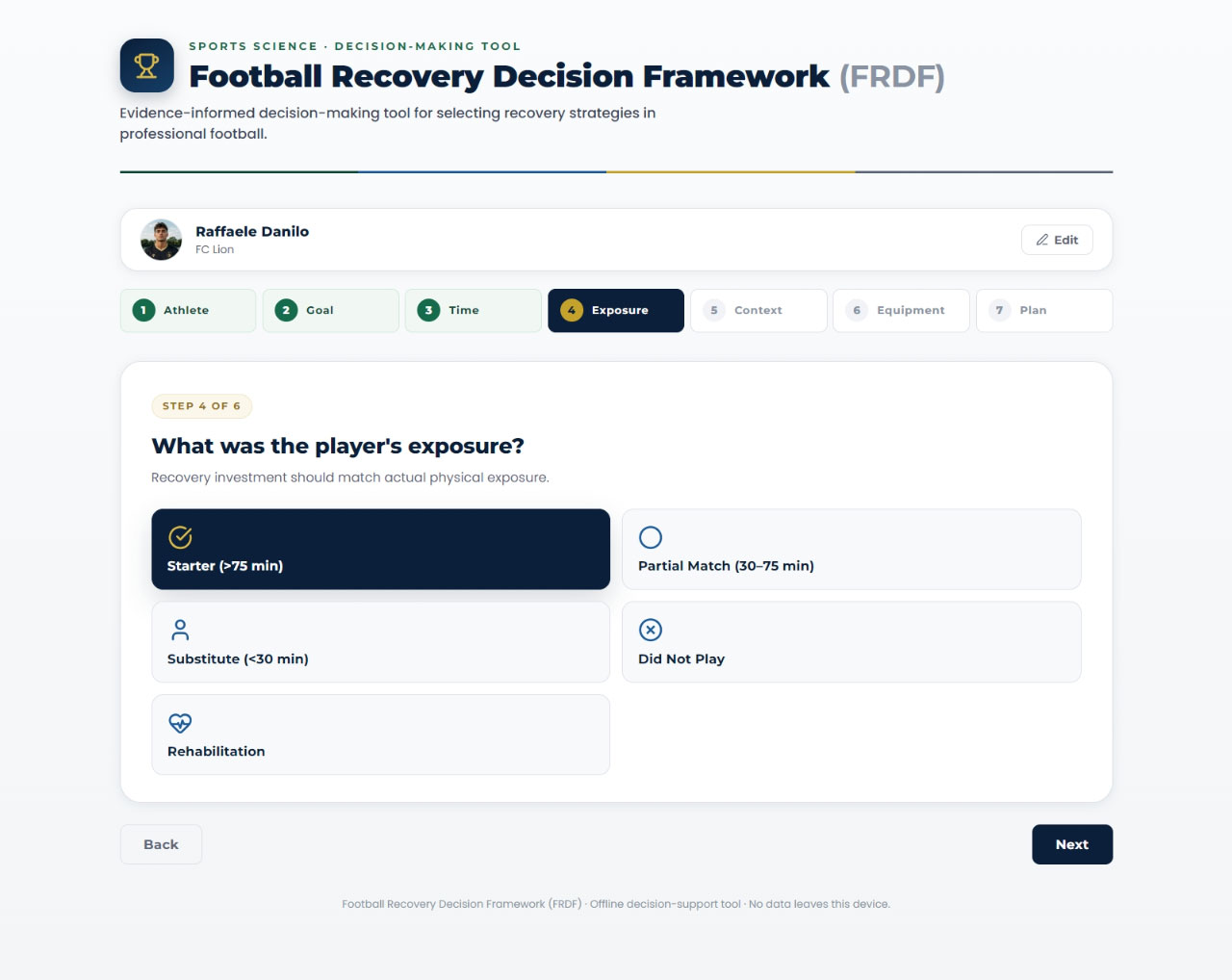
The app takes the same decision logic and makes it fast to use for one player at a time.
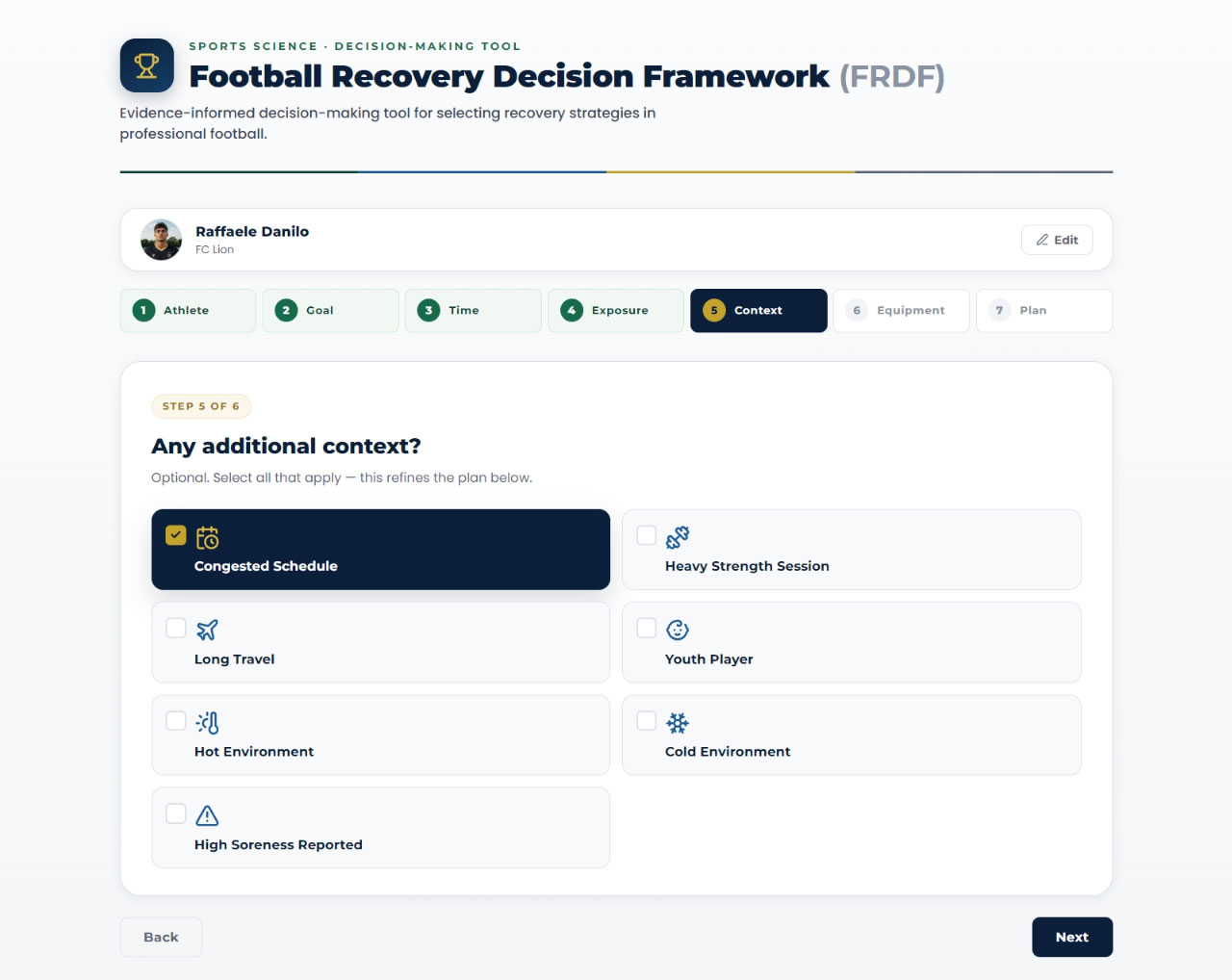
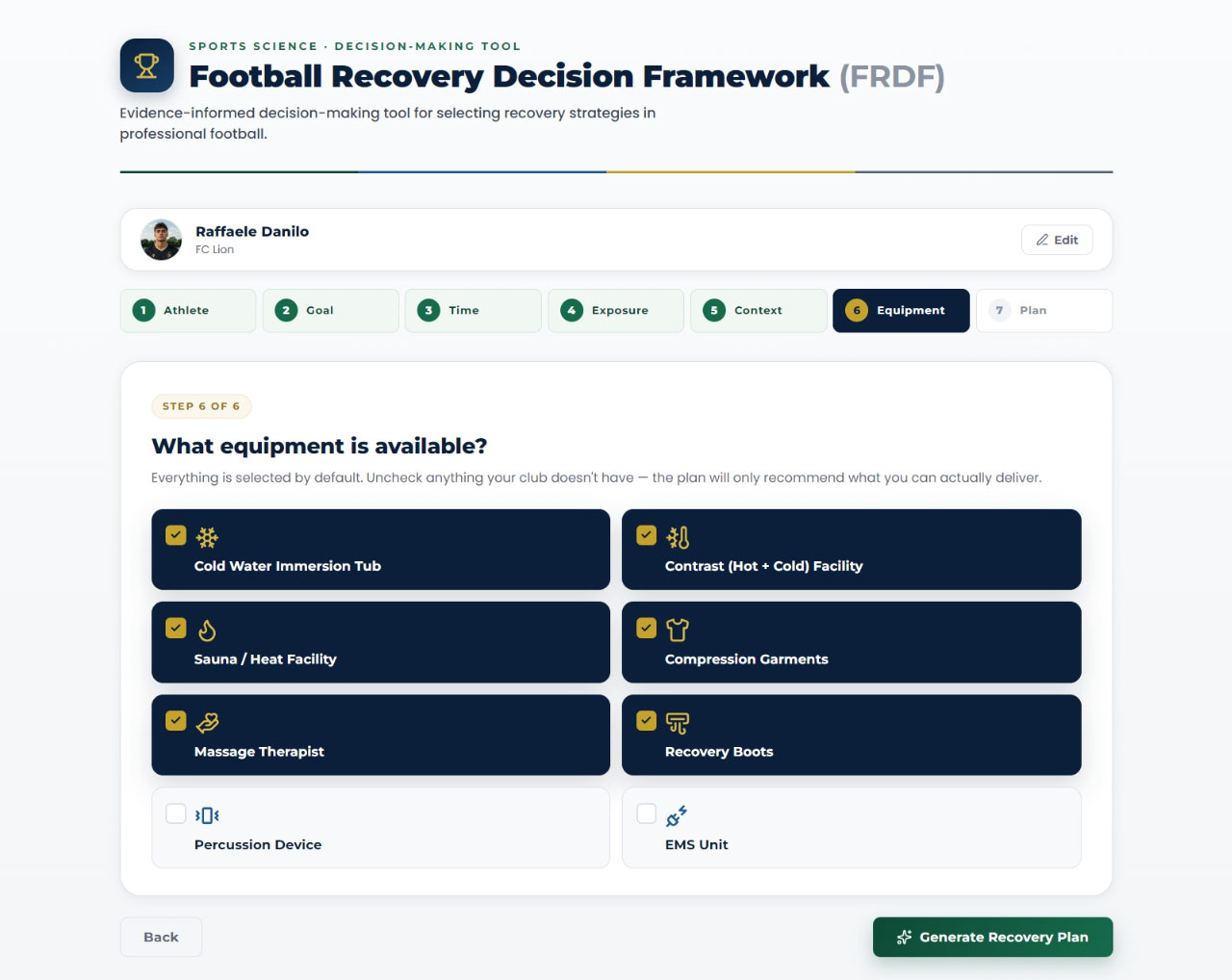
You start with the athlete, then choose the primary recovery goal, the time until the next match, the player’s actual match exposure, any relevant context, and the equipment you have available.
That last step matters more than it looks. If your club doesn’t have a cold tub or a sauna, you simply leave it out and the plan won’t recommend something you can’t deliver on Monday morning.
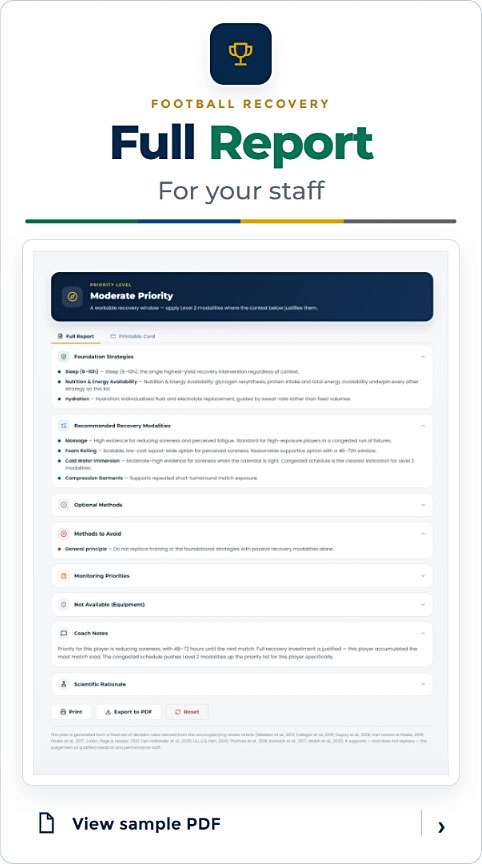
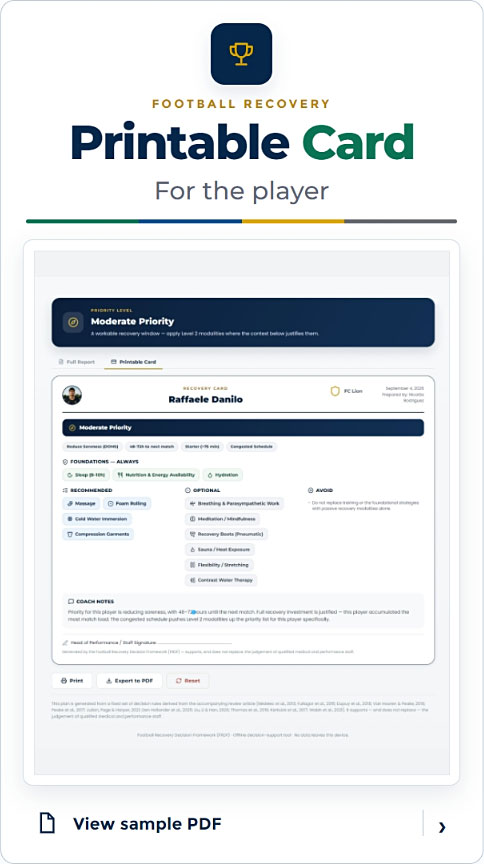
The app then generates a structured plan: foundational strategies, recommended methods, optional methods, methods to avoid, monitoring priorities, coach notes, and the scientific rationale behind the decision. There’s also a simpler printable Recovery Card for the individual player, and you can print or save any plan as a PDF straight from the browser.
It runs offline, and whatever player information you enter stays on your device.
How I’d Use The Two Together
Use the app when the decision needs to be made quickly. Enter the player, the goal and the constraints, generate the plan, and see where the framework lands.
Use the manual when you need the detail behind that plan: protocol parameters, contraindications, coaching considerations, or the reasoning for a particular method. That’s also why the ranges in the manual are presented as starting points to adapt with your medical and performance staff, not fixed prescriptions.
That distinction is the important one. The FRDF is decision support. It narrows the options and shows you the reasoning. It doesn’t replace the judgment of qualified medical and performance staff, and the app says so on every plan it generates.
Who Can Access it
If you’re a Premium member, the complete Football Recovery Decision Framework is available to you right now.
It’s also included for Standard members at Level 3, meaning monthly members who have been part of the community for more than three months.
If you’re not on one of those plans, the Football Recovery Decision Framework is also available on its own in our online store for $60. Members reading this don’t need it, but it’s there if you want to point a colleague at it.
One Thing That Would Help
Run it once on a real player from last weekend rather than a hypothetical one, then tell us how it went in the comments.
If there’s a scenario the framework handles badly in your environment, that’s exactly the kind of thing worth knowing about, and exactly the kind of thing that makes the next version better.








Responses