
Microcycle Planning for Team Sports

Planning a microcycle in team sports is not just a scheduling problem. It is a coordination problem.
The playing squad needs recovery. The reserves need a real session. Non-travel players still need load. Injured athletes are on their own timeline. The medical staff needs to be aligned too. All of this can happen in the same week, sometimes on the same day, and none of it waits for Sunday’s plan to hold together.
That is the gap this presentation addresses: not the clean textbook version of microcycle planning, but the version that exists once a real squad, a real schedule, and real constraints start pulling the week in different directions.
The starting point is a shift in planning direction. Top-down planning still matters, but it often breaks down once competition density and squad variation take over. The more useful question is not only “What should the ideal week look like?” but “What can we actually organize with the players, staff, time, and constraints we have today?”
That bottom-up logic shapes the rest of the framework.
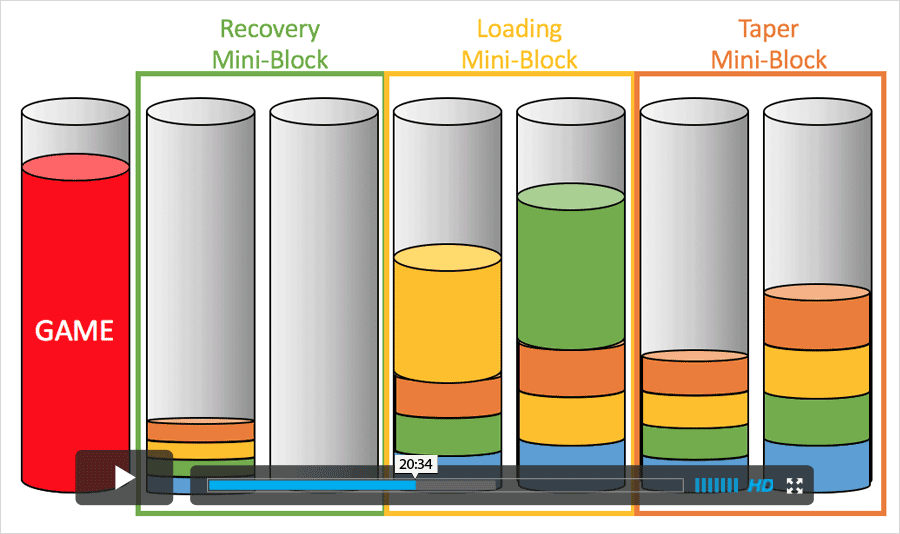
A major part of the presentation is built around three mini-blocks: Recovery, Loading, and Taper. These are not just labels for intensity. They define the purpose of each phase, the order in which you place training elements, and the constraints each block creates for the others.
Their length changes. Their position changes. Their purpose does not.
From there, the presentation moves into the decisions that make microcycle planning difficult in real environments: how to distribute work across functional groups, when to push one quality harder, when to microload across the week, how individual and collective work shift as match day approaches, and how a simple Kanban board can keep the staff aligned without turning every adjustment into another meeting.
No perfect recipes. No universal templates.
Just a planning model that holds up better when the week stops cooperating.
The presentation covers:
- Top-down versus bottom-up planning
- Functional groups within the team
- Recovery, Loading, and Taper mini-blocks
- Planning for microcycles of different lengths
- Strength versus weakness work distribution
- Individual versus collective work
- Probabilistic planning of training components
- Timing and combinations of training qualities
- Microloading versus saturated approaches
- Heuristics for working under uncertainty
- Kanban boards for staff alignment and agile periodization
Watch the full presentation and see how this framework fits your environment.






Responses