
Small-Sided Games in Football: From Theory to Practical Application

Small-sided games have been in every football toolbox for decades. What’s often missing isn’t familiarity with the method. It’s control over the variables that actually make it work.
A 4v4 in a 20×20 box and a 4v4 in a 40×40 area look like the same format on paper. The stimulus they produce has almost nothing in common. And that’s where most SSG design drifts away from what it was supposed to do.
What SSG Actually Does
At the structural level, SSG keeps the logic of football intact. Cooperation, opposition, decisions under pressure. What changes is scale. Fewer players, smaller pitch, modified rules, adjusted duration.
That reduction is what makes SSG useful in the first place. More ball contacts, more decisions, more reps of specific situations, all inside a football context. And because the game itself is preserved, the adaptations transfer back to competition without the usual gap you get with isolated drills.
The catch is that SSG don’t organise themselves. They produce whatever stimulus their variables produce. If those variables aren’t controlled, the session drifts somewhere between what the coach wanted and whatever the players naturally fall into.
Space per Player: The One Variable Most Coaches Underuse
The single most influential variable in SSG design is the relative space per player. In the literature it shows up as EII (Individual Interaction Space), defined as the total playing area divided by the number of participating players (Parlebas, 2001).
Three rough ranges are worth keeping in mind.
Under 100 m² per player gives you a high density of actions. More accelerations, decelerations, duels, changes of direction. Cardiovascular load is moderate. Neuromuscular load is high.
Between 100 and 200 m² per player shifts things toward volume. Distance covered goes up, heart rate stays elevated, both aerobic and anaerobic systems get hit.
Above 200 m² per player finally opens the space enough for real sprinting to happen. Running speeds go up, sprint distance goes up, acceleration frequency drops off.
These ranges point you in a direction. They don’t give you numbers. A coach planning a 5v5 for strength-focused work knows the format should sit under 100 m² per player. That still leaves the question open: what’s the actual pitch?
This is where most SSG design quietly breaks. Not in the concept. In the execution. A 5v5 at 60 m² per player is not the same session as a 5v5 at 90. Same format, different stimulus.
The accompanying PDF lays out specific dimensions for squares and rectangles across formats from 1v1 to 10v10, matched to whatever EII range you’re after. The Excel calculator goes the other direction. You enter players, pitch size, sets, and duration, and it gives you back estimated total distance, sprint distance, acceleration counts, and metabolic power distance based on Sangnier et al. (2018). Between the two, the guesswork comes out of the process.
Fitting SSG Into the Weekly Plan
A common pattern in modern microcycle design is lining up SSG with the physical emphasis of each day.
MD-4 leans toward strength. Small pitches, fewer players, high interaction density. This is where accelerations, decelerations, duels, and contact happen inside a game context.
MD-3 shifts to endurance. Bigger relative spaces (100 to 200 m²), longer durations, collective formats like 4v4, 5v5, or 6v6. Distance accumulates, heart rate stays up.
MD-2 is speed. Larger absolute and relative space (200 to 300 m² per player), more players, lower volume. The goal is to expose players to sprinting without stacking fatigue before the match.
MD-1 is activation. Short, light, focus on coordination and quick decisions. Nothing that leaves residue.
The logic is simple enough. The implementation is where it gets messy. Knowing that MD-4 should sit under 100 m² per player is one thing. Translating that into 3v3 at 20×20, or 5v5 at 22×45, especially when you’re adjusting on the fly because three players are out sick, is where the calculator saves time.
Geometry and Connection
Space and microcycle logic handle the physical side of SSG design. The other side is how players actually connect inside that space, which comes down to the shape of the task and the numerical relationships between attackers and defenders.
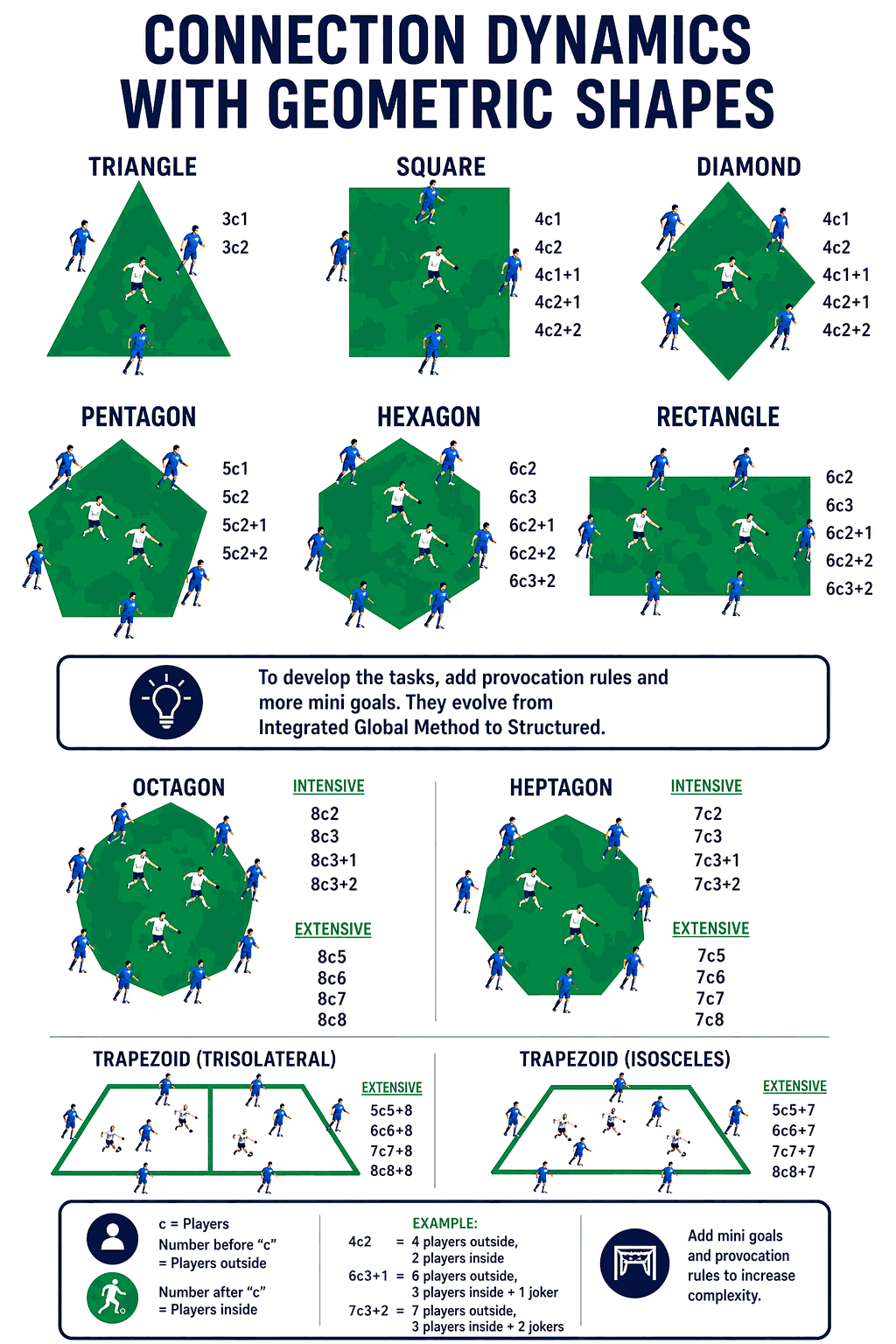
This is where geometric shapes earn their place. Each shape (triangle, square, diamond, pentagon, hexagon, rectangle, heptagon, octagon, trapezoid) changes how players occupy the pitch, what passing lines emerge, and what kind of superiority is created. The shape conditions the decision-making before any rule is added.
The notation is straightforward once you see it. 4v2 means four players on the outside and two on the inside. From there you can build superiority with neutrals (4v2+1), or layer in more complexity (4v2+2). Same principle across shapes. The intention of the task is what decides how it’s set up.
Then comes the intensive/extensive distinction. Smaller space, high pressure, limited time produces cognitive and neuromuscular load. Larger space with more time to decide shifts the emphasis toward running volume and aerobic stimulus. Same shape, same numerical setup, different load. It’s the same trick the EII framework pulls, just applied at the level of player relationships rather than pitch size alone.
For any of this to transfer back to the match, the task has to evolve. Constraint-based rules, touch limits, body orientation cues, mini-goals, or changes in space. That’s what turns a shape-based exercise into a designed environment instead of a drill.
The point isn’t to train players in shapes. It’s to train the relationships, decisions, and behaviours that show up inside them.
Where SSG Design Usually Breaks Down
A few patterns keep showing up in how SSG actually get used.
Running the same formats every week without touching the variables. Players adapt, the stimulus flattens, and the session turns into maintenance rather than development.
Ignoring the relative space per player. Most coaches pick a pitch based on what’s free or what feels right, then run the session without checking whether the dimensions match what they were trying to train.
Treating all SSG as roughly equivalent. A 3v3 in a small area and an 8v8 in a big one are two different training methods in the same clothes.
Disconnecting SSG from the day of the week. If the format doesn’t match the physical priority of that session, the whole logic of the microcycle quietly falls apart.
And running SSG without any form of load control. RPE, duration, GPS where you have it. Without something tracking the output, SSG becomes filler rather than training.
None of this is exotic. It’s the difference between using SSG as a default activity and using them as a method.
The Tools
The Small-Sided Games Manual and the SSG Session Calculator are built to close the distance between what you want the session to do and what it actually does.
The Manual covers the internal logic of SSG (space, time, players, ball), pitch dimensions by format and EII target, microcycle distribution by physical quality, practical examples for strength, endurance, speed, and activation sessions, and the common errors to watch out for.
The SSG Session Calculator takes your inputs (team size, pitch size, sets, duration) and gives back density per player, total distance, sprint distance and number of sprints, acceleration and deceleration counts, and metabolic power distance.
Together they take SSG design from rough to measurable. Which, for most of us working with limited time and half a squad available, is the part that actually matters.









Responses