
Speed in Soccer Masterclass

Most coaches agree that speed decides games, but far fewer agree on what speed in soccer actually is, how to train it, or when to expose players to it.
Acceleration, max sprinting, deceleration, repeat efforts, reaction, decision making, and positioning all happen under tactical pressure, yet speed is still often trained in isolation, read through averages, or planned without fully understanding what the game actually demands.
What Makes This Different
You have probably watched presentations that explain energy systems or show clean drill examples, then struggled to connect them into a real training week.
The Speed in Soccer Masterclass gives you two complete presentations that belong together. One explains the framework. The other shows how it looks on the pitch with a real team. No polished demos. Full sessions, real decisions, real coaching corrections.
Efthymios Kyprianou works with the NEA SALAMINA FC women’s team through two full training days. Warm ups, progressions, mistakes, fixes, and intensity that reflects actual football.
The Framework First
The theory presentation starts with a simple but often skipped question: what is speed in soccer?
It is not sprint distance or top speed on a GPS report. Speed has neuromuscular components like accelerations, decelerations, and changes of direction, and metabolic components like repeat high intensity efforts and recovery capacity. They appear differently in matches and stress the body in different ways.
One key point stands out. Average match speed is around 8.5 km per hour, yet decisive moments happen above 35 km per hour. If training follows averages only, the speeds that decide games are never properly exposed.
The presentation also shows how to profile players beyond fast or slow. Players can be strong but slow, or fast but not explosive. Once you understand these profiles, individualizing work becomes practical instead of theoretical.
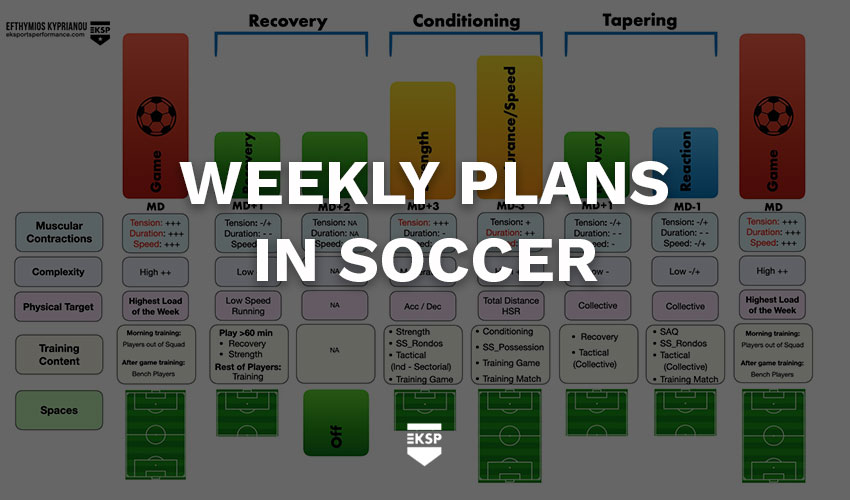
Training load monitoring ties this together. Two very different sessions, one in small spaces focused on strength and one in large spaces focused on endurance, can produce almost identical acceleration counts and heart rate data. The theory explains why this happens and how to interpret sessions beyond raw numbers.
What It Looks Like on the Pitch
The real case scenario shows two complete sessions.
The first session targets strength and neuromuscular load in smaller spaces. A foot tennis warm up already demands movement, reactions, and positioning under pressure. Passing drills progress as defenders close space quickly, forcing decisions. By the six versus six and four versus four games, the neuromuscular load is high, all through football actions.
The second session opens the space and shifts toward endurance and speed. Players receive, turn, dribble at speed, finish, and immediately transition into two versus one situations. Possession games flip into counterattacks the moment the ball is won. Defenders organize while attackers reach high speeds from realistic positions.
Coaching is constant throughout. Timing of runs. Body orientation. When to accelerate and when to slow down. Real cues, real intensity.
One thing becomes clear: even when the session goal changes, neuromuscular load remains high. Accelerations, stops, and direction changes accumulate regardless of the main objective. A GPS summary alone never tells the full story.
What This Helps You Solve
This masterclass helps when sessions feel heavier than the data suggests. You’ll see how to connect speed work to your game model instead of separating it, get a clear starting point for individualization, and understand when to expose players to maximum speed during the week.
Why Speed in Soccer Masterclass Matter
Theory without practice stays abstract. Practice without theory becomes copying drills.
Together, these videos show you how to think about speed in a way that fits soccer, where speed always happens with a ball, an opponent, a decision, and a tactical context.
This is not about chasing perfect metrics. It is about preparing players for the moments that decide matches.






Responses