
Philosophy Behind Agile Periodization: Why Philosophy Matters – Part 2

In the previous part, I argued that you cannot be theory-free and that every model compresses a large and messy world. The conclusion was not to reject models, but to treat our understanding as partial, conditional, and revisable.
Complexity resists one clean story
Complex systems are context-sensitive. Their parts interact. The same intervention can have different effects depending on the athlete’s current state, history, environment, and everything else happening at the same time. Outcomes emerge from the interaction rather than from one isolated component acting alone.
I use phenomenon for an event or recurring pattern that demands description or explanation. A robust phenomenon, in the provisional sense used here, is a pattern that remains recognizable across reasonable changes in observation, measurement, dataset, or model—even when people disagree about why it occurs. We’ll examine that definition properly later. For now, the distinction prevents us from confusing a recurring feature of the world with an output produced by one favourite model.
Sandra Mitchell uses the term integrative pluralism to describe why complex phenomena often require several partial explanations rather than one master theory (Mitchell, 2012). The point is not that every explanation is equally good. The point is that physiology, psychology, skill, technology, social context, and lived experience may each reveal a different layer of the same event.
Suppose an athlete underperforms. A physiological story may point toward fatigue. A psychological story may point toward anxiety or motivation. A skill-acquisition story may point toward poor calibration to the task. An organizational story may point toward unclear roles, conflict, or schedule chaos. A phenomenological story may ask what the situation feels like and means to the athlete (Figure 1).
One of those perspectives may carry more weight. Several may be operating together. None should be promoted to universal truth simply because it belongs to your favourite discipline.
This is where specialists can become ideological without noticing. The physiologist sees physiology. The biomechanist sees forces and moments. The skill-acquisition researcher sees information and constraints. The therapist sees tissues and symptoms. The coach sees the whole athlete, except when the coach is also trapped inside his own favourite story.
Nobody gets a free pass.
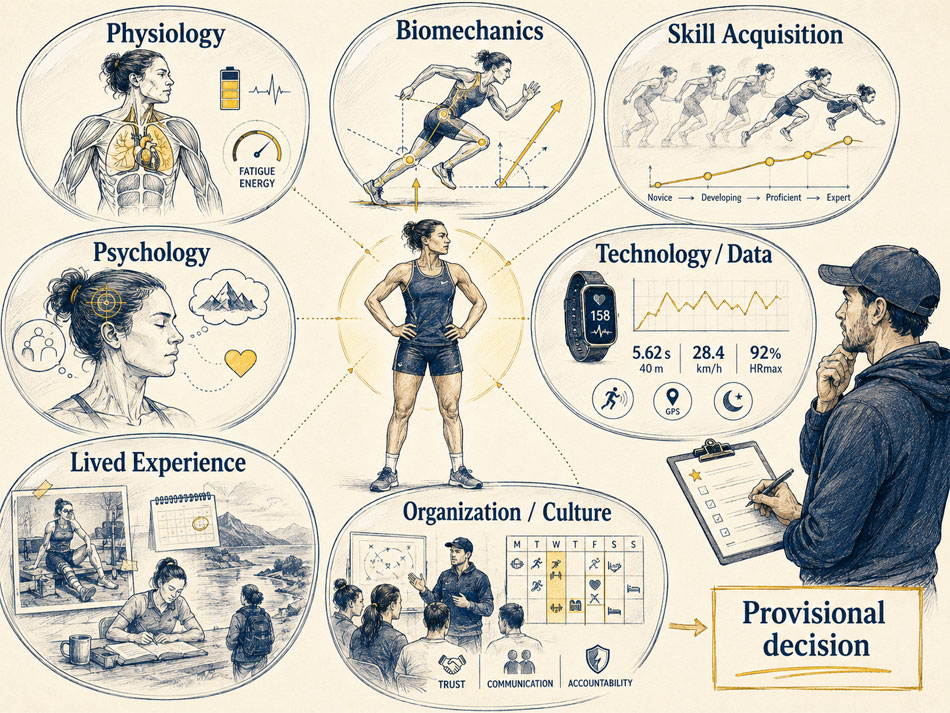
Figure 1: Different lenses reveal partial aspects of the athlete; coaching judgment determines how much weight each deserves.
Integrative pluralism is a discipline, not permission to throw everything into a blender. The perspectives need boundaries. We should know what level each one addresses, what evidence supports it, and where its domain of validity ends. “Holistic” is not a magic word that excuses vague thinking. It is often what people say when they cannot name the parts. Name the damn parts.
Data do not tell us what to do
Collecting information gives us an is. Coaching requires an ought.
An athlete has a VO2max of 62 mL·kg-1·min-1. A player’s high-speed running dropped in the second half. A groin-squeeze score is 15% below the usual value. A bar moves more slowly than expected. These are descriptions, assuming the measurement and interpretation are valid.
They do not automatically prescribe an intervention.
Should we train the athlete harder, reduce load, change the exercise, substitute the player, move the player to another position, repeat the test, ignore the score, or ask what happened last night? The data cannot answer without a theory, a goal, values, and context. This is the working version of Hume’s is~ought problem (Hume, 1739) in coaching clothes: a description of what is does not, by itself, determine what ought to be done. The full argument will be covered later.
The same applies to evidence from research. A study may estimate an average treatment effect. The coach still has to decide whether the participants, dose, setting, outcome, and trade-offs resemble the current problem. Then the individual athlete may respond differently anyway.
Evidence constrains the decision. It does not make the decision.
That difference is easy to say and hard to live with, because uncertainty feels less professional than a traffic-light dashboard. Coaches, athletes, and organizations often prefer a clear answer, even when the clarity is fake. Philosophy gives us language for tolerating the gap without becoming passive.
We can act without pretending to know everything.
Athletes do not experience variables
Athletes do not experience VO2max, hypertrophy, force–velocity profiles, or acute:chronic ratios. They experience breathing, heaviness, confidence, frustration, pain, flow, boredom, fear, breakthrough, and the strange feeling that the same session is easy on Tuesday and impossible on Friday.
This does not mean that physiological variables are unreal or unimportant. It means the athlete’s lived experience is another legitimate level of description. Phenomenology deals with this first-person world rather than treating the athlete only as an object inside the Place of Things (Käufer & Chemero, 2015).
Coaching has always involved both worlds. We measure the athlete and talk to the athlete. We inspect tissues and interpret behaviour. We quantify work and negotiate meaning. Problems begin when one side colonizes the other.
A purely technical account can reduce an athlete to a spreadsheet with limbs. A purely experiential account can ignore mechanisms, constraints, and inconvenient measurements. The task is not to select one permanently. It is to keep the pair in tension.
Place of Things~Forum for Action will return later. For now, remember the basic distinction: the Place of Things describes objects and categories; the Forum for Action organizes relevance, meaning, and what can be done next. Coaches need both.
Contraries are complementary
The first major pillar of my philosophy is captured by the phrase contraria sunt complementa: opposites are complementary.
Niels Bohr used the idea of complementarity in physics, but the broader pattern appears everywhere. Light~dark. Freedom~constraint. Stability~change. Nature~nurture. Central~peripheral. Structure~function. Substance~Form. Top-down~bottom-up. Explore~exploit. Cruising~blasting.
Coaching arguments often present these as fights in which one side must defeat the other. Sometimes the contrast is real and a decision has to be made. But many pairs define and enrich each other. We understand exploration partly through its relationship to exploitation. We understand a plan partly through the deviations it cannot absorb. We understand structure through function and function through structure.
This does not mean splitting every decision fifty-fifty. Complementarity is not compromise by arithmetic. The appropriate balance shifts with context.
A youth coach may lean toward development rather than immediate results. A coach preparing an athlete for a world-record attempt may accept a different risk profile. An athlete who always pushes may need “listen to your body.” An athlete who always negotiates may need “no pain, no gain.” The slogans contradict each other. Wisdom is knowing which one is medicine and which one is poison in the current dose.
Table 1 gives a few examples of opposite proverbs, often used by coaches.
| Context | One useful truth | The opposite useful truth | Coaching problem underneath |
|---|---|---|---|
| Training load | “No pain, no gain.” | “Train smarter, not harder.” | When to push and when to protect adaptation |
| Talent~work ethic | “Hard work beats talent when talent does not work hard.” | “You cannot make mulberry pie out of pig shit.” | Development effort without denying biological differences |
| Skill acquisition | “Repetition is the mother of learning.” | “Variety is the spice of skill.” | Stabilizing a solution while preserving adaptability |
| Data~intuition | “What gets measured gets managed.” | “Not everything that counts can be counted.” | Using metrics without allowing metrics to define the whole problem |
| Planning | “Stick to the plan.” | “Adapt on the fly.” | Maintaining direction while responding to reality |
| Feedback | “Tell them what to do.” | “Let them figure it out.” | Instruction~discovery |
Table 1: Opposite proverbs as compressed coaching philosophies.
The Australian “You cannot make mulberry pie out of pig shit” proverb is not elegant. It is memorable, which is often more useful.
Kelso and Engstrøm call the ability to live with these tensions a squiggle sense (Kelso & Engstrøm, 2006, 2024). The squiggle marks a boundary that is real but not clean (indicated by the tilde ~ sign). Light contains a seed of darkness, to borrow the yin–yang image. Structure creates freedom and can also suffocate it. Variation creates adaptability and can also prevent stable learning.
The art is not resolving the tension forever. The art is navigating it without demanding fake closure (Figure 2).
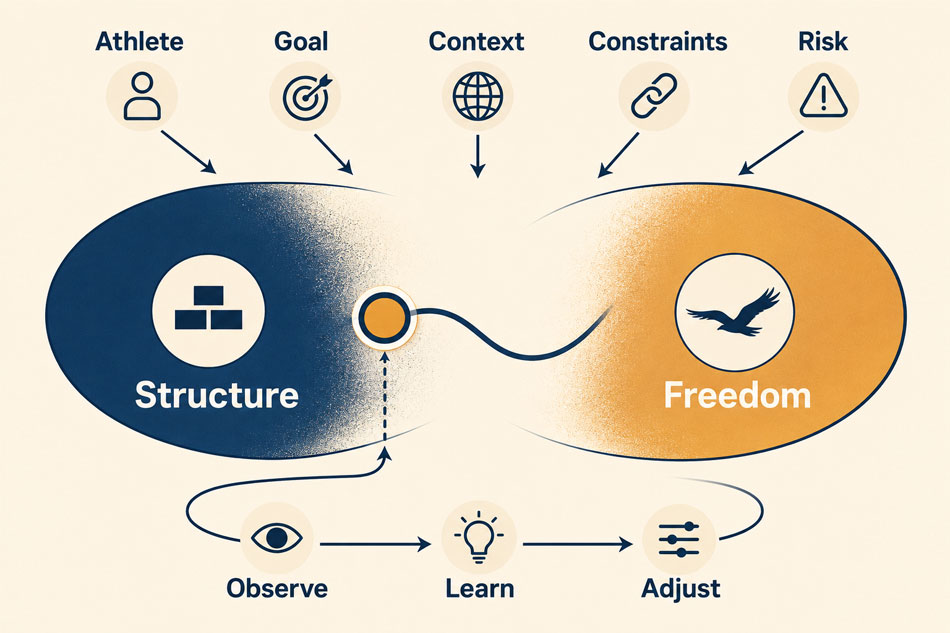
Figure 2: Complementary pairs are navigated rather than permanently solved.
Models are tools, not truths
The second pillar is pragmatic or integrative pluralism.
The large world is too complex for one model to explain everything we care about. We create partial models to describe, predict, explain, and intervene. A critical-velocity model can be useful. A force–velocity profile can be useful. A psychological framework, a tactical model, a movement screen, or a coach’s experienced eye can be useful.
Useful does not mean true in the final, eternal sense.
Scott Page’s The Model Thinker helped popularize many-model thinking (Page, 2018). Christian & Griffiths (2016) did something similar by translating algorithms into everyday decisions, and Algorithms to Live By became one of the books that influenced how I think about explore~exploit and practical strategy. Peter Bevelin’s Seeking Wisdom and the work associated with Charlie Munger make the same case from another direction: build a latticework of models rather than forcing every problem through one hammer (Bevelin, 2007).
The hammer problem is common in sport. Give a physiologist a performance issue and the explanation becomes physiological. Give the same issue to a motor-learning specialist and the explanation becomes skill. Give it to someone obsessed with fascia and, miraculously, fascia appears.
Funny how that works.
Pluralism asks us to use physiology, psychology, phenomenology, technology, statistics, skill acquisition, and coaching intuition as lenses. Some lenses are better supported than others. Some fit particular problems and fail badly elsewhere. The task is to integrate them pragmatically while preserving their boundaries.
This is not relativism. “Models are tools” does not mean every tool is equally good, every claim is merely a perspective, or any method can be justified after the fact. A spoon and a screwdriver are both tools. Try repairing a motorcycle with the spoon and report back.
Pragmatic pluralism means:
- No single model explains performance completely.
- Several partial perspectives may be needed.
- Each perspective has a domain of validity.
- Models should be judged by evidence, coherence, usefulness, and consequences.
- Feedback from the athlete and environment changes the weight given to each model.
The last point makes pluralism agile. We do not blend everything once and declare victory. We update through iteration.
The personal route into complementarity
A few books arrived at the right time for me.
Zen and the Art of Motorcycle Maintenance by Robert Pirsig gave me language for the tension between the classical and romantic modes of understanding (Pirsig, 2005). The classical mode dissects, categorizes, and explains. The romantic mode encounters immediate quality and lived experience. Both matter. The book is also a motorcycle story, which probably helped.
The Complementary Nature and The Squigle Sense by J. A. Scott Kelso and David Engstrøm helped me see opposing descriptions as potentially complementary rather than mutually destructive (Kelso & Engstrøm, 2006, 2024). I first encountered it while wrestling with determinism after reading Richard Dawkins’ The Selfish Gene (Dawkins, 1976). That deterministic frame pushed me toward a fairly pessimistic place. Complementarity opened another route.
Robert Anton Wilson’s Prometheus Rising and Jordan Peterson’s Maps of Meaning also shaped the broader picture (Wilson, 1983; Peterson, 1999). Whatever one thinks about Peterson’s later public role, the long-form lectures and the underlying treatment of myth, meaning, order, and chaos are more interesting than social-media clips of somebody “destroying” somebody else. Clips are usually intellectual junk food. Easy calories.
Neil Gaiman’s American Gods supplied another useful image (Gaiman, 2001). Human beings always believe in something that organizes attention and action. Even the rejection of religion can leave other gods behind: data, science, efficiency, optimization, progress, the market, the method, the coach’s system. We are not ideology-free simply because the ideology wears a lab coat.
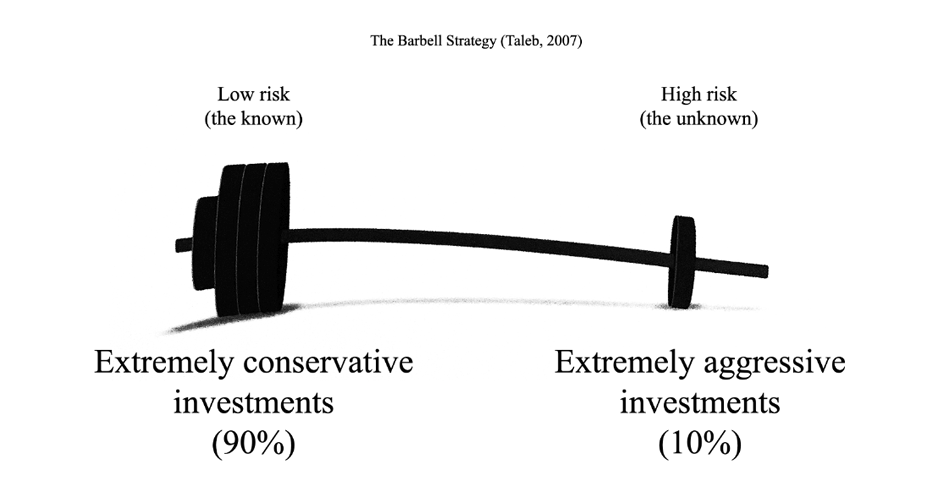
Nassim Taleb’s Antifragile and The Black Swan shifted my thinking about uncertainty, optionality, downside protection, and the limits of prediction (Taleb, 2010, 2012). Gerd Gigerenzer’s work offered a related but often more readable treatment of heuristics and decision-making under uncertainty (Gigerenzer & Gaissmaier, 2011; Gigerenzer, 2014). Mitchell (2012) gave the broader philosophy a name: integrative pluralism.
None of these books provides an Agile Periodization template. Together they changed the questions I asked.
That is what a good book usually does.
Philosophy as a filter in an age of abundance
Coaches now face an information problem that earlier generations did not face in the same form. Research papers, podcasts, social posts, exercise demonstrations, dashboards, newsletters, and confident opinions arrive faster than anyone can evaluate them. The difficulty is no longer finding information. The difficulty is distinguishing signal from noise without becoming trapped inside the first ideology that offers relief.
A philosophy acts as a filter.
It helps you ask whether a claim describes a robust phenomenon—a pattern that survives reasonable changes in how we examine it—or merely one model’s output. It makes you inspect the scale at which a theory operates. It reminds you that prediction, explanation, and intervention are different jobs. It asks whether an apparent opposition is actually a complementary pair. It forces you to separate what is from what you think ought to be done.
Most importantly, it makes your own position available for criticism.
A coach who says, “This is my current model, here are its assumptions, and here is what would change my mind,” is not weak. That coach is epistemologically honest. A coach who hides uncertainty behind certainty theatre is not strong. He is selling something, perhaps to himself.
Warning 1 names the practical danger.
Pluralism can become an excuse for indecision. “It depends” is sometimes the correct opening and a terrible ending.
Name what it depends on. Choose a provisional action. State the downside. Decide what feedback will make you continue, modify, or stop.
From philosophy to Agile Periodization
Agile Periodization sits downstream from the philosophy developed here. The later articles make four connected moves: inspect how we think; distinguish phenomena, theories, models, and maps; use complementary pairs to cross from description into intervention; and turn the resulting philosophy into an iterative planning and practice-design process.
First, they inspect the filters: how philosophy, theory, wisdom, and ideology shape what the coach notices before any model is selected.
Second, they examine representation: how phenomena, theories, models, measurements, and categories can reveal part of the athlete without becoming the athlete. This is the family of problems organized around map~territory.
Third, they examine action under uncertainty: how complementary perspectives, values, downside protection, exploration, and practical judgment allow us to intervene without pretending prediction is complete.
Fourth, they examine updating and practice design: how feedback changes both the plan and the beliefs that produced it. Iterative planning gives that stance an operating rhythm, while Problemming carries it into the tasks athletes actually perform.
The family resemblance is simple: the world is larger than the model, action cannot wait for final certainty, and feedback is information rather than an insult to the plan.
Four practical consequences of a philosophical position
This is not a programming manual. It is also not philosophy floating safely above the mess. Abstract terms earn their place when they change what we notice, question, or do. The following situations are not recipes. They show how different philosophical commitments can turn the same observation into different actions.
Identifying a limiting factor
A coach says an endurance athlete is limited by VO2max. Another says the limiter is the lactate threshold. A third points toward movement economy. All three may be using legitimate concepts, but the word limiter quietly does a lot of work.
Does a limiter mean the lowest percentile on a profile? The variable with the strongest association to performance? The component most likely to improve? The component whose improvement would transfer to competition? Those are different definitions. A low score is an observation relative to a reference group. It is not automatically a causal bottleneck.
The philosophy changes the intervention. If the athlete’s profile is treated as a machine with separable parts, the coach may target the weakest component. If performance is treated as an emergent interaction, the coach may ask whether the supposedly weak component is actually constraining performance in the task. If the model is treated as a useful map rather than the territory, the coach may test the hypothesis with a short intervention and watch what happens.
Same athlete. Different ontology, different action.
Interpreting a test
Suppose an athlete’s body mass, jump height, or bar velocity changes. The number looks objective, which can make the interpretation feel objective as well. It is not.
You still need to decide whether the change exceeds normal variation, whether the test was performed under comparable conditions, whether the score represents the construct you care about, and whether the construct matters for the next decision. A highly reliable measure can answer the wrong question with impressive consistency.
This is where coaches often jump from epistemology to prescription without noticing. We move from “the score is lower” to “the athlete is fatigued,” then from “the athlete is fatigued” to “reduce training.” Each arrow requires assumptions. Perhaps the athlete slept badly. Perhaps technique changed. Perhaps the score is noise. Perhaps the athlete is fatigued and should still train because the session is intended to expose the athlete to that exact state.
The number did not choose the action. You did.
Predicting injury
Injury discussions reveal philosophical commitments quickly. One camp searches for stable risk factors and thresholds. Another treats injury as an emergent event produced by interactions among tissue capacity, exposure, movement, fatigue, history, environment, and chance. A third emphasizes the limits of prediction and shifts toward preparation, robustness, and response planning.
These are not only scientific disagreements. They produce different coaching systems. A threshold model encourages screening and classification. A complex-systems model encourages monitoring interactions and avoiding excessive confidence. A radical-uncertainty model asks how to protect the downside when the exact event cannot be predicted.
We still need tissues, loads, and sensible progressions. Rejecting prediction does not mean rejecting preparation. It means being careful about the claim. “This may reduce a plausible risk” is different from “this predicts who will get injured.”
Words matter because expectations matter.
Coaching children
The nature~nurture tension becomes practical the moment we coach children. If talent is treated as a fixed biological possession, early selection can look rational. If development is treated as mostly trainable, the coach may invest broadly and delay specialization. If both sides are treated as complementary, the coach accepts individual differences without turning current performance into destiny.







Responses