
The Invisible Strength: A Practical Framework for Football

How I plan, dose, and measure what a squad actually needs
A practical framework built from ten-plus years on the pitch: from analytical strength to specific strength, from training methods to testing, from plyometrics to injury-prevention work. Not textbook theory, but the actual criteria I use to plan, dose, and decide with a squad.
Nicolás Rodríguez
The Strength You Never See on the Scoreboard
Football is intermittent, acyclical, chaotic, and adversarial. That single fact should shape everything about how we train strength. A player’s performance doesn’t depend on how much he can squat in a gym. It depends on how much usable force he can produce in very little time, over and over again, inside situations that never repeat themselves the same way twice.
Strength is the substrate everything else rests on: speed, acceleration, sprinting, change of direction, jumping, physical duels, joint stability, and injury resilience. Take strength away and every other quality becomes fragile, no matter how good a player looks in a highlight reel.
I call it the invisible strength because it almost never shows up as the headline. It shows up in what doesn’t happen: the player who doesn’t break down in March, who wins the duel in the 89th minute, who is simply still available when others in the squad aren’t. This article is not a list of exercises. It’s the framework I use to decide what kind of strength a squad needs, when in the season to train it, with which method, and how to measure whether it’s working.
Two Ways to Understand Strength
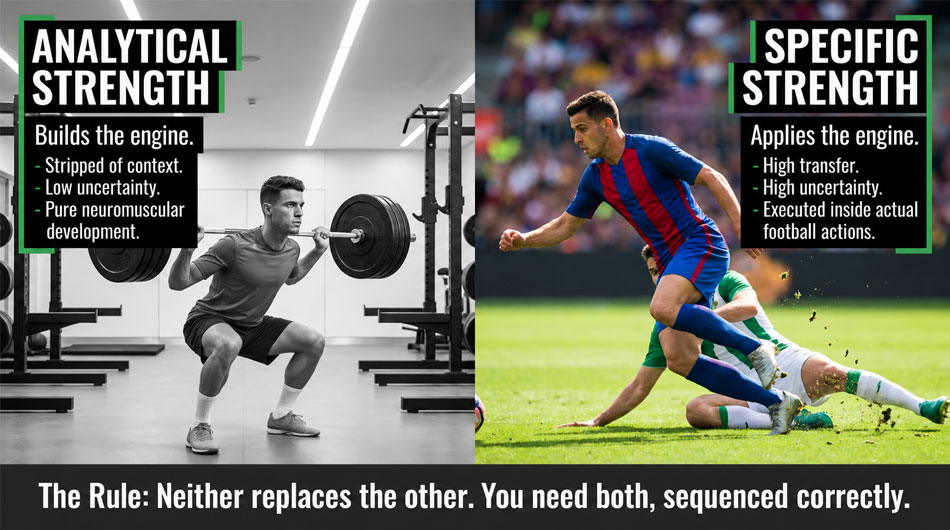
Before getting into methods, there’s a distinction that organizes everything else: analytical strength and specific strength are not the same thing, they aren’t trained the same way, and they play different roles in a program.
Analytical strength
This is strength developed in isolation, stripped out of the context of the game: squats, presses, sprints without opposition, vertical jumps with no decision-making involved. The goal is pure neuromuscular development, with low uncertainty and little to no connection to decision-making. It builds the engine.
Specific strength
This is strength expressed inside actual football actions such as duels, small-sided games and strength-oriented rondos, integrated with technical actions and real match situations, using the ball and the presence of opponents. It has high transfer because it carries the coordinative and decision-making load the game demands. It’s what teaches the engine to apply itself.
Neither replaces the other. A squad that only trains in the gym has an engine it doesn’t know how to use in a 1v1. A squad that only trains strength with the ball has application without a real ceiling of force behind it. You need both, sequenced correctly.
The Four Analytical Strength Qualities
Inside analytical strength I work with four distinct qualities. They are not interchangeable, and I don’t prioritize all four at once. I sequence them across the season.
Maximal strength (neural dominance)
This is the neuromuscular system’s capacity to produce the highest possible tension against a heavy resistance. In trained athletes, this quality is dominated by neural adaptations (recruitment of high-threshold motor units, better intermuscular synchronization, higher firing frequency, less unnecessary co-contraction) rather than by muscle size. In plain terms: better use of the muscle a player already has.
It rarely shows up in pure form during a match, but it conditions almost every high-demand explosive action on the pitch. It raises the ceiling for every other strength quality, improves a player’s ability to decelerate and absorb force, adds weight to physical duels, and is what allows power to be explosive. Without enough maximal strength underneath it, power output hits a low ceiling fast.
How and when I use it: high loads, low volume, no failure, mainly in preseason with targeted maintenance during the competitive season. It’s a foundational quality, not a visually impressive one. Nobody applauds it, but everything else collapses without it.
Structural strength (functional hypertrophy + submaximal strength)
This is the muscle–tendon–bone system’s capacity to absorb, transmit, and tolerate repeated mechanical loads. It isn’t a classic textbook strength category. It’s a practical synthesis widely used in modern football conditioning to describe musculotendinous adaptations and mechanical tolerance: greater functional cross-sectional area, improved tendon stiffness and resilience, higher tolerance to volume and intensity, and better joint stability under load.
This is the quality that lets a squad sustain the intensity of training and matches, reduces accumulated wear, and allows neural strength and power to be expressed without the player breaking down. A player without structural strength either gets injured, or unconsciously drops his training and match intensity to protect himself.
How and when I use it: medium-to-high loads, moderate volume, controlled tempos, mainly in preseason as the base, with targeted reinforcement blocks through the year. It’s the strength that lets you train hard without falling apart.
Power strength
The capacity to apply high levels of force in the shortest possible time. This is the manifestation closest to visible performance: force applied fast, not force applied heavy. It adapts neural activation speed, rate of force development (RFD), fast intermuscular coordination, and efficiency in using elastic energy.
This is the strength that accelerates, jumps, changes rhythm, and decides matches. It has the highest direct transfer to what shows up on the pitch. Without a prior base of structural and maximal strength, it simply doesn’t hold up over a season.
How and when I use it: medium-to-low loads, maximal execution velocity, low volume, minimal accumulated fatigue, from the end of preseason through the entire competitive calendar.
Strength-endurance
The capacity to sustain force output under fatigue, local or general. It doesn’t raise the performance ceiling. It extends how long a player can hold it: local neuromuscular endurance, the ability to repeat contractions, metabolic tolerance.
It lets players repeat force-based actions throughout the full 90 minutes, avoids sharp performance drop-offs late in matches, and helps the squad cope with congested fixture periods. It’s also the quality I’m most careful with, because too much work oriented here can interfere with neural and explosive adaptations.
How and when I use it: low-to-medium loads, high repetitions, high volume, always contextual, never the spine of the yearly program.
Putting the four together
| Quality | Dominant adaptation | Load (% 1RM) | Volume | When I prioritize it |
|---|---|---|---|---|
| Maximal (neural) | Neural | 85–100% | Very low | Preseason, after the structural base + in-season maintenance |
| Structural | Muscular / tendinous | 65–85% | Medium–high | Start of preseason (base) + targeted reinforcement |
| Power | Neuromuscular | 30–70% | Low | End of preseason through the full season |
| Strength-endurance | Muscular / metabolic | 30–60% | High | Occasional use only, never the yearly backbone |
What’s Actually Changing: Four Types of Adaptation
When I plan, I’m not only thinking about which strength quality I want to develop. I’m thinking about which type of adaptation I’m producing. There are four, and mixing them up is one of the most common mistakes in football conditioning.
Neural adaptation is learning to use the muscle a player already has more effectively (more recruitment, faster activation, better coordination) without changing muscle size. On the pitch, that looks like better acceleration or a cleaner deceleration without any added mass.
Muscular adaptation changes the tissue itself: it gets bigger, more resilient, and tolerates more load. It’s slower to build than neural adaptation, and on the pitch it shows up as more physical presence and support, not necessarily more speed.
Neuromuscular adaptation is using that muscle better inside the real movement: timing, coordination, force application. It integrates the neural and the muscular pieces and is the most sport-specific of the four: running, braking, and changing direction better, not just being stronger in a vacuum.
Metabolic adaptation is learning to produce and use energy more efficiently to sustain effort. It doesn’t make a player stronger or faster. It makes him more resistant to fatigue, so the muscle tires more slowly and tolerates repeated contractions for longer.
A short mnemonic ties this together: neural means switching the system on better; muscular means building more tissue; neuromuscular means applying it better; metabolic means holding on longer. In the explosive, decisive actions of modern football, the neuromuscular piece is usually the one that decides the outcome.
Specific Strength: Duels and Small-Sided Work
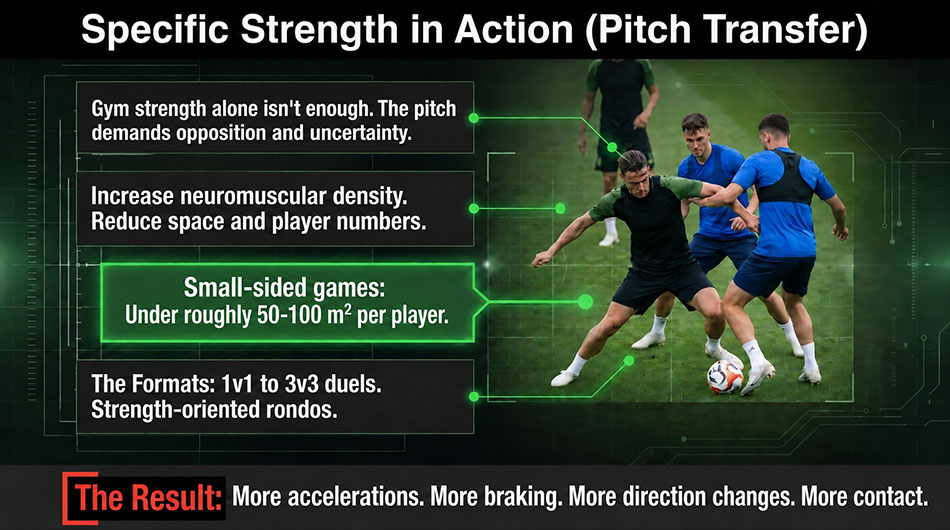
Strength in football isn’t built in the weight room alone. It can also be trained through specific tasks that reproduce accelerations, braking, changes of direction, physical contact, explosive movement, decision-making, opposition, and uncertainty, exactly the ingredients a gym session can’t reproduce. Small-sided games and duels let a coach integrate those neuromuscular demands inside a real game context. Stølen et al. (2005) describe football as requiring numerous explosive actions, including sprinting, turning, changing pace, and tackling.
The formats I use most: 1v1, 2v1, 2v2, and 3v3 duels, with or without goalkeepers; strength-oriented rondos, manipulating space, time, and player numbers; and small-sided games in spaces under roughly 50–100 m² per player. The principle behind all of them is simple: reducing space and player numbers increases the neuromuscular density of the exercise. Less space per player means more accelerations, more braking, more direction changes, more contact, in other words, more tension. It’s the bridge between the strength built in the gym and the strength the match demands.
Training Methods
These are the methods I reach for depending on which strength quality I need to prioritize in a given block. Each one has a specific job, and they aren’t interchangeable.
French Contrast
A neural potentiation sequence that chains a heavy strength action, a ballistic action, a reactive action, and a fast specific action. It’s demanding and low-volume, and it requires players who already have a real strength base. This is not a method for a squad still building its foundation.
Hernández-Preciado et al. (2018), in the Journal of Strength and Conditioning Research, found that countermovement jump height was 5.1%, 6.8%, and 8.5% above baseline after the first, second, and third sets of a single French Contrast session, while the control group’s jump height dropped slightly. That’s consistent with the post-activation potentiation (PAP) mechanism the method relies on.
A typical block runs: heavy strength at 85–90% 1RM for 1–2 reps, a ballistic movement at 30–40% for 2–3 reps, a short reactive plyometric for 3–5 contacts, and a fast specific action (acceleration or change of direction) over 10–20 meters. I run 2–3 blocks per session, with 15–30 seconds between exercises and 3–4 minutes between blocks. The demand is maximal intent and zero technical failure.
Cluster
Splits a set into mini-blocks with short intra-set pauses to preserve bar speed and neural quality. Format: 4–6 clusters of 1–2 reps with 15–30 seconds of rest between them, at 85–90% for neural work or 60–70% moved fast for power work. Two to four sets, with 2–3 minutes of rest between sets.
Complex Training
Pairs a strength exercise with a similarly-patterned explosive movement. Less aggressive than French Contrast and easier to sustain across a training block. Strength at 75–85% for 2–4 reps, paired with a bodyweight or 30–40% explosive movement for 3–5 reps, across 3–5 sets.
Isometrics
Force production without movement, with high neural activation and low metabolic fatigue cost, which makes it a useful tool during congested fixture periods. There are two variants I use: the ISO Hold, sustaining a position with or without external load for 10 to 60 seconds across 1–6 sets, and the ISO Push, driving against an immovable resistance for half a second to 10 seconds across 2–3 sets. Both need to be trained at the joint angles that matter for the sport action, not at whatever angle is convenient.
Maximal Strength Method
Very heavy loads to raise the neural ceiling, without needing to constantly re-test absolute 1RM. Load: 85–95%, 1–3 reps, 3–5 sets, 3–5 minutes of rest. This method demands technical perfection and zero failure. It’s not a method to run tired or with a large group unsupervised.
Submaximal Method
High but not maximal loads, aimed at building structural support and a neural base without the systemic stress of true maximal work. This is the method I lean on most with a full squad: 70–85% 1RM, 3–6 reps, 3–6 sets, 90–180 seconds rest, controlled velocity, no failure, RIR 1–3. It’s sustainable across a training block, works well for large groups, and combines cleanly with unilateral variations. It’s the method that builds a footballer’s body: structural strength as the dominant outcome, neural base as a secondary one.
Neuromuscular Intermittent Method
Short bursts of strength and power actions with incomplete rest, aimed at sustaining neuromuscular quality under controlled fatigue. Format: 10–20 seconds on, 20–40 seconds off, across 3–6 blocks and 1–2 sets, using bodyweight or light implements. This is the method I use specifically to develop strength-endurance.









Responses