
Physiological, Tactical and Methodological Applications of High-Intensity Interval Training in Soccer

Abstract
High-Intensity Interval Training (HIIT) represents a cornerstone of modern soccer preparation, combining scientific precision with tactical intent. Its application allows practitioners to improve aerobic and anaerobic performance, repeated sprint ability (RSA), and recovery efficiency—all of which are essential to the physical and tactical demands of the game. This paper explores the physiological foundations, testing protocols, programming strategies, and field experiences related to HIIT in soccer. The aim is to provide applied knowledge for coaches and performance specialists seeking to bridge science and practice.
Keywords: Soccer, HIIT, aerobic capacity, tactical periodization, performance, conditioning, repeated sprint ability.
1. Introduction
Modern soccer demands the integration of physical, technical, and cognitive components at intensities that have increased markedly over the past two decades. The introduction of tracking technology and data analytics (Barnes & Bradley, 2014) has revealed that elite players cover between 9 and 12 kilometers per match, performing high-intensity actions approximately every six seconds. These demands highlight the need for precise conditioning methods that reproduce the metabolic profile of the sport.
HIIT has emerged as one of the most efficient and adaptable conditioning methods for soccer. Through structured intervals alternating between effort and recovery, HIIT develops both aerobic efficiency and the ability to sustain repeated high-intensity actions (Buchheit & Laursen, 2013). In my own professional practice, the most successful programs have been those that integrate HIIT with tactical objectives—not as an isolated conditioning element but as a performance enhancer within the game model.
The following sections explore the physiological mechanisms, practical evaluations, and programming considerations that underpin effective HIIT design in soccer contexts, emphasizing individualization, progression, and integration.
2. Physiological Demands of Soccer
Soccer performance depends on the ability to perform explosive actions repeatedly, with incomplete recovery. Approximately 70–80% of total energy expenditure during a match is supplied by aerobic metabolism, which sustains overall intensity and facilitates recovery between sprints, accelerations, and duels (Bangsbo et al., 2006).
| Variable | Typical Range | Physiological Insight |
|---|---|---|
| Match duration | 90–95 min | Continuous metabolic stress with partial recoveries |
| Total distance | 9–12 km | Position-dependent, central to endurance capacity |
| High-speed distance | 800–1200 m | Correlates with team intensity and tactical style |
| HR average | 80–90% HRmax | Reflects sustained submaximal effort |
| VO₂max | 55–70 ml·kg⁻¹·min⁻¹ | Predictor of recovery and intensity tolerance |
| Explosive actions | 150–250 | Repeated anaerobic efforts requiring rapid recovery |
The aerobic system provides the foundation for sustaining high intensity and delaying fatigue. It accelerates phosphocreatine resynthesis, lactate clearance, and neuromuscular recovery. Meanwhile, the anaerobic system determines peak intensity and short-term explosiveness. A well-structured HIIT program should stimulate both systems, optimizing efficiency rather than maximizing fatigue.
3. Energy Systems and Physiological Adaptations
Soccer is a sport of complex energetic interaction. Each phase of play activates a combination of systems:
| Energy System | Duration | Example in Play | Training Objective |
|---|---|---|---|
| ATP-PC (Alactic) | <10 s | Sprint, jump, short press | Max power development |
| Glycolytic (Lactic) | 10–45 s | Sustained pressing, dribble under pressure | Lactate tolerance |
| Aerobic (Oxidative) | >45 s | Constant repositioning, recovery | Recovery and endurance |
Adaptations achieved through HIIT:
- Increased maximal oxygen uptake (VO₂max) and velocity at VO₂max (vVO₂max).
- Faster phosphocreatine resynthesis during recovery intervals.
- Enhanced mitochondrial density and oxidative enzyme activity.
- Improved buffering capacity and tolerance to acidosis.
- Better autonomic balance and heart rate recovery post-exercise (Dupont et al., 2004).
The goal is not only to improve VO₂max but also to elevate the player’s ability to express high-intensity work repeatedly, a determinant of performance in elite soccer (Iaia et al., 2009).
4. Performance Evaluation: Individualization Tools
4.1 The 30-15 Intermittent Fitness Test (IFT)
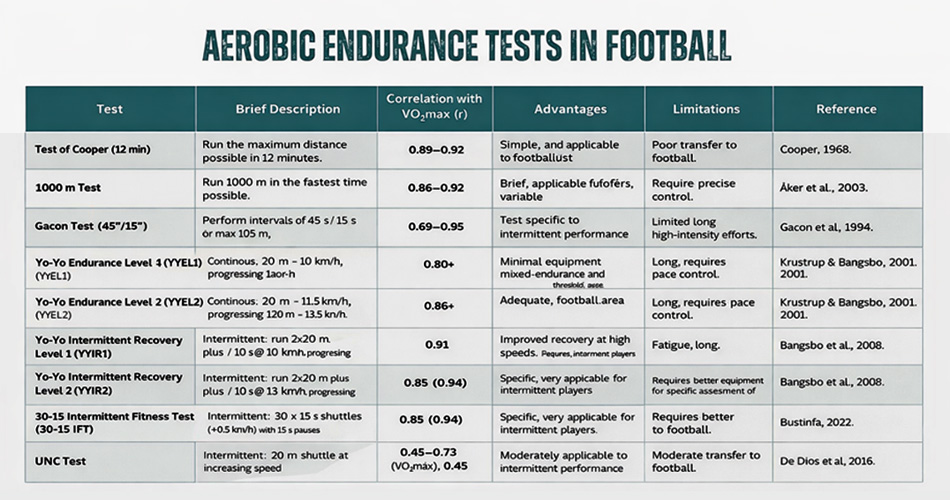
Developed by Buchheit (2008), the 30-15 IFT is a reliable method for evaluating intermittent aerobic power. Players run 40 m shuttles for 30 seconds, followed by 15 seconds of active recovery. The speed increases by 0.5 km·h⁻¹ each stage until exhaustion.
Output: the final velocity (VIFT), which reflects both aerobic capacity and change-of-direction efficiency.
| Zone | %VIFT | Physiological Target | Training Focus |
|---|---|---|---|
| 80–90% | Extensive aerobic | Base endurance | Continuous 15/15 runs or extensive SSG with low tactical stress |
| 90–100% | Intensive aerobic | VO₂max improvement | 15/15 or 30/30 intervals, medium-sided games (4v4, 5v5) |
| 100–110% | Mixed zone | Tolerance to repeated efforts | 10/20 intervals, pressing transition games (3v3, 4v4) |
| >110% | Anaerobic | RSA and explosive performance | Sprint-based HIIT, repeated sprint training, short SSG with transitions |
Players with higher VIFT values typically show better recovery between repeated sprints and maintain technical performance longer during matches (Buchheit, 2010). In applied settings, this test has allowed me to calibrate HIIT prescriptions precisely, ensuring equitable training load distribution across heterogeneous squads.
4.2 Yo-Yo Intermittent Recovery Test
The Yo-Yo IR test, designed by Bangsbo et al. (2008), evaluates the player’s ability to repeatedly perform intense efforts interspersed with brief recoveries. The test correlates strongly with total distance and high-speed distance covered during matches.
Protocol: 20 m shuttle runs at progressively increasing speeds with 10 s of active recovery. The test ends when the athlete fails twice to reach the marker on time.
It provides a practical index of aerobic recovery ability under fatigue, making it ideal for monitoring fitness status throughout the season.
Application Insight (Field Experience)
In professional environments, I combine both tests: the 30-15 IFT for precise velocity-based prescription and the Yo-Yo IR for monitoring adaptation. For example, during pre-season testing of a second-division team, the average VIFT improved from 19.5 to 20.6 km·h⁻¹ after a four-week HIIT program, paralleled by a 9% improvement in Yo-Yo IR2 performance — indicating enhanced aerobic efficiency without overtraining indicators.
5. Programming and Periodization of HIIT in Soccer
Effective HIIT programming requires balancing intensity, density, and specificity according to the competition phase, individual fitness, and tactical model. The key is to apply principles of progression, variation, and recovery control.
5.1 Structure and Phases
| Period | Goal | HIIT Type | Weekly Frequency | Example |
|---|---|---|---|---|
| Pre-season | Aerobic foundation & tolerance to load | Extensive (4×4’, 3’ rec) + 15/15 intervals | 3 sessions | 2 physical + 1 integrated |
| Early season | Aerobic-anaerobic balance | Mixed intervals (30/30, 20/10) | 2 sessions | 1 with ball + 1 pure |
| In-season | Maintenance & tactical synchronization | Integrated HIIT (small-sided games) | 1–2 sessions | SSG formats 4v4, 6v6 |
| Congested periods | Recovery emphasis | Reduced density (lower total time) | 1 session | Aerobic recovery circuits |
Progression principle: Increase either total duration, intensity (%VIFT), or complexity (ball use, tactical rules), but never all simultaneously.
5.2 Microcycle Example (In-Season)
| Day | Focus | Type | Duration | Load |
|---|---|---|---|---|
| Monday | Recovery + light technical | Aerobic regen | 30–40 min | Low |
| Tuesday | HIIT physical (15/15 @100% VIFT) | Extensive | 40 min | High |
| Wednesday | Tactical training | Team model | 70–90 min | Medium |
| Thursday | RSA + small-sided | Sprint-based HIIT | 50 min | High |
| Friday | Tactical rehearsal | Specific drills | 60 min | Low |
| Saturday | Match | Competition | 90+ min | Max |
| Sunday | Recovery | Active | 30 min | Low |
6. Tactical Integration and Small-Sided Games
6.1 Linking HIIT with Tactical Periodization
In high-performance football, isolated conditioning must be replaced by integrated conditioning. When physical load is aligned with tactical objectives, players perceive greater meaning in training and transfer gains to match play more effectively (Owen et al., 2012).
Example:
- 4v4 with scoring transitions (30’’ work / 15’’ rest) → improves VO₂max, tactical compactness, and pressing coordination.
- 6v6 on 40x40m with constraint “5 passes before goal” (45’’/15’’) → simulates controlled high-intensity phases.
| Format | Players | Duration | Objective |
|---|---|---|---|
| 3v3 + GK | 30x20m | 6×1’/30’’ | Acceleration, repeated sprints |
| 4v4 | 25x25m | 4×4’/2’ | Aerobic-anaerobic balance |
| 6v6 | 40x40m | 5×3’/1’ | Tactical endurance |
| 8v8 | 60x50m | 3×6’/2’ | Team compactness & recovery under load |
The combination of tactical load (decision-making, positioning) and physical load (intensity, recovery ratio) defines the real effectiveness of HIIT within a football environment.








Responses