
The Specificity Conundrum and the Intervention Pyramid Part 2 – From Pyramid to Practice

This article continues Part I: Why “Functional” Training Never Really Solved It.
Part I reframed specificity from resemblance to relevance. The Intervention Pyramid located the reason for intervening: begin with human-specific and sport-specific priors, then earn athlete-specific and event-specific updates. The Intervention Barbell protected the broad base while bounding narrower bets. Substance~Form explained why we sometimes reduce complexity to load a resource and reintegrate it where expression matters.
That untangled the exercise-classification problem. It did not answer the more dangerous question:
When is physical preparation supporting sport—and when is it pretending to be sport?
This is where specificity debates usually slide from confusion into cosplay. A coach observes a sporting problem, translates it immediately into a capacity, and then builds a gym exercise that resembles the action. The movement looks specific, but the original problem may have involved perception, timing, positioning, tactics, or an opponent who refuses to cooperate with our periodization plan.
NoteThe two-part argument
Part I builds the decision architecture.
Part II applies it across sports, separates capacity problems from skill problems, clarifies local tissue work, and turns the framework into a seven-step intervention audit.
One model should produce different answers
The human layer does not erase sporting differences. It gives us a common starting platform from which those differences can make sense.
Table 1 offers examples rather than programs. The same four questions produce different answers without requiring a separate physiology for every sport.
| Sport | Human base | Sport support or protection | Athlete-level question | Event overlay |
|---|---|---|---|---|
| Soccer | Broad strength, running options, jumping, aerobic support | Prepare for acceleration, high-speed running, braking, contact, and capacities that practice underprovides | Does this player repeatedly miss speed exposure, need a local loading target, or accumulate excessive match load? | Surface, climate, travel, congestion, opponent, temporary role |
| Basketball | Strength, jumping and landing options, locomotor variety, aerobic support | Tolerate repeated jumping, braking, contact, and dense schedules without adding more court chaos | Is the athlete constrained by force, exposure history, recurring symptoms, role, or minutes? | Tournament density, travel, venue, opponent, expected rotation |
| Handball | Broad strength and power, throwing capacity, movement variability | Support repeated throws, jumps, contacts, and direction changes; load neglected tissues directly | Does the athlete need more local shoulder capacity, lower-body work, or a different dose around throwing volume? | Opponent system, match sequence, surface, travel, role |
| Sailing | General strength, aerobic base, locomotor variety, carrying and pulling | Prepare for prolonged postures, repeated force against the boat, environmental exposure, and movement the sport neglects | Which positions, tasks, or tolerance limits are specific to this sailor and boat class? | Wind, temperature, race duration, location, equipment, travel |
| MMA | Strength, power, aerobic support, basic locomotor options | Build what sparring and technical practice cannot safely or reliably dose; avoid counterfeit fight circuits | Which capacity repeatedly constrains training or the athlete’s preferred game? | Opponent style, round format, travel, altitude, climate |
| American football | Broad strength, speed options, jumping, throwing or catching support, aerobic recovery | Prepare for collisions, accelerations, high-force actions, positional demands, and large practice costs | What differs by position, play count, exposure, training age, and individual response? | Opponent, surface, weather, travel, game plan, temporary role |
Table 1 — One decision model, different answers. The Intervention Pyramid organizes context; it does not flatten it.
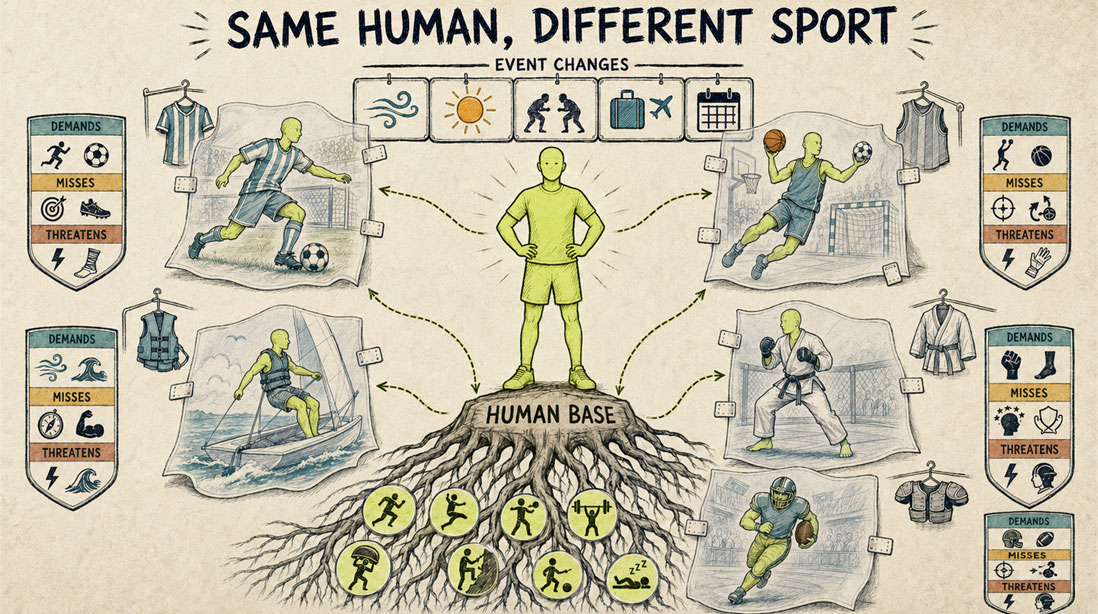
Figure 1 — Sports change the demands, threats, roles, and event conditions. The underlying human does not disappear.
The point of Figure 1 is not that a soccer player and a sailor should train identically. Their differences should emerge from a chain of reasoning, not from our urge to make every exercise wear the sport’s jersey.
This is one of the main ways the Intervention Pyramid resolves the old conundrum. It preserves a common human platform without prescribing one universal program. It respects sporting differences without inventing a new universe for every sport.
Closed and open sports change the balance
The balance between Substance and Form changes across sports.
In a relatively closed sport such as powerlifting, the gym task may be the sporting Form itself. Technique, strength expression, competition rules, and physical preparation converge around a small set of lifts.
In an open sport such as soccer, handball, basketball, or MMA, the athlete must continually perceive, decide, coordinate, and adapt to other people. The sporting Form cannot be reduced to a list of physical outputs.
This produces a practical rule:
The more open and interactive the sport, the less physical preparation should pretend to reproduce the whole thing.
Let sport practice own the representative problems. Let physical preparation support the capacities, exposures, and protection jobs that make those problems more solvable.
The gym is allowed to isolate. Sport practice must eventually organize the available resources inside the information, timing, opposition, and consequences of the sport.
Skill needs a related—but different—pyramid
Physical preparation begins with the human layer because the body is the shared platform.
For the present model, sport-skill preparation begins one level higher. Its broadest useful layer is the sport itself:
- Sport
- Position or role
- Athlete
- Event
This does not deny broad human capacities for learning and coordination. It keeps the classification tied to its job. Once we ask about sport skill, the sport’s rules, information, intentions, and recurring problems provide the first useful boundary.
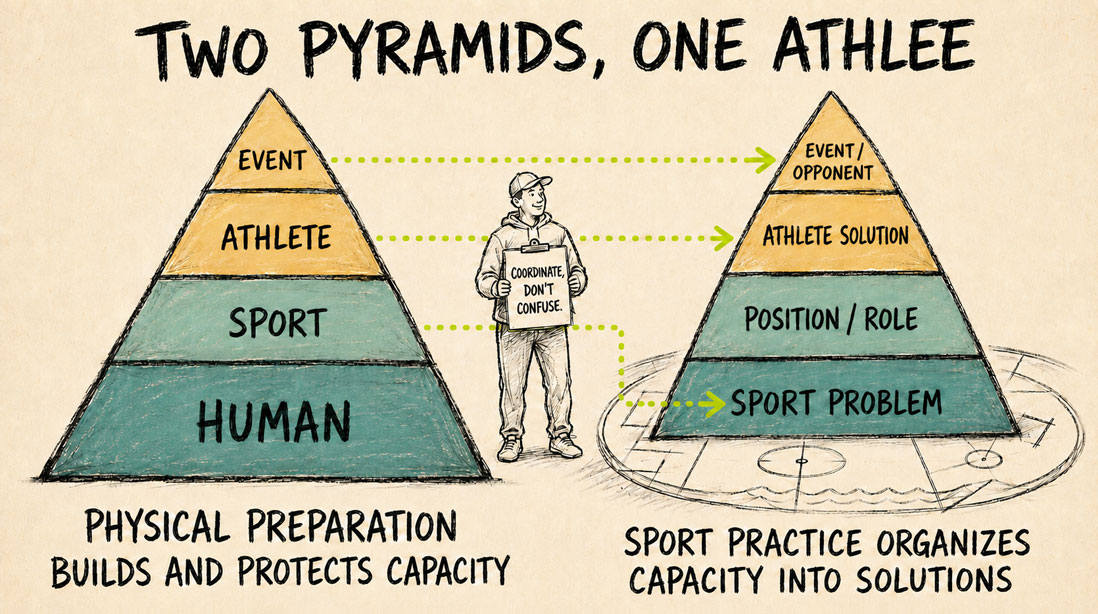
Figure 2 — Physical preparation and skill preparation narrow differently. They should coordinate without pretending to be the same practice.
Figure 2 and Table 2 show where the two hierarchies align and where they differ.
| Level | Physical-preparation question | Skill-preparation question |
|---|---|---|
| Broad base | What should remain available to the human? | What are the sport’s central problems, rules, information, and action possibilities? |
| Sport or role | What does the sport demand, underprovide, and repeatedly threaten physically? | Which problems recur for this position or role? |
| Athlete | Which capacity, tolerance, history, or response is specific to this athlete? | How does this athlete perceive, learn, and solve the problem? |
| Event | What physical preparation changes because of the coming competition? | What changes because of this opponent, venue, tactical plan, score state, or format? |
Table 2 — Physical and skill preparation coordinate around the athlete, but they do different jobs.
Sport and role define the recurring skill problems
Sport-specific skill begins with the representative problems of the sport:
- What information is available?
- What is the athlete trying to achieve?
- What does the opponent permit or remove?
- Which rules shape the possible solutions?
- What timing, spacing, and coordination make an action successful?
This is why a generic agility drill is not automatically soccer skill, and a choreographed pad sequence is not automatically fighting skill. The movement may look right while the problem is absent.
Positions and roles narrow that problem set. A goalkeeper, central defender, winger, pivot, point guard, offensive lineman, and helmsman receive different information and solve different recurring problems. Role-specific practice should emphasize those problems without freezing the athlete into one ideal solution.
The athlete and event narrow the skill problem
Athletes bring different histories, bodies, attentional habits, preferences, fears, strengths, and solution tendencies.
The coach’s job is not to impose a museum-quality “correct movement” regardless of context. It is to help the athlete discover more effective and adaptable solutions within the sport’s constraints.
Instruction remains useful, but it should be dosed like medicine. Too little can leave the athlete lost. Too much can make the athlete dependent on the coach’s narration.
Athlete-level skill work therefore asks:
- What problem is this athlete failing to solve?
- What information are they missing or misusing?
- Which solution do they over-rely on?
- Which useful options are absent?
- What task change could invite exploration without prescribing the answer?
The event layer narrows preparation to the next opponent, venue, format, tactical plan, or likely competition state. A defender explores an attacker’s tendencies. A fighter prepares for an opponent who pressures from a particular stance. A sailor develops decision rules for an expected wind pattern. A basketball team rehearses late-game problems against a particular defensive coverage.
These are right-side bets. They can create an advantage, but they can also overfit. The opponent may behave differently. The weather may change. The planned game state may never appear.
Event-level skill practice should expand readiness, not hypnotize the athlete into waiting for one predicted script.
Do not make physical preparation cosplay as skill
The two pyramids should talk to each other, but they should not merge into beige soup.
Sport practice is usually the big rock. It contains the information, timing, opposition, consequence, and tactical problems that define the sport. Physical preparation supports that practice. It changes what the athlete can tolerate, repeat, express, and potentially learn, but it cannot substitute for solving the sport’s problems.
Physical preparation often leans toward Substance: strength, tissue capacity, range of motion, energy resources, and tolerance. Sport practice must eventually organize those resources into Form: perception, timing, coordination, decisions, and useful solutions.
The border is not perfectly clean. Sport practice also loads the body, while physical preparation changes the athlete’s available actions. Interaction does not mean identity.
This distinction matters most in open sports, where the problem is alive.
If an MMA athlete cannot maintain position against a skilled opponent, the limitation may involve strength. It may also involve leverage, timing, perception, technical understanding, tactical choice, or an unpleasant mixture of all of them. Adding battle ropes because the athlete looked tired is not analysis.
If a soccer player arrives late during defensive transitions, the problem may be speed. It may also be starting position, anticipation, attention, team spacing, or a tactical instruction that creates an impossible recovery run. Improving sprint time does not automatically repair a bad starting position.
Before selecting the method, classify the dominant problem. Table 3 provides a compact diagnostic.
| Dominant problem | What is breaking down? | Main intervention | Role of physical preparation | Useful update signal |
|---|---|---|---|---|
| Capacity or dose | The athlete lacks, cannot tolerate, or has not recently received a required exposure | Develop, maintain, or carefully reintroduce the relevant capacity | Primary | Response to the dose and change in the target capacity or tolerance |
| Information or skill | The athlete fails to perceive, decide, time, coordinate, or solve the sport problem | Representative practice, instruction, task design, or tactical change | Supporting | Change in behaviour while the real problem is present |
| Mixed | A physical resource and the athlete’s solution interact | Coordinate physical work with skill practice | Shared but distinct | Improvement in both the resource and the live sporting behaviour |
Table 3 — Classify the dominant problem before choosing the method.
Start with the problem; regulate it with dose
Problemming is my deliberately awkward term for beginning with the problem the athlete must solve rather than with the exercise, method, capacity, or dose we happen to enjoy prescribing.
Problem-led planning asks:
What is breaking down, under which constraints, and what kind of change would count as improvement?
Much traditional planning has been dose-led. We name a capacity—strength, speed, aerobic power, tissue tolerance—and organize the exercises, volume, intensity, frequency, and progression needed to develop it.
There is nothing inherently wrong with this. Capacities require exposure, and exposure must be regulated. The error occurs when the capacity becomes the planning unit while the performance problem becomes an afterthought.
Table 4 compares the two perspectives.
| Question | Dose-led perspective | Problem-led perspective |
|---|---|---|
| Starting point | Which capacity or adaptation should change? | Which performance problem must the athlete solve? |
| Planning unit | Exercise, workload, exposure, and progression | Problem, behaviour, task, and constraints |
| Physical-preparation role | Build or protect the required resources | Identify which physical resource limits solvability and give it a clear job |
| Skill-practice role | Regulate repetitions, duration, density, pressure, and recovery | Design a task in which the relevant problem can emerge |
| Main strength | Control, progression, and load management | Direction, relevance, and representative task design |
| Failure when isolated | A beautiful workload attached to the wrong problem | A clever task with an inadequate, unsafe, or inconsistent dose |
Table 4 — Dose-led and problem-led perspectives answer complementary questions.
The problem should come first because dose cannot tell us what deserves to be dosed. Once direction is clear, dose becomes essential. A representative task can still be dosed stupidly. A perfectly controlled workload can still solve nothing that matters.
From the skill side, defining the problem is only the first move. The coach must also choose the kind of practice that makes the problem available.
Sometimes a drill is useful because the athlete needs to stabilize a known solution, reduce complexity, receive clearer feedback, or regain confidence. At other times, the task should preserve enough opposition, information, timing, and consequence for the problem to emerge.
This is not another drills bad, games good argument. A drill may be the smallest adequate tool. It should earn its place by serving the problem rather than becoming a ritual we defend because it looks tidy.
Representative practice does not mean adding random “chaos,” shouting colours, or putting the athlete on unstable equipment. It means making the relevant problem difficult to avoid while leaving room for a useful solution to emerge.
Physical preparation follows the same problem-first logic without pretending to be skill practice. If the meaningful bottleneck is tissue tolerance, high-speed exposure, maximal strength, or aerobic capacity, isolate it and load it. The exercise does not need to look like the sport.
A knee extension with a clear job is more relevant than a circus exercise wearing a soccer costume.
Physical preparation is allowed to be physical preparation.
The problem sets direction.
The task makes the problem available.
Dose regulates the exposure.
Feedback updates the plan.
That prevents a lot of nonsense.
Local does not mean individualized
The leg-extension machine exposes a useful gap in the model—or, more accurately, a gap in how we may be tempted to use it.
Where does direct tissue work belong in the Intervention Pyramid?
The clean answer is: nowhere permanently.
The Pyramid classifies why we are intervening. A leg extension describes where and how directly we deliver the load. Those are different questions.
A leg extension tells us where the stimulus goes. It does not tell us why the exercise belongs in the program.
Part I introduced Substance~Form to separate these dimensions. Direct tissue work sits toward the Substance end of that continuum because it reduces the number of interacting components and lets us load a local target with less technical noise. That anatomical narrowness does not automatically make the exercise sport-specific, athlete-specific, or important.
Keep three decisions separate:
- Intervention layer—why? Human-specific, sport-specific, athlete-specific, or event-specific.
- Intervention resolution—how directly? Integrated sporting Form, a regional pattern, or local tissue/Substance.
- Priority and dose—how much? A primary intervention, an accessory, or a temporary microdose.
The same leg extension can therefore move across the Pyramid without changing its appearance.
| Rationale for the same exercise | Dominant layer | What makes it belong there? |
|---|---|---|
| Use a simple, controllable exercise to preserve broad knee-extensor capacity inside a general physical program | Human-specific prior | The rationale applies broadly; the exercise is one possible accessory, not a compulsory human movement |
| Add controllable local loading because the sport schedule supplies abundant global work but does not reliably provide that dose | Sport-specific prior | The justification comes from a recurring demand, miss, or threat shared within the sport |
| Address this athlete’s observed quadriceps deficit, history, symptoms, tolerance, or response to previous training | Athlete-specific update | Individual information changes the decision |
| Maintain a useful stimulus during a congested week, travel period, or temporary constraint that makes a higher-cost option unattractive | Event-specific overlay | A short-lived condition changes the form or dose, and the change should disappear when the condition does |
Table 5 — The exercise does not own a layer. The rationale locates it; intervention resolution describes how directly it delivers the stimulus.
In Part I, the field-sport example placed the knee extension at the athlete-specific layer because the stated reason was a clear local loading target in that athlete. Change the reason and the classification moves. Local does not automatically mean individualized.
Consider an athlete returning after ACL reconstruction. If repeated assessment and training response suggest that direct quadriceps loading deserves attention, the rationale is athlete-specific. A knee extension, an isometric task, or another suitable option may then provide the dose. The athlete’s history and response locate the intervention; the machine merely delivers it. The exact exercise and dose still require appropriate clinical and coaching judgment.
Now imagine that the entire squad performs a modest dose of knee extensions because the staff wants a cheap, controllable knee-extensor exposure that fits the group session. That may sit at the human- or sport-specific layer. It can still be a small rock.
This is the conundrum resolved:
- anatomically specific does not mean sport-specific;
- local does not mean athlete-specific;
- isolated does not mean non-functional;
- important does not mean large dose.
Direct tissue work is not a fifth layer. It is one resolution option that can serve any layer when the job and cost justify it.
How to use the model on Monday
A conceptual model earns its keep only when it changes a decision.
The seven-step audit in Table 6 connects the Intervention Pyramid, Intervention Barbell, Substance~Form, and feedback loop.
| Step | Question | Output |
|---|---|---|
| 1. State the problem | What is happening, without naming the preferred exercise? | An observable problem statement |
| 2. Locate it | Is the issue mainly human, sport, athlete, event, or a combination? | The relevant pyramid layer or layers |
| 3. Choose the route and effect | Should we add or develop something, protect something, or remove avoidable downside? | A testable intention and Via positiva / Via negativa route |
| 4. Choose the resolution and tool | How directly should we load or practise the target, and what is the simplest adequate intervention? | Exercise, task, dose, or subtraction |
| 5. Inspect total cost | What does it cost in fatigue, time, attention, recovery, equipment, and group flow? | A realistic place in the week |
| 6. Protect the base and bound the bet | What downside must be controlled before exposing the plan to a narrow hypothesis? | A safer and smaller probe |
| 7. Act and update | What response will make us retain, remove, or modify the intervention? | An explicit feedback rule |
Table 6 — A seven-step intervention audit for day-to-day coaching.
1. State the problem without naming an exercise
Bad:
We need more Nordic hamstring curls.
Better:
This player has had little recent exposure to high-speed running and direct knee-flexor loading while match demands are about to increase.
The exercise may still be a Nordic curl. But now it has a job, and other options can compete for that job.
2. Locate the problem
Is this a broad capability issue? A recurring sport demand, miss, or threat? A meaningful athlete-level bottleneck? A temporary event constraint?
If the problem sits at several layers, say so. A model should clarify complexity, not erase it.
3. Choose the route and intended effect
Are we trying to develop or supplement something useful through Via positiva? Are we trying to protect a resource, maintain it, or remove avoidable downside through Via negativa? Are we trying to practise a skill, restore a tolerated exposure, or learn how the athlete responds?
The same intervention may produce several effects, including effects we did not invite. Naming the intended effect does not control reality. It makes the bet inspectable.
4. Choose the resolution and simplest adequate tool
This means the simplest tool that preserves what matters for the job.
If the goal is direct local loading, move toward Substance and isolate. If the goal is coordinated expression, move toward Form and integrate. If the goal is sport problem-solving, design a representative task. If the goal is exposure, control the dose. If the goal is learning, preserve information and allow useful exploration.
Do not let intervention resolution choose the Pyramid layer for you. A local exercise can serve any layer. An integrated task can still be a poor solution to the stated problem.
Do not add complexity to signal intelligence.
5. Inspect the total cost
Every intervention occupies time, attention, recovery capacity, equipment, coaching bandwidth, and athlete trust.
A theoretically excellent exercise that cannot fit the week is not excellent. A sophisticated monitoring system that nobody uses is décor. A highly individualized session that destroys group flow may solve one problem while creating five others.
The program lives in a room, inside a schedule, among other people.
6. Protect the base and bound the bet
Before adding a right-side bet, ask what broad capability must remain, which recurring sport cost must still be covered, what can go seriously wrong if the hypothesis is wrong, and whether a smaller probe can reduce the downside.
This is the Intervention Barbell in practice.
7. Act, observe, and update
A plan is a working guess. A task tests that guess. A prescription puts something at stake.
Act, observe the response, and update. Do not keep a failing intervention alive because it looked impressive in the original presentation.
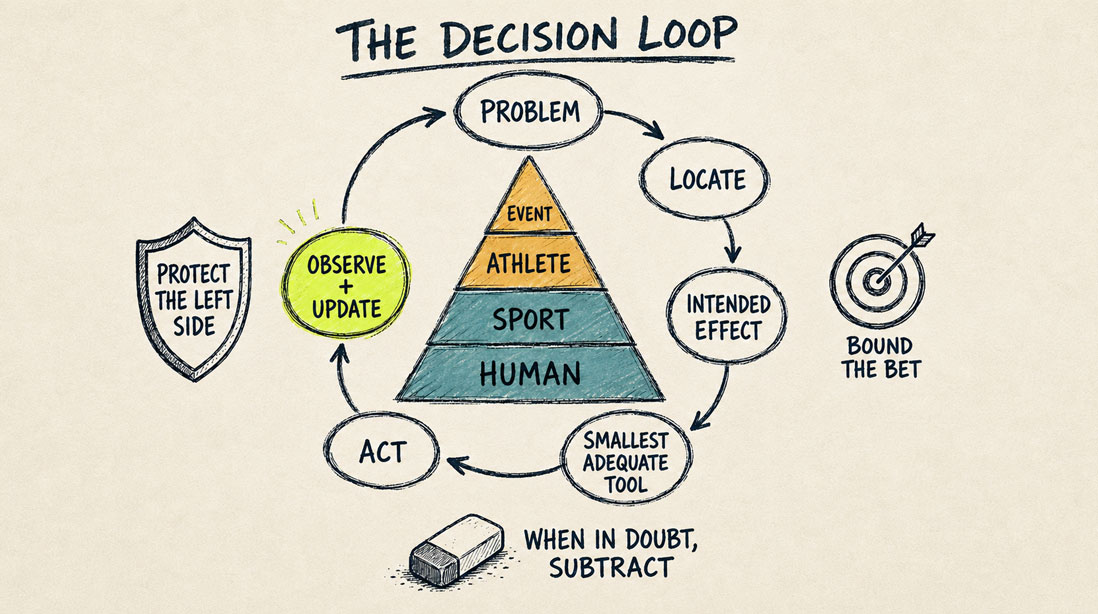
Figure 3 — The Intervention Pyramid supplies a prior; feedback updates it. Programming remains a loop rather than a declaration.
Figure 3 is deliberately circular. The pyramid is a top-down viewpoint, not a replacement for bottom-up information.
Without a top-down model, each new measurement can pull the program in a different direction. Without bottom-up feedback, the model becomes doctrine. We need both: a stable prior and a willingness to update.
Worked example: the same player, four layers
Imagine a starting fullback in professional soccer.
The team has two matches most weeks for the next month. The player has accumulated many minutes, has had little maximal-speed exposure in recent training, and reports that gym sessions leave heavy residual fatigue. The next away match is on an unfamiliar surface in unusually hot conditions. The opposing winger is fast and stays high.
Table 7 shows how one situation changes as we move through the four layers.
| Layer | What we know | Intervention implication | What should update the decision? |
|---|---|---|---|
| Human | The player still needs usable strength, aerobic support, exposure to speed, movement options, and direct loading for tissues practice does not address cleanly | Keep a small, economical portfolio; this is not the month to demonstrate every movement pattern known to social media | Loss of a base quality, inability to recover, or excessive residual cost |
| Sport | Soccer already supplies abundant running, braking, technical work, and match fatigue, but controlled maximal-speed exposure may be missing | Cover the missed exposure and manage recurring costs instead of adding more soccer-shaped fatigue | Actual practice and match exposure, schedule change, response to speed work |
| Athlete | Minutes, recent speed exposure, response to gym fatigue, and role differ from the team average | Consider lower-volume strength, direct local work, and carefully placed speed exposure; treat this as a hypothesis | Residual fatigue, quality of training, tolerance, and repeated response |
| Event | Heat, travel, unfamiliar surface, and a fast high-positioned opponent are temporary constraints | Address environmental readiness and recovery logistics physically; address positioning, cover, and communication through skill and tactics | Updated forecast, travel plan, opponent behaviour, and post-event review |
Table 7 — One player viewed through the four layers of the Intervention Pyramid.
Another fullback on the same team may need something else. Not because individualization is sacred, but because the evidence differs.
Notice where the physical-preparation model stops. The opposing winger creates a physical demand, but the answer is not automatically more conditioning. Starting position, cover, communication, and anticipation belong to skill and tactics.
The event overlay is real. It is also temporary.
After the match, the opponent disappears. The human remains.
Keep the claims smaller than the pyramid
Any model becomes dangerous when its slogans travel faster than its distinctions. The Intervention Pyramid does not make the following claims.
It does not create four separate programs
The layers overlap. A sprint exposure can support broad human capability, satisfy a sport demand, and address an athlete-level gap at the same time. A leg extension can serve a human or sport prior while also addressing an athlete-level reason.
The question is not which box owns the exercise. The question is which reasoning justifies it, which job dominates now, and what evidence should update the decision.
It protects neither equipment tribes nor certainty theatre
If isolation lets us overload a useful Substance at manageable cost, use it. If a machine is the best tool, use it. If a complex free-weight exercise is the best tool, use that. The Pyramid has no interest in protecting equipment tribes.
Nor does sport-level protection mean we can calculate the future and remove uncertainty. We can identify recurring exposures, prepare relevant capacities, remove avoidable stupidity, regulate dose, and keep claims proportional to our information.
Robustness is not invulnerability.
It is not general preparation with a more expensive haircut
There is obvious overlap with general physical preparation. There should be. A new diagram does not make old exercises new.
The difference lies in the decision architecture. General often tells us only that the work is not yet specific. The human layer asks which broad capabilities we are preserving and why. The pyramid then connects that base to sport protection, Substance~Form, the Intervention Barbell, and explicit rules for earning narrower athlete and event bets.
If those links improve decisions, keep the model. If the model becomes another tribe, burn the T-shirt.
When in doubt, subtract
When coaches feel lost, they often reach for more detail.
More testing. More categories. More sport-specific exercises. More corrective work. More individualized options. More coloured cells in the spreadsheet. More certainty in the presentation.
Sometimes the way forward is subtraction.
Return to the four questions:
- What should remain available to this person as a human?
- What does the sport demand, underprovide, and repeatedly threaten?
- What is meaningfully specific to the athlete in front of me?
- What is unusually true about the next event?
Then ask whether the dominant problem is physical, skill-based, or mixed.
The two articles now form one decision process:
- begin with the human rather than the exercise category;
- support the sport through demands, misses, and recurring threats;
- let sport practice solve representative sport problems;
- let physical preparation build and protect resources the sport cannot reliably provide;
- tailor to the athlete when the evidence warrants it;
- prepare for the event without turning a temporary condition into a permanent identity;
- choose intervention resolution separately from the Pyramid layer;
- make narrow bets observable and update them from feedback.
Protect the broad left side. Make smaller bets on the narrow right side. Isolate when isolation gives leverage. Integrate where expression matters. Start with the problem. Use dose as a regulator. Observe what happens. Update.
Train the human first. Add the specialist. Adapt temporarily to the event.
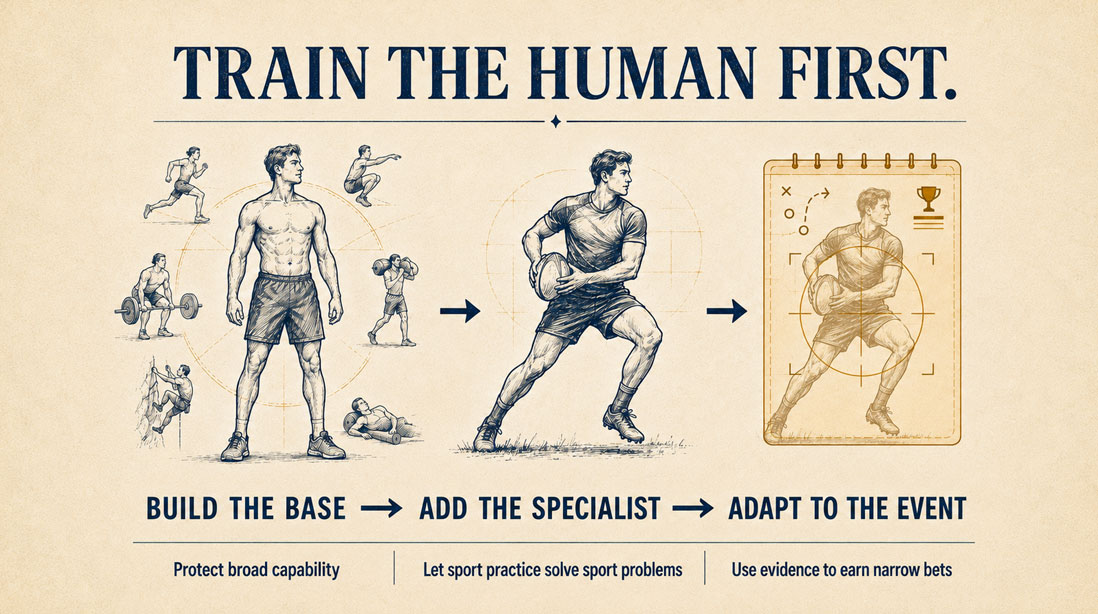
Figure 4 — The shortest version of the argument: build the human base, add the specialist, and adapt temporarily to the event.
Figure 4 compresses the argument without pretending that it is one perfect method.
Coaches can use barbells, machines, sprints, jumps, games, circuits, carries, isolated work, complex tasks, and boring accessories without joining an ideological fan club. The tool earns its place through the job it performs and the cost it creates.
Different sports do not require different universes. The soccer player, handball player, basketball player, sailor, fighter, and lineman are specialists. They are also humans. Their sports demand different expressions, impose different costs, neglect different capabilities, and create different event problems.
The Intervention Pyramid respects those differences without losing the common platform.
No exercise becomes good because it looks human, functional, athletic, or sport-specific.
It becomes useful when it performs a clear job for the human specialist standing in front of us.
That is how the Intervention Pyramid resolves the specificity conundrum: not by giving coaches another list of approved exercises, but by giving each intervention a place, a purpose, a cost, and an update rule.
And, inconveniently, it still requires coaching.
[/wlm_private]








Responses