
Flexibility in Football: Beyond Stretching

Executive summary
Flexibility often occupies a secondary place in football preparation, or is reduced to a few stretches at the end of training. Yet the key question is not simply how much a player stretches. It is which ranges of motion the player needs, how well those ranges are controlled, and whether force and speed can be expressed in demanding positions.
Football does not require maximal, uniform flexibility at every joint. It requires sufficient range for specific actions, available when needed and controlled under speed, load, fatigue and opposition. Flexibility should therefore be considered alongside active mobility, strength at longer muscle lengths, end-range isometric control, dynamic work and progressive exposure to football-specific movements.
Key points
- Football requires sufficient range of motion for specific actions, together with the strength and control to use that range under demanding conditions.
- Flexibility, active mobility and strength at longer muscle lengths describe related but distinct capacities. Assessment should help identify which capacity, if any, limits a player.
- Static, PNF and dynamic stretching can increase acute ROM, with no statistically significant differences detected between techniques in a recent meta-analysis. Method selection should also consider the intended outcome and timing within training.
- Eccentric hamstring training can influence muscle architecture, while Nordic-based interventions have evidence supporting reduced hamstring injury incidence. These findings do not establish a single protective mechanism.
- ROM should be interpreted alongside strength, symptoms, injury history and individual characteristics. Evidence from groin and youth-player studies illustrates why flexibility alone is an insufficient basis for injury-risk decisions.
Keywords: football, soccer, flexibility, mobility, range of motion, stretching, long-muscle-length strength, physical preparation.
1. Introduction: the capacity that is almost always left until last
Picture two players going through a routine pre-season screening. Both show a limited hip range on the same test. The first cannot reach the position even with an assistant moving the joint for them: the passive range itself is not there. The second reaches the same position passively without difficulty, but cannot hold or control it when asked to move into it actively. On paper, both “fail” the same active range-of-motion test with a similar result. Should both follow the same stretching routine?
They should not, and that gap is the central problem this article addresses: what range is needed, what is actually limiting it in a given player, and how the staff will know whether the intervention worked.
In many teams, flexibility appears at the same point in every session: a few stretches before training or a short routine at the end. Familiar exercises are repeated, positions are held for several seconds and the box is considered ticked. Far less often does the staff define which limitation they are trying to change, how much range a player needs or how the effect will be evaluated.
This contrasts with the way speed, strength, endurance and recovery are planned. Those areas typically have explicit goals, doses, rest periods, indicators and progressions. Flexibility, by contrast, is often guided by tradition: “we need to stretch”, “we need to loosen up” or “it prevents injuries”. These phrases are too broad to guide an individualized intervention.
The central mistake is treating flexibility as an isolated routine rather than a capacity interacting with technique, strength and movement mechanics. A footballer does not need to be flexible in the abstract; the player needs enough range for specific actions, the ability to control it and the capacity to tolerate the forces that occur within it.
The useful questions are not only “how far can the player stretch?” but also: What range is needed? Can the player reach it actively? Can they produce force there? Can they maintain control at speed? Is pain or a clinical restriction present? Does the intervention address a real need? These questions make flexibility trainable and assessable.
2. What do we mean by flexibility?
2.1 Flexibility and range of motion
Flexibility is commonly described as the ability of a structure or joint-muscle system to allow movement through a given range. In practice, it is observed through range of motion (ROM), measured actively or passively. Results depend on joint anatomy, muscle-tendon properties, stretch tolerance, the nervous system, temperature and the measurement procedure.
2.2 Mobility: reaching range with control
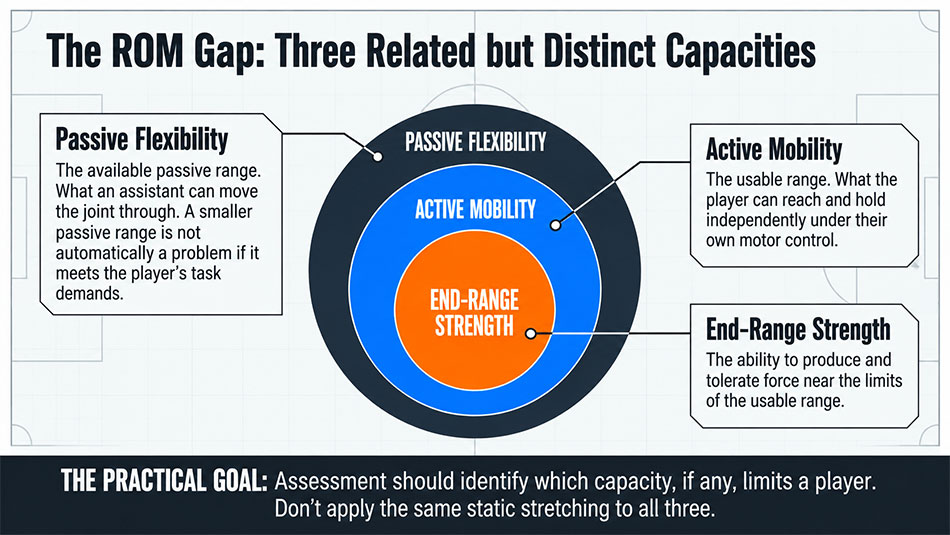
Mobility is commonly used to describe the ability to reach and use a range of motion, especially actively. A player may display a large passive range when another person moves the leg but be unable to control the same range independently. This distinction matters in football, where body position must be organized actively during rapid actions, loss of balance and contact.
2.3 Passive flexibility, active flexibility and end-range strength
These concepts are not interchangeable. An assessment measuring only passive ROM may miss deficits in strength, control or load tolerance. Conversely, a smaller range is not automatically a problem if it is sufficient for the player’s tasks and does not limit function.
3. How much flexibility does football demand?
There is no universal, valid statistic stating that flexibility accounts for a particular percentage of match demands. Unlike distance covered or the number of accelerations, flexibility is not captured as one external-load variable by GPS. Demands arise in specific actions, joints and body positions. Any single number presented as “football’s flexibility demand” would therefore be misleading.
| Football action | Potential range demand | Practical implication |
|---|---|---|
| Kicking and long passing | Hip range, pelvic control, swing-leg coordination | Assess the relevant range and control; do not assume more passive ROM automatically improves the kick. |
| Acceleration and sprinting | Hip extension/flexion, ankle function and force at longer muscle lengths | Pair mobility with sprint exposure and strength. |
| Changes of direction | Hip and ankle range, trunk and pelvic control | Train active range and control under progressively faster tasks. |
| Tackling, reaching and recovery from imbalance | Variable hip, knee and ankle positions | Use a broad movement repertoire and build tolerance progressively. |
| Jumping and landing | Ankle, hip and trunk movement options | Prioritize control, force absorption and task-specific strength. |
The demands also differ between players, and that variability is not only a matter of style. Position, technique, injury history, anatomy, age, maturation status, training exposure and individual movement strategies all influence the range required. Passive ROM in youth players also changes with age and maturation, with restrictions becoming more common around and after peak height velocity (see Section 6.2). The goal is not to make every player equally flexible; it is to identify meaningful restrictions and develop useful, controlled range.
4. What does the evidence say about performance and injury?
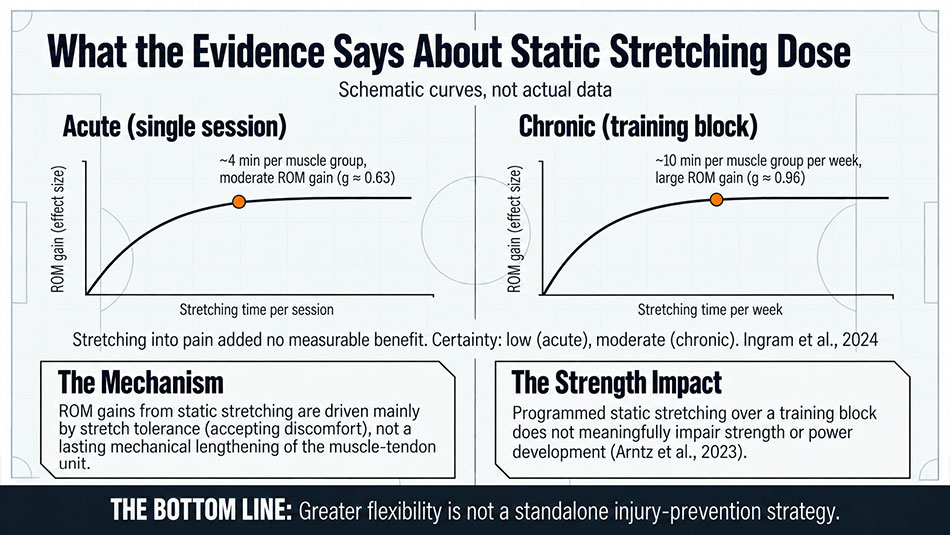
Stretching can improve ROM, but the effect depends on the technique, dose, frequency and outcome being measured. A 2024 systematic review, meta-analysis and multivariate meta-regression by Ingram et al., pooling the static-stretching dose-response literature, found a moderate acute effect (Hedges’ g ≈ 0.63) peaking at roughly four minutes of cumulative stretching per muscle group in a single session, and a large chronic effect (g ≈ 0.96) peaking at roughly ten minutes per muscle group per week across a training block. Stretch intensity did not moderate the result: stretching beyond the point of discomfort added no measurable benefit. The authors flag this as a practical ceiling rather than evidence that unlimited further dose keeps paying off, and note the certainty of the acute estimate is low and the chronic estimate moderate.
Static stretching remains a useful tool for ROM development under that dosing logic. Dynamic stretching is often appropriate in a warm-up because it rehearses movement while progressively increasing amplitude. PNF techniques can also improve ROM, although protocols vary and require careful coaching; see Section 5.4 for what the comparative evidence actually shows.
Acute performance effects need context. Long static-stretching doses immediately before explosive tasks may temporarily reduce some measures of strength or power, while shorter doses integrated into a complete warm-up may have smaller effects. Arntz et al. (2023) examined the chronic picture across a full systematic review and meta-analysis and found that, unlike the acute case, regularly programmed static stretching over a training block did not meaningfully impair strength or power development; the two effects should not be confused. This is not a reason to avoid static stretching; it is a reason to match the method and timing to the objective.
Greater flexibility should not be presented as a standalone injury-prevention strategy. Football injuries are multifactorial and involve exposure, strength, sprinting load, fatigue, previous injury, coordination, tissue capacity and clinical factors. ROM can be relevant to assessment and rehabilitation, but a larger number on a flexibility test does not by itself prove that a player is safer. Sections 5.6, 6.1 and 6.2–6.3 give three concrete cases where the data argue against that assumption: hamstring architecture, the groin, and age and joint laxity.
Return-to-play decisions after muscle injury should use a broader picture: symptoms, clinical examination, strength, sport-specific performance, progressive exposure and the medical team’s judgment. ROM may contribute to that picture, but should not be the only criterion.
5. Methods for developing and using range of motion
Each method below is described with its mechanism, what the evidence actually supports, where it fits, and where it does not. Evidence levels refer to confidence in the specific outcome named next to each rating; they are not a ranking of overall method effectiveness, and they are not proof of transfer to football performance or injury prevention.
5.1 Static stretching
Definition
The segment is moved into a tolerable stretch position and held without bouncing. It may be passive, with external assistance, or active, when the player uses their own muscles to maintain the position.
Mechanism
ROM gains from static stretching are driven mainly by increased stretch tolerance, the amount of tension or discomfort a player accepts before stopping, rather than a lasting mechanical lengthening of the muscle-tendon unit itself.
Evidence
Ingram et al. (2024) is the most direct dose-response evidence available: a single-session dose of about 4 minutes per muscle group produces a moderate acute ROM gain (g ≈ 0.63), and about 10 minutes per muscle group per week produces a large chronic gain (g ≈ 0.96) across a training block, with no added benefit from stretching into pain. Arntz et al. (2023) found that programmed static stretching across a training block does not meaningfully reduce strength or power development, separating the chronic picture from the acute one.
Benefits
- Reliable, well-dosed method for increasing passive ROM.
- Low technical demand; easy to standardize across a squad.
- Chronic use does not appear to compromise strength or power gains.
Limitations
- A long dose placed immediately before an explosive task can acutely reduce power output.
- Gains are not automatically transferred to active control of the new range (see Section 5.5).
- Evidence is of low-to-moderate certainty; individual response varies.
When to use it
When the primary goal is ROM development and there is time to work in a controlled manner: dedicated sessions, post-training, or isolated from the explosive block of a warm-up.
When not to prioritize it
Immediately before sprinting, jumping or high-speed actions if a long hold is planned; keep stretching with a long cumulative dose away from that window.
Practical application
Target roughly 4 minutes of cumulative hold per muscle group per session for an acute ROM effect, or roughly 10 minutes per muscle group per week for a chronic effect, without chasing pain; intensity beyond mild discomfort adds no extra benefit per the current dose-response data.
Evidence level: Moderate (acute and chronic ROM improvement)
5.2 Dynamic stretching
Definition
Dynamic stretching moves repeatedly through a range without long holds at the end position. Examples include controlled leg swings, lunges, hip rotations and ankle movements with gradually increasing amplitude.
Mechanism
Repeated sub-maximal movement through range raises tissue temperature, rehearses the motor pattern that will follow, and increases ROM acutely through tolerance and movement-specific neuromuscular readiness.
Evidence
Hernández-Martínez et al. (2026), in a systematic review with meta-analysis of warm-up strategies using different stretching types in soccer players (Applied Sciences), support dynamic stretching as a practical, performance-compatible choice for pre-training and pre-match preparation, consistent with the broader literature on acute effects of stretching technique summarized by Behm et al. (2016, 2023).
Benefits
- Prepares the specific movement pattern while increasing ROM.
- Generally compatible with pre-exercise strength and power demands.
- Scales naturally from general to football-specific.
Limitations
- Dynamic stretching is particularly useful for warm-up preparation; its relative effectiveness for long-term ROM development depends on the protocol and requires separate consideration from its acute effects.
- Quality depends on control: fast, uncontrolled swinging reduces the training value and can resemble uncontrolled ballistic work.
When to use it
In the warm-up, immediately before training or matches, progressing from slow and general to fast and football-specific.
When not to prioritize it
As the only tool when the explicit goal is to change a player’s baseline ROM over weeks; static stretching or PNF are better documented for that goal.
Practical application
Progress from controlled, moderate-amplitude movements to faster, more football-specific actions across the warm-up, increasing range gradually rather than reaching maximum amplitude on the first repetition.
Evidence level: Moderate (warm-up and acute-preparation compatibility)
5.3 Ballistic stretching
Definition
Ballistic stretching uses rhythmic movement or momentum to reach a large range, rather than a controlled, held position.
Mechanism
Momentum carries the segment past the range that could be reached under control alone, exposing tissue to a stretch stimulus at speed, a different loading pattern from either a static hold or a slow dynamic movement.
Evidence
Behm et al. (2023) include ballistic technique within their systematic review and meta-analysis of acute effects of various stretching techniques on ROM. Ballistic methods are not shown to be categorically unsafe or ineffective, but the dose-response and long-term evidence base for ballistic stretching specifically is considerably thinner than for static stretching, dynamic stretching or PNF.
Benefits
- Can expose the body to ranges and speeds closer to competitive demands.
- May be time-efficient once a player has the control to use it safely.
Limitations
- Requires a foundation of active control and tissue tolerance before it is introduced.
- Aggressive, uncontrolled bouncing adds injury risk without a clear corresponding benefit over controlled alternatives.
- Weakest evidence base of the methods covered here.
When to use it
With players who already demonstrate good active control of range, for a specific, clearly defined purpose, introduced gradually.
When not to prioritize it
As a default or first-choice method, or with players unaccustomed to the stimulus; it is not a shortcut to faster ROM gains.
Practical application
If used, start with small amplitudes and low momentum, build up over sessions, and frame it as one component within a broader mobility plan rather than a competition to reach farther.
Evidence level: Low (acute ROM improvement; thin dose-response data)
5.4 Proprioceptive neuromuscular facilitation (PNF)
Definition
PNF techniques combine a stretch position with voluntary contractions and relaxation phases; some variants also use contraction of the antagonist. Variants include contract-relax and contract-relax-antagonist-contract (CRAC), differing in timing, intensity and sequence.
Mechanism
PNF was historically explained by autogenic inhibition (the contracted muscle relaxing via the Golgi tendon organ) or reciprocal inhibition (the antagonist relaxing the target muscle). Sharman, Cresswell & Riek (2006), reviewing the mechanistic literature in Sports Medicine, concluded that the autogenic and reciprocal inhibition explanations are not well supported by the electromyographic evidence, and that the ROM gain from PNF is more plausibly explained by an increase in stretch tolerance, the player accepting a greater sensation of stretch, rather than a true change in reflex-driven muscle relaxation.
Evidence
Behm et al. (2023) found that PNF, static stretching and dynamic/ballistic stretching all improved acute ROM, with no statistically significant differences detected between techniques (static ES = −0.57, PNF ES = −0.58, ballistic/dynamic ES = −0.45; Q = 0.667, p = 0.72). PNF is therefore a reliable way to improve acute ROM, on par with the alternatives, not a method shown to outperform them; Sharman’s stretch-tolerance explanation is about how PNF works, not about why it would produce more gain than static stretching.
Benefits
- Active contraction phases give the player a role in the process, which can aid buy-in and perceived control.
Limitations
- Protocols vary considerably across the literature, which makes between-study comparison difficult.
- Requires clear instructions, controlled effort and safe assistance; poorly coached PNF risks becoming a test of pain tolerance rather than a training stimulus.
When to use it
When ROM development is the priority and there is time and a trusted assistant (coach, physio, teammate) to guide the contraction and relaxation phases correctly.
When not to prioritize it
As a method coached primarily around “pushing through” discomfort; mild stretch discomfort should not be confused with a requirement to provoke pain.
Practical application
See Section 7 for the specific 30-second, four-phase protocol used in practice in this program.
Evidence level: Moderate (acute ROM improvement, comparable to other stretching techniques)
5.5 Active mobility and end-range control
Definition
Active mobility requires the player to reach and control range using their own muscles, without external assistance. Exercises may include controlled leg raises, hip rotations, transitions, ankle movements or segmental drills with progressive amplitude.
Mechanism
This approach trains the neuromuscular system to produce and control force throughout a range the player can access independently, addressing the gap between passive range (what an assistant can move the joint through) and active range (what the player can reach and hold under their own control).
Evidence
Skopal, Drinkwater & Behm (2024) reviewed 22 mobility-training studies in athletes and concluded that mobility training may improve, or is unlikely to impair, performance outcomes such as strength, speed, change of direction and jumping. These findings support mobility training as a performance-compatible option, but do not directly establish that active mobility exercises reduce the gap between passive and actively controlled ROM.
Benefits
- Develops active control of range that can then be progressively integrated into football-specific movements.
- Performance-compatible per Skopal, Drinkwater & Behm (2024): unlikely to impair strength, speed, change of direction or jumping.
- Lower acute fatigue cost than heavy external-resistance work.
Limitations
- Improvements in active control do not necessarily produce equivalent changes in passive ROM; both should be assessed separately when relevant.
- Benefit depends on movement quality; accumulating uncontrolled repetitions adds little.
When to use it
When assessment identifies a meaningful difference between passive ROM and the range a player can actively control, and as a bridge between isolated flexibility work and football-specific integration (Section 5.8).
When not to prioritize it
As a substitute when the limiting factor is genuinely passive ROM itself, with no usable range available to train.
Practical application
Controlled leg raises, hip rotations, transitions and ankle drills with progressive amplitude, assessed by movement quality rather than repetition count.
Evidence level: Moderate (performance compatibility; direct effect on passive-active ROM gap not yet tested)
5.6 Strength at longer muscle lengths
Definition
Strength work performed at relatively long muscle lengths, complementing stretching rather than replacing it. Depending on the joint and objective, options include Romanian deadlifts, long-stride lunges, deep squats within a controlled range, calf raises through full range, or hamstring-specific variations such as the Nordic hamstring exercise.
Mechanism
Eccentric training, including the Nordic hamstring exercise, lengthens biceps femoris long head (BFlh) fascicles, while concentric-only training tends to shorten them (Behan, Timmins & Opar, 2019; Timmins et al., 2016). Eccentric loading and training at long muscle lengths are related but distinct characteristics: the conventional Nordic hamstring exercise is performed with the hip close to neutral, whereas hip-dominant exercises such as Romanian deadlifts load the hamstrings at longer muscle lengths. Both approaches may produce architectural adaptations, although their mechanical demands differ (Van Hooren et al., 2022).
Evidence
In a prospective cohort of 152 elite soccer players, Timmins et al. (2016) found athletes with short BFlh fascicles (under 10.56 cm) were 4.1 times more likely to sustain a hamstring strain injury, and athletes with low eccentric knee-flexor strength (under 337 N) were 4.4 times more likely; the combination of both carried the highest share of injuries in the cohort. These thresholds come from this specific cohort and should not be treated as universal screening cut-offs. Randomized controlled trials show the Nordic hamstring exercise reduces hamstring strain injury incidence, with a 51% risk reduction reported when it is added to a prevention program; a low-volume Nordic protocol produced architectural gains similar to a high-volume one, and 45° hip extensions produced results similar to the Nordic exercise itself (Behan, Timmins & Opar, 2019).
Benefits
- Produces a measurable architectural change (fascicle lengthening), not just a transient ROM number.
- Directly tied to reduced hamstring strain injury incidence in trial evidence.
- Low-volume protocols can be as effective as high-volume ones, which helps with program adherence, historically the weak point of Nordic-based programs.
Limitations
- The relationship between fascicle length and injury is indirect; prospective trials confirming that architectural change itself reduces injury are still needed.
- Exercise selection must respect technique, training history and injury history; these are genuine strength stimuli, not simply “loaded stretches”.
When to use it








Responses