
Philosophy Behind Agile Periodization: Why Philosophy Matters — Part 1

This is a series about the philosophy behind Agile Periodization. It is not an Agile Periodization manual, a collection of ready-made programs, or another colourful annual plan pretending to be a universal solution.
If you want a sequence of phases that can be copied into Monday’s spreadsheet, this series may occasionally annoy you. Good. A template can organize a week. It cannot tell you what an athlete is, what counts as evidence, which outcomes deserve priority, or what you should do when reality refuses to behave like the model.
The intended change is not from having no plan to having a plan. It is from carrying assumptions unconsciously to making them visible, questionable, and revisable. The plans come later. The philosophy determines how tightly we hold them.
This material began as the Agile Periodization: Philosophical Foundations course. It is being published here as a sequence of Complementary Training articles and will eventually become part of a book. That origin matters.
A course can tolerate a detour, a repeated sentence, a slide that carries more weight than it should, or a speaker correcting himself halfway through an explanation. A book is less forgiving. The reader cannot hear the tone, see the hand waving at the diagram, or ask what the hell a particular phrase was supposed to mean. The argument has to stand on the page.
So this is not a transcript with the filler words removed. It is a reconstruction of the original course into the book I was trying to explain while recording it.
The subject is the philosophy behind Agile Periodization, but the word philosophy should not scare you away. I am not trying to turn coaches into professional philosophers, and I am certainly not pretending to be one. I am a coach and sport scientist who kept running into the same practical problem: the more I learned about physiology, biomechanics, statistics, motor learning, and planning, the harder it became to believe that one clean model could organize all of it.
That is a good problem. Annoying, but good.
When you know very little, decisions can look easy. Pick a model, follow the rules, and call the result evidence-based. Once you have worked with enough athletes, teams, schedules, injuries, personalities, and organizations, those rules begin to leak. The same method helps one athlete and annoys another. A beautiful annual plan survives until the first congested week. A test score moves, but nobody agrees what that movement means. A model gives a precise answer to a question the coach did not actually ask.
The usual response is to look for a better model. Sometimes that is exactly what we need. Sometimes we need a better measurement, a clearer theory, or a more useful category. But there is another possibility: the problem is not that we have failed to find the final model. The problem is that no final model is coming.
That is where this series starts.
What this series is trying to do
Agile Periodization is often mistaken for a programming template. People ask for an Agile Periodization plan in the same way they ask for a block plan, a conjugate plan, or a daily undulating plan. They expect a sequence of phases, a loading pattern, and perhaps a colourful annual calendar.
I understand the request. It is also the wrong level of the problem.
Before we select exercises, loading schemes, blocks, and microcycles, we have already taken positions on four problems: what kind of thing an athlete is, how we can know anything useful about that athlete, what outcomes and costs matter, and how we should act when our knowledge is incomplete. In philosophical language, these are problems of ontology, epistemology, axiology, and practical judgment. In coaching language, they are the assumptions hiding underneath the program.
Agile Periodization is one practical consequence of the position developed in this series. Athletes are treated as situated, open, adaptive systems rather than closed machines. Models are treated as selective tools rather than mirrors of reality. Evidence constrains decisions but does not prescribe them. Every intervention carries values, costs, and uncertainty. Planning and adaptation therefore form a recursive process: we plan, act, observe, update, and plan again.
The specific methods are still there, but they are downstream from this philosophy. They are provisional solutions, not sacred architecture.
This sounds obvious until you look at how most planning is taught.
Traditional periodization education usually begins from the top. We define qualities, divide the season, assign phases, distribute load, and then work downward toward sessions. Real coaching often begins from the bottom. An athlete is sore. The competition date changes. A player returns late from national-team duty. The available facility has two racks and twelve athletes. The head coach wants a tactical session that destroys the neat loading pattern. Neither direction is sufficient by itself.
Top-down~bottom-up is one of the many complementary pairs developed in this series. Others include map~territory, Substance~Form, Place of Things~Forum for Action, explore~exploit, cruising~blasting, precision~significance, and is~ought. The tilde (~) matters. It does not mean that the two sides are identical, nor that the difference should be dissolved into philosophical soup. It means they are held in tension. Each side reveals something the other misses.
Note 1: Complementarity is not fifty-fifty
A complementary pair joins two positions that appear contrary but reveal different and interacting aspects of the same problem. The tilde (~) does not erase the difference between them. It keeps the relationship visible.
Top-down~bottom-up does not mean that top-down and bottom-up are identical, nor that the correct answer always sits politely in the middle. Sometimes one pole deserves most of the weight. The athlete, goal, context, timing, and risk move the emphasis. Push either side too far and its strength develops a shadow: structure becomes rigidity, emergence becomes drift, precision becomes irrelevance, and flexibility becomes indecision.
Kelso and Engstrøm call the ability to recognize and navigate these tensions a squiggle sense (Kelso & Engstrøm, 2006, 2024). The boundary between the poles is real, but it is rarely clean or permanently settled.
Complementarity is therefore not compromise by arithmetic. It is the discipline of asking what each side helps us see, what it hides, and which side deserves more weight here and now. This idea is expanded later and connected to contextual judgment.
Note 1 leads to a useful question. It is rarely, “Which side is correct forever?” It is, “Which side deserves more weight here, now, for this problem?”
That is a wisdom problem. There is no spreadsheet cell for it.
Who this is for
I wrote this primarily for reflective coaches and sport scientists who are interested in the reasoning underneath training decisions. Therapists, researchers, serious athletes, and other practitioners may recognize the same problems from different angles, but the central conversation is with the coach who has accumulated enough experience to distrust recipes and enough curiosity to inspect what replaced them.
You do not need a background in philosophy. You do need a willingness to stop at an apparently obvious statement and ask what is hiding inside it. The series assumes you are uninitiated and occasionally suspicious of the whole subject.
Good. Keep the suspicion.
This series is not written primarily for somebody searching for plug-and-play templates. Applied examples remain important, but they are consequences and tests of the philosophy, not the organizing promise of the series.
The articles introduce philosophical terms when they sharpen a coaching problem. Ontology becomes the question of what we believe actually exists when we talk about “readiness,” “fatigue,” “talent,” or a “limiting factor.” Epistemology becomes the question of how we claim to know that something changed. Axiology asks what deserves to count as improvement, harm, or an acceptable trade-off. The is~ought gap becomes the gap between observing a lower jump score and deciding what to do about training. Integrative pluralism becomes a way to use several partial perspectives without pretending they are all equally useful.
Every abstract concept is pulled back toward coaching. The examples come from the original course: strength training, endurance, VO2max, critical velocity, force–velocity profiling, injury prediction, youth development, football, MMA, tactical planning, testing, nutrition, coffee, Lego, subway maps, bus benches, apartment hunting, and the occasional Australian proverb that probably should not appear in a philosophy textbook.
It appears anyway.
A warning about mental models
This series contains many models. That creates an obvious danger.
A coach can collect mental models in the same way some people collect exercises: endlessly, without becoming any better at deciding what matters. The point is not to memorize a zoo of clever pairs and use them to sound philosophical over coffee. The point is to notice when a particular frame is directing your attention, what it leaves out, and when another frame may help.
Treat every model in this series as a tool. Not a truth.
Some tools will be useful immediately. Others will sit in the toolbox until a problem gives them meaning. A few may not fit your context at all. That is not a failure of the series. It is the series’ main argument.
Provisional does not mean sloppy
The original course changed while I recorded it. I noticed concepts that needed another explanation, moved topics between modules, and discovered that several ideas were more connected than I first thought. That process was not a flaw sitting outside Agile Periodization. It was Agile Periodization happening to the course itself.
Start with a provisional structure. Put it into the world. Notice what does not fit. Update it.
The same applies to this series. Its structure and claims remain open to revision. That does not excuse inconsistent terminology, missing definitions, broken references, or a concept arriving long before the reader can understand it. Those are editorial problems, not evidence that the series is agile. They need to be fixed.
I have not tried to remove every uncertainty or force every concept into one final hierarchy. Some models overlap. Some terms carry slightly different meanings in different literatures. Some questions remain open because they are genuinely open, not because one more diagram would magically close them.
You are allowed to disagree. More than allowed, actually. Attack the models. Ask where they fail. Check whether the examples transfer to your sport and your athletes. A philosophy that cannot survive criticism is not a philosophy worth keeping. It is branding.
Read the series as a coach: with curiosity, practical suspicion, and enough humility to update your position.
Then go coach.
Note 2
Two coaches can look at the same athlete, the same test, and the same ugly Tuesday session—and prescribe two completely different things. Which one is “evidence-based”? What assumptions were smuggled in before the data even arrived? And what happens when those assumptions stay hidden?
This article does not decide which coach is correct. It asks what each coach must already believe about what exists (ontology), how it can be known (epistemology), what matters (axiology), and how one should act. That chain is philosophy in working clothes. No toga required.
The problem summarized in Note 2 begins with a simple claim.
You cannot be theory-free.
I use theory here in a broad working sense: an organized account of what is happening and why. A model is a selective representation used to describe, explain, predict, or guide intervention. Later articles will make the boundaries messier, because the boundaries are messy. For now, these definitions are enough to keep us moving without pretending the words are self-explanatory.
You can be unaware of your theory. You can refuse to name it, call yourself “practical,” and roll your eyes whenever somebody uses a word with more than four syllables. You can even say that you do not believe in models and that you only coach what is in front of you.
But you cannot be theory-free.
The moment you describe an athlete as strong, explosive, aerobically limited, technically poor, fatigued, talented, robust, fragile, ready, or not ready, you have already selected a particular way of dividing reality. The moment you choose a test, interpret its score, identify a limiting factor, or prescribe an intervention, you have gone one step further. You are not merely observing an athlete. You are looking through a model of what an athlete is, how performance works, and what should be changed.
That is philosophy doing practical work, whether you admit it or not.
I came to this subject through confusion rather than enlightenment. The more I learned about physiology, biomechanics, statistics, skill acquisition, and planning, the less confident I became that there was a clean border between right and wrong. Competing explanations sounded plausible. Different methods worked under different conditions. Precise models became fuzzy when they met real athletes, real teams, and real organizations.
I needed a way to organize that mess.
Over the years I began building a working philosophy that helped me think about training without pretending I understood everything. It is still a work in progress. That phrase will appear more than once in this series, partly because it is true and partly because anyone offering a finished philosophy of coaching should probably make you suspicious.
The aim is not to produce the final theory of training or smuggle a programming manual into a philosophical book. The aim is to make the commitments underneath Agile Periodization visible: athletes are not closed systems, models are partial, evidence does not prescribe action by itself, decisions contain values, and plans must remain open to revision.
Agile Periodization grows out of that position. It is not the position itself.
The practical coach already has a philosophy
Some practitioners treat theory as the opposite of practice. Theory belongs to academics, conferences, and papers. Practice belongs to the gym, the pitch, the mat, and the athlete standing in front of you.
The distinction is understandable. It is also too clean.
A coach who says, “I do not need theory; I know what works,” is making at least three theoretical claims. First, that “what works” can be identified. Second, that past success transfers to the present athlete. Third, that the observed result was caused by the intervention rather than by maturation, selection, context, motivation, schedule, measurement noise, or dumb luck.
That is already a lot of theory for someone who claims not to have any.
Even the most basic test carries hidden assumptions. Put an athlete on a scale and record body mass. Simple. Yet the act assumes that there is a value worth measuring, that the instrument is sufficiently accurate, that repeated measurements contain both signal and noise, and that a change in the number may represent a change in the athlete rather than a change in hydration, timing, clothing, food intake, or the scale itself. Classical test theory formalizes this by separating an observed score into a theoretical true score and error, although both terms bring their own baggage (Borsboom, 2005).
The scale did not arrive theory-free. Neither did the jump mat, GPS unit, force plate, questionnaire, or coach’s eye.
The same problem appears when we move from measurement to explanation. Consider a familiar argument about VO2max. Is the main limitation central, involving oxygen delivery, or peripheral, involving extraction and use in the working muscles? The debate is not merely about facts sitting on a table. Each side organizes the system differently, highlights different mechanisms, and suggests different interventions. The coach who chooses one explanation also chooses where to look and what to train.
Or take injury prediction. Do injuries emerge from identifiable risk factors that can be measured and controlled? Are they better understood as interactions inside a complex system? Are some events so dependent on local circumstances that prediction is the wrong ambition? Each answer carries an ontology (read: a claim about what kind of thing an injury is), an epistemology (read: a claim about how we can know), and a practical recommendation.
The argument reaches the program before the coach finishes the sentence.
Note 3: Hidden theory audit
Take one decision you made this week and write down:
- What did you believe existed?
- What evidence did you trust?
- What causal story linked the evidence to the intervention?
- What outcome did you value?
Do not turn this into an academic exercise. Five minutes is enough. The point is to make the hidden theory visible.
The audit in Note 3 makes the assumptions explicit.
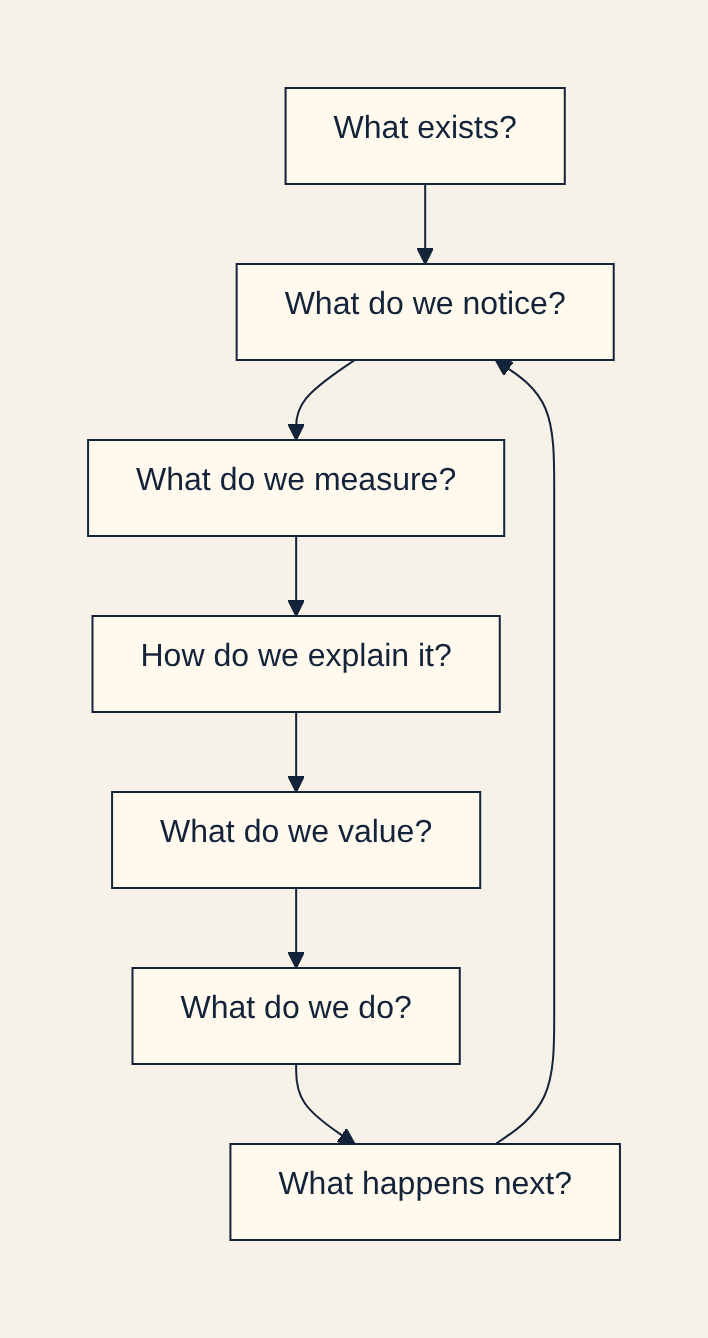
Figure 1: The hidden chain connecting philosophical assumptions to everyday coaching decisions.
Figure 1 shows why philosophy is not an ornament added after the “real” work. It sits upstream from what counts as real work in the first place.
Philosophy without the toga
The word philosophy comes from the Greek philosophia, usually translated as the love of wisdom. That sounds respectable until we have to define wisdom, at which point the floor becomes slippery.







Responses