
Endurance Training In Football

Physiological and Energetic Foundations of Endurance in Football
Introduction
Modern football demands a highly complex physical performance, where the ability to sustain intermittent, explosive, and prolonged efforts largely defines sporting success. Among the conditional capacities that determine performance, endurance plays a central role, as it underpins the player’s ability to maintain game intensity and execute technical and tactical actions efficiently throughout the full 90 minutes (Stølen et al., 2005). Understanding the physiological and energetic foundations that support endurance allows practitioners to design more specific and effective training programs, aligned with the real demands of competitive football.
1. Concept of General and Specific Endurance
General endurance is defined as the organism’s capacity to perform prolonged effort through the coordinated functioning of the cardiovascular, respiratory, and metabolic systems. In contrast, specific endurance refers to the application of this capacity within the context of football, where efforts are not continuous but intermittent, alternating between low- and high-intensity phases (Bangsbo, 1994).
During a match, players perform between 1,000 and 1,500 motor actions of varying intensity, combining running, sprinting, jumping, turning, and changes of direction (Di Salvo et al., 2009). Consequently, football endurance cannot be understood as a simple ability to cover long distances, but rather as the capacity to repeatedly perform high-intensity actions with incomplete recovery periods.
2. Predominant Energy Systems in Football
Football performance depends on the interaction of the three main energy systems: the aerobic system, the anaerobic alactic system (ATP–PCr), and the anaerobic lactic (glycolytic) system. Although aerobic metabolism contributes approximately 70–80% of the total energy expended during a match, decisive moments—such as sprints, duels, or rapid transitions—rely primarily on anaerobic systems (Iaia & Bangsbo, 2010).
- Aerobic (oxidative) system: Responsible for ATP resynthesis during low- to moderate-intensity activities. It is essential for sustaining the overall match pace and facilitating recovery between efforts.
- Anaerobic alactic system: Provides immediate energy through phosphocreatine (PCr) breakdown during very high-intensity, short-duration actions (2–4 seconds).
- Anaerobic lactic system: Becomes predominant during longer submaximal efforts (20–60 seconds), contributing to energy production at the cost of increased lactate accumulation.
The predominance of each system depends on the type of effort, its duration, and the recovery time between actions. This metabolic combination defines football as an intermittent aerobic–anaerobic sport, where efficiency in alternating between energy systems is a key determinant of performance.
3. Physiological Adaptations to Aerobic Training
Endurance training produces a series of physiological adaptations that enhance the body’s efficiency in meeting the energetic demands of the game. These adaptations can be classified as acute (immediate) and chronic (long-term structural or functional).
Acute adaptations
During exercise, a linear increase in heart rate, stroke volume, and total cardiac output is observed, along with a redistribution of blood flow toward the active muscles (Stølen et al., 2005). Pulmonary ventilation, oxygen consumption (VO₂), and muscle temperature also increase, optimizing metabolic reactions.
Chronic adaptations
With prolonged training, significant cardiovascular and muscular changes occur:
- Increased cardiac volume and left ventricular size, improving stroke volume and reducing resting heart rate.
- Increased number and size of mitochondria, enhancing substrate oxidation.
- Greater capillary density and improved oxygen transport, increasing aerobic capacity.
- Improved utilization of fat as an energy source, sparing muscle glycogen.
- Reduced lactate concentration during submaximal efforts, allowing higher intensities to be sustained with less metabolic fatigue (Bangsbo, 1994; Iaia & Bangsbo, 2010).
These adaptations are essential for maintaining competitive intensity, particularly during second halves, when glycogen depletion and neuromuscular fatigue tend to appear.
4. Functional Training Zones and Heart Rate
Aerobic training planning is organized according to functional intensity zones, determined by percentages of maximum heart rate (HRmax) or maximal oxygen uptake (VO₂max). Billat and Seiler (as cited in Stølen et al., 2005) propose five main training zones:
| Functional Zone | %VO₂max | %HRmax | Type of Effort | Suggested Duration |
|---|---|---|---|---|
| 1. Regenerative | 50–60% | 60–70% | Active recovery | 20–60 min |
| 2. Extensive aerobic | 60–75% | 70–80% | Aerobic base | 30–90 min |
| 3. Intensive aerobic | 75–85% | 80–87% | Aerobic threshold | 20–60 min |
| 4. Anaerobic threshold | 85–95% | 87–92% | Mixed zone | 10–30 min |
| 5. VO₂max | 95–100% | 92–100% | Maximal capacity | 3–8 min |
In football, most match play occurs between zones 3 and 4, where blood lactate levels typically range between 4 and 8 mmol/L (Rampinini et al., 2007). Training within these zones improves both aerobic power and the ability to recover between high-intensity actions.

5. Manifestation of Endurance According to Playing Position and Match Phase
Endurance does not manifest uniformly across all playing positions nor throughout the entire match. Its expression depends on three main factors: tactical role, game model, and match phase (Dellal et al., 2011; Carling et al., 2008).
- Goalkeepers: Predominantly perform brief explosive efforts with prolonged recovery periods. Training prioritizes anaerobic alactic endurance and basic aerobic capacity.
- Central defenders: Alternate intermittent low- and moderate-intensity actions. They require a solid aerobic base and occasional anaerobic power.
- Fullbacks: Exhibit a high frequency of sprints and long-distance runs. They require high aerobic power and good lactate tolerance.
- Central midfielders: Cover the greatest distances (10–12 km per match), with a predominance of extensive aerobic endurance.
- Wingers and forwards: Concentrate repeated explosive efforts with high heart rate variability. Intermittent endurance and anaerobic power are decisive (Bradley & Noakes, 2013).
In addition, the game model conditions physiological demands. Possession-based teams require high aerobic capacity to sustain continuous movement, while high-pressing teams demand greater aerobic and intermittent power. Conversely, teams employing a low defensive block prioritize metabolic efficiency and recovery within moderate heart rate zones (Casamichana & Castellano, 2010).
Evaluation of Endurance in Football Players
Module objective: To understand and apply the main field-based endurance tests supported by scientific evidence, to comprehend what each test actually measures, and to learn how to interpret the results in order to guide training load prescription.
Evaluation of Endurance in Football
Evaluating endurance in football is not about measuring how much a player runs, but rather about assessing the player’s capacity to sustain performance in an intermittent sport characterized by changes of pace, accelerations, decelerations, and incomplete recovery periods.
Evaluation allows practitioners to:
- Establish baseline performance levels
- Individualize training loads
- Monitor performance development over time
- Make objective decisions within the planning process
Testing is not about filling out a spreadsheet.
It is about building a performance profile of the player.
Difference Between Field Tests and Laboratory Tests
| Characteristic | Laboratory Test | Field Test |
|---|---|---|
| Environment | Controlled setting, treadmill or cycle ergometer | Natural setting, on the playing field |
| Main measurement | Direct VO₂max, lactate, ventilation | Distance, speed, heart rate, time |
| Equipment | Gas analyzer, mask, ergometer | Stopwatch, cones, audio test |
| Accuracy | Very high (VO₂, precise thresholds) | Estimative, indirect correlation |
| Cost | High | Low or none |
| Transfer to football | Limited (no changes of direction or interaction) | High (simulates game conditions) |
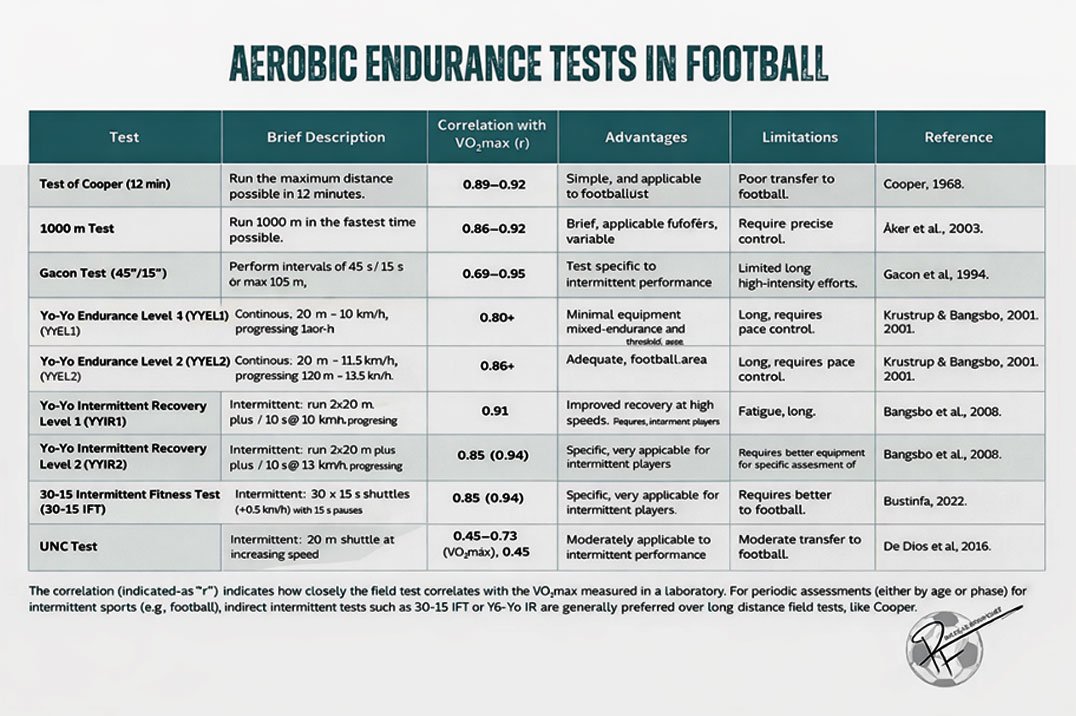
Field-Based Aerobic Endurance Tests and Their Correlation with VO₂max
“Data alone does not create change. What we do with it does.”
In training, testing is essential, but interpreting data with sound judgment is decisive.
As Marcos Chena states: “What matters is not the data itself, but what we do with it.”
Measuring strength, endurance, or speed only makes sense when those numbers allow us to make informed decisions:
- ✅ Adjust training loads
- ✅ Detect potential risks
- ✅ Individualize training stimuli
- ✅ Optimize performance
Testing is not about filling out a spreadsheet.
It is about building a performance profile, identifying patterns, and giving meaning to the training process.
The real value lies not in having data, but in using data to train better.
Calculation of Maximum Heart Rate (HRmax)
Classical formulas for estimating HRmax:
- Tanaka (2001):
HRmax = 208 – (0.7 × age)
→ The most commonly used formula in team sports. - Fox & Haskell (1970):
HRmax = 220 – age
→ The traditional formula, although somewhat less accurate.
MAIN ENDURANCE TESTS IN FOOTBALL
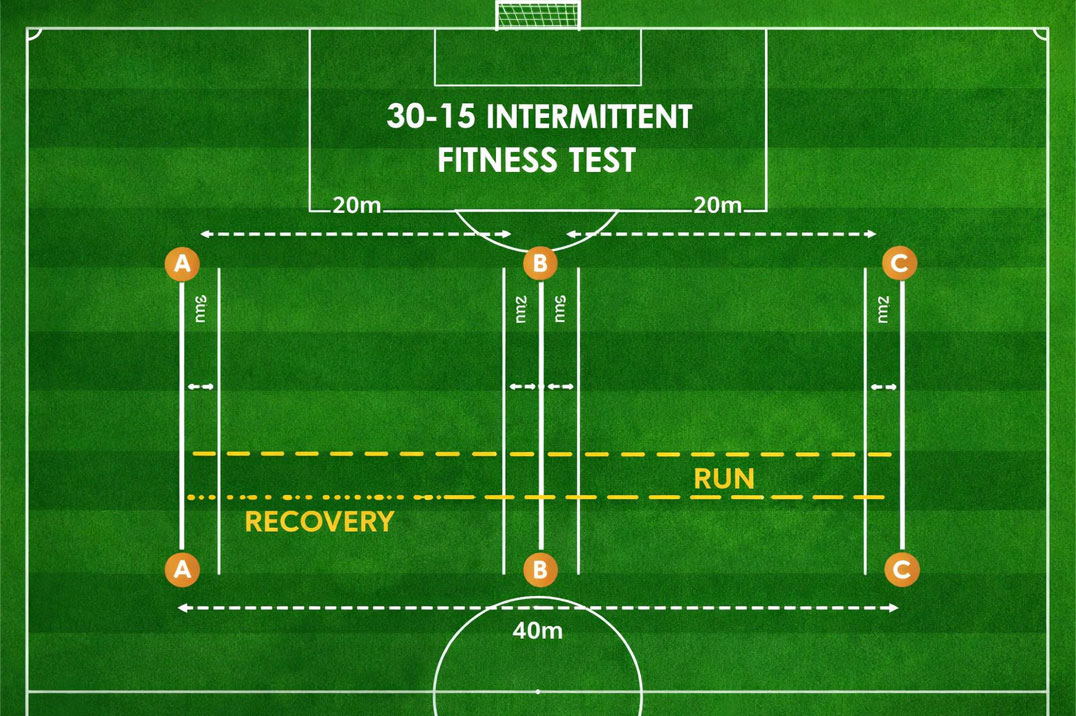
A. 30–15 Intermittent Fitness Test (30–15 IFT)
The 30–15 IFT is an intermittent running test designed by Martin Buchheit.
Protocol:
- Shuttle runs performed for 30 seconds
- 15 seconds of passive recovery
- Initial speed: 8 km/h
- Speed increases of 0.5 km/h per stage
- The test continues until exhaustion or failure to comply with the protocol
Test termination:
- The player stops due to exhaustion
- Or fails to reach the 3-meter zone at the beep on three consecutive occasions
Main outcome:
- VIFT (Final Speed Achieved in the IFT)
VIFT is used to:
- Prescribe training intensities
- Design running-based or HIIT training sessions
- Individualize aerobic and intermittent training loads
B. Yo-Yo Intermittent Recovery Test
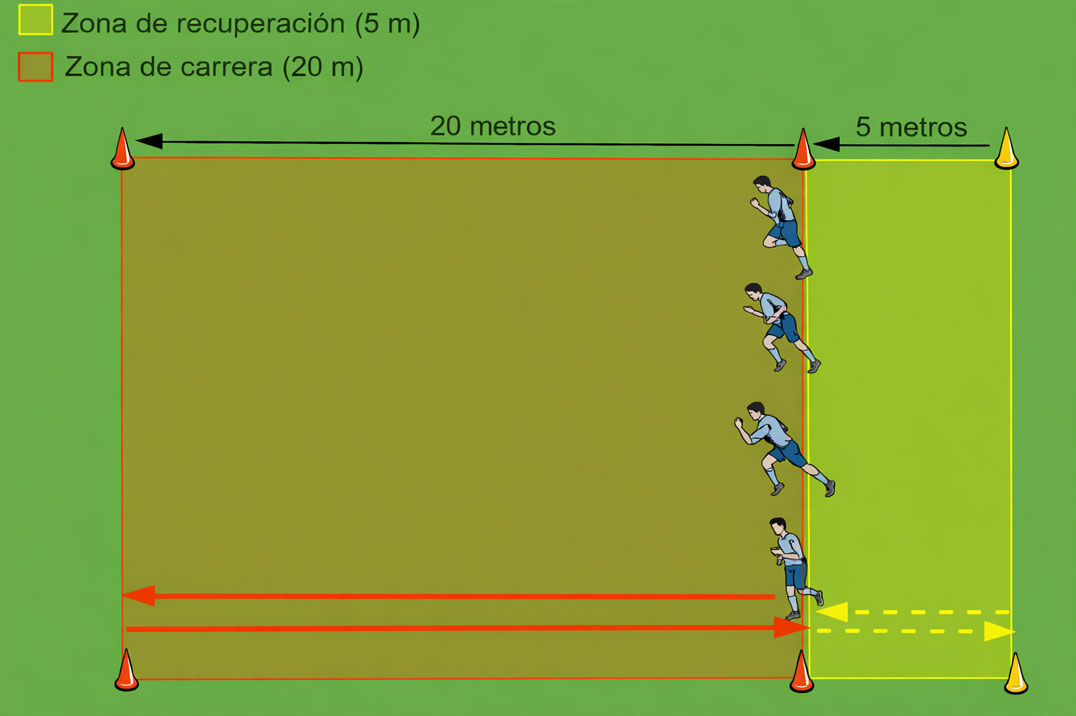
The Yo-Yo Test is inspired by the Course Navette, but it incorporates active recovery periods, which makes it more specific to football.
Protocol:
- 20-meter shuttle runs
- 10 seconds of active recovery (jogging 2 × 5 m)
- Progressive speed increments controlled by audio signals
- The test ends after two consecutive failures
Outcome:
- Total distance covered
Most commonly used variants:
-
Yo-Yo Endurance Test (YYE1 / YYE2)
Evaluates continuous aerobic capacity -
Yo-Yo Intermittent Recovery Test (YYIR1 / YYIR2)
Evaluates intermittent endurance specific to football
The YYIR is considered one of the tests with the highest validity for intermittent sports.
C. 1000-Meter Test
The 1000-meter test is a practical alternative when audio systems or specific testing equipment are not available.
What it evaluates:
- Aerobic power
- Estimated VO₂max
- Maximal Aerobic Speed (MAS)
Protocol:
- Run 1000 meters in the shortest possible time
Limitations:
- It is not an intermittent test
- Performance depends on pacing strategy
- It has lower specificity for modern football
Interpretation of Results
The value of a test does not lie in the number itself, but in how that number is used.
Test results allow practitioners to:
- Classify player profiles
- Adjust training volumes and intensities
- Differentiate training loads between starters and substitutes
- Guide the dominant type of training stimulus
The same test result does not imply the same training prescription for every player.
Linking tests to training prescription
The approach I propose is that testing should not be an end in itself, but a direct tool for load prescription.
In the case of the 30–15 Intermittent Fitness Test, the VIFT provides a highly practical reference for designing intermittent training tasks, as it integrates speed, changes of direction, and incomplete recovery—key characteristics of football performance. From VIFT values, training intensities can be expressed as percentages and then translated into concrete running speeds for interval-based drills, both with and without the ball.









Responses